


Every building with a parapet wall, flat roof extension, or exposed boundary wall needs aluminium copings. Without a proper coping system, rainwater sits on the top of the wall, works into mortar joints, and causes rising damp, efflorescence, structural decay, and internal water damage. This guide explains exactly what aluminium copings are, why they are the specification material of choice on UK construction projects in 2026, and how to select, size, and install the right system for your building.
Metal Profiles Ltd manufactures aluminium copings at our Chelmsford, Essex facility. Flat and sloping profiles, any RAL or BS powder coat colour, secret-fix and strap-fix systems, made to any width from 150mm to 900mm, delivered nationwide within 5 to 10 working days.
50+ Year lifespan
A2 Fire rated (BS EN 13501-1)
70% Lighter than stone
Any RAL / BS colour
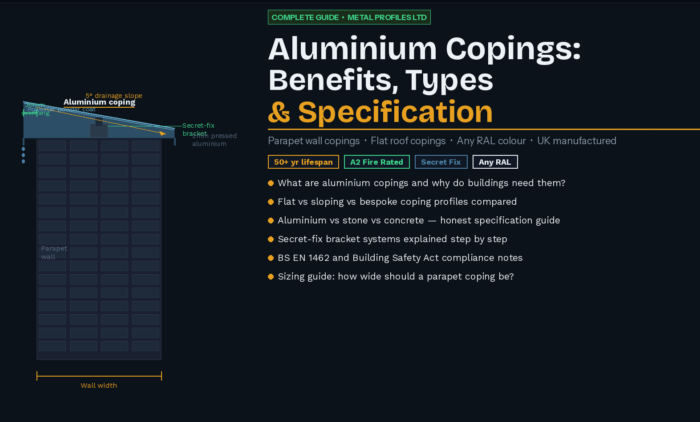
What Are Aluminium Copings?
Aluminium copings are pressed metal protective coverings fitted to the top of parapet walls, boundary walls, and flat roof upstands. The coping extends down both faces of the wall, completely encasing the top edge and directing rainwater away from the wall surface and into the gutter or drainage system. On a properly installed aluminium coping system, no water can penetrate the wall from the top, one of the most common failure points in flat-roofed and parapet-walled buildings.
The term “coping” comes from the Latin cappa, meaning cap or hood and that is exactly the function: a protective cap for the top of a wall. The material has evolved from natural stone through concrete, lead, and PVC to pressed marine-grade aluminium, which is now the dominant specification choice across domestic, commercial, and industrial construction in the UK.
Why does every parapet wall need a coping?
A parapet wall is a low wall extending above a roof level. Without a coping, rainwater rests on the exposed top surface and soaks into the porous brickwork and mortar joints. Over time this causes:
- Water ingress into the building envelope, leading to internal damp and mould
- Efflorescence (salt staining) on the external brick face as minerals are leached out by water
- Frost spalling, where water trapped in the brickwork expands on freezing and breaks the masonry
- Structural deterioration of the wall itself, leading to expensive remediation
- Damage to flat roofing membranes at the parapet upstand junction
A correctly specified and installed aluminium coping eliminates all of these risks for the life of the building.
Types of Aluminium Copings Available in the UK
Metal Profiles Ltd manufactures aluminium copings in two standard profiles. Flat and sloping and can fabricate bespoke profiles for any architectural requirement.
Flat Aluminium Copings
Flat aluminium copings have a level top surface. They are used on internal parapet walls, on parapets where the architectural specification demands a horizontal roofline, and on boundary walls where the level appearance is preferred. Flat copings are manufactured from 2mm pressed marine-grade aluminium and fitted with a secret-fix bracket system or strap-fix system depending on the coping width and exposure conditions.
Note on flat copings.
Flat aluminium copings are suitable for protected locations but carry a greater risk of water pooling on the coping surface if not perfectly level. For exposed external parapet walls, sloping copings are the preferred specification. Discuss your site exposure conditions with Metal Profiles Ltd before specifying a flat profile.
Sloping Aluminium Copings
Sloping aluminium copings incorporate a 5-degree or greater pitch on the top face that actively directs rainwater away from the wall and down into the gutter system. The slope ensures the coping surface is self-draining, no water ever stands on the coping. Sloping copings are the recommended specification for all exposed external parapet walls, boundary walls, and flat roof upstands in the UK.
Bespoke Aluminium Copings
For buildings with curved parapets, raked or ramped walls, non-standard angles, or special architectural features, Metal Profiles Ltd fabricates bespoke aluminium copings to any profile. Curved copings can follow true radius curves for circular parapet walls. Stepped and ramped copings suit buildings with staggered rooflines. Pier caps and column capping are also available to complete the full parapet system.
| Profile Type | Top Face | Best Application | Available Widths |
|---|---|---|---|
| Flat coping | Level | Internal parapets, protected locations, boundary walls | 150mm to 900mm |
| Sloping coping | 5° pitch (self-draining) | All exposed external parapet walls recommended default | 150mm to 900mm |
| Bespoke coping | Any | Curved walls, raked parapets, pier caps, special profiles | Any to specification |
The Benefits of Aluminium Copings in Construction
The growing dominance of aluminium copings on UK construction projects is not a trend, it is the result of aluminium outperforming every competing material on the specification criteria that matter most to architects, building engineers, and contractors.
Durability and long service life
Marine-grade aluminium naturally forms a protective oxide layer that prevents corrosion. When polyester powder coated with an external-grade finish, aluminium copings have a proven service life of 40 to 60 years in suburban and rural environments and 25 to 40 years in coastal and industrial environments where salt and airborne pollutants accelerate surface degradation. A well-maintained aluminium coping system outlasts the mortar, membranes, and stone copings it is designed to protect.
A2 fire rating required for buildings over 18 metres
Aluminium copings are classified A2-s1,d0 under BS EN 13501-1 non-combustible, with minimal smoke production and no flaming droplets. Under the Building Safety Act 2022 and the associated amendments to Approved Document B, external wall elements on higher-risk buildings (over 18 metres) must use A2 or A1 rated materials. Metal Profiles Ltd aluminium copings meet this requirement. PVC copings do not.
Lightweight up to 70% lighter than stone copings
Natural stone copings for a parapet wall can weigh 60 to 120 kg per linear metre. Aluminium copings typically weigh 3 to 8 kg per linear metre. This has significant implications for structural loading, particularly on retrofit projects where the existing parapet wall may not be designed to carry the weight of stone copings. Aluminium copings can be installed without structural reinforcement in virtually all retrofit scenarios.
Secret-fix installation – no visible fixings
The secret-fix bracket system used for aluminium copings completely conceals all fixings. The coping lengths simply click onto pre-fixed concealed brackets, leaving a smooth, uninterrupted top surface with no screw heads or bolt heads visible from the ground or roof level. This delivers a cleaner architectural finish than any through-fixed coping system and eliminates the risk of water ingress at fixing penetrations a common failure mode in older bolt-fixed stone and concrete copings.
Any RAL colour consistent with the full roofline system
Metal Profiles Ltd powder coats aluminium copings in any RAL or BS colour. Because we also manufacture aluminium fascias, soffits, gutters, and downpipes, the entire roofline and parapet system can be specified in the same colour from the same batch, ensuring a consistent, professional finish across the full building envelope.
Environmental sustainability
Aluminium is 100% recyclable and retains its full material properties through repeated recycling cycles. Recycling aluminium uses only 5% of the energy required to produce primary aluminium. Specifying aluminium copings contributes to BREEAM Materials credits and supports the circular economy commitments increasingly required by planning authorities and ESG-focused clients.
Low maintenance
An aluminium coping system in good working order requires nothing more than an annual visual inspection and an occasional rinse with clean water to remove surface deposits. There is no repainting cycle, no repointing, no re-sealing, and no structural repairs required for the life of the product under normal conditions.
Aluminium Copings vs Other Materials Specification Comparison
Understanding how aluminium compares to alternative coping materials is essential for correct specification. The table below covers the four most common UK coping materials.
| Material | Lifespan | Fire Rating | Weight (per m) | Maintenance | Colour Choice | Water Seal |
|---|---|---|---|---|---|---|
| Aluminium | 40–60+ yrs | A2 | 3–8 kg | Minimal | Any RAL/BS | EPDM sealed joints |
| Stone / Concrete | 30–80 yrs | A1 | 60–120 kg | Repointing every 10–20 yrs | Very limited | Mortar joints crack |
| PVC / GRP | 10–20 yrs | Not rated | 2–4 kg | Moderate | Limited | Adhesive joints degrade |
| Lead | 60–100 yrs | A2 (some) | 40–80 kg | Moderate | Lead grey only | Soldered joints |
Why aluminium wins the specification comparison.
Stone copings have excellent durability but fail at the joints mortar cracks, water enters, and the failure is not visible until internal damp appears. Aluminium copings with EPDM-sealed internal joints eliminate this failure mode entirely. PVC copings fail on fire rating and longevity. Lead copings are heavy, costly, and offer no colour choice. Aluminium is the clear specification choice for new build and retrofit projects.
How to Size Aluminium Copings for Your Parapet Wall
Correct coping width is critical for weathertightness. The coping must span the full width of the parapet wall and overhang both faces sufficiently to direct water clear of the wall surface and into the drainage system.
Minimum overhang requirements
- Minimum 30mm overhang on each face of the parapet wall
- 50mm overhang is preferred on exposed sites or where the wall face below is porous brickwork
- The overhanging edge should have a downward-facing drip detail to prevent water tracking back under the coping
Standard coping width sizing guide
| Wall Construction | Typical Wall Width | Coping Width | Notes |
|---|---|---|---|
| Single skin brick | 102mm | 180–200mm | Min 30mm overhang each side + 2mm coping body |
| Full brick (solid) | 215mm | 280–310mm | Standard domestic parapet specification |
| Cavity wall (standard) | 260–280mm | 330–360mm | Most UK residential extensions |
| Cavity wall (insulated) | 300–350mm | 370–430mm | Modern high-performance cavity construction |
| Bespoke / non-standard | Any | Wall width + 60mm min | Contact Metal Profiles Ltd for non-standard widths |
Need help sizing your aluminium copings?
Contact Metal Profiles Ltd on 07566 862501 or email info@metal-profiles.co.uk with your parapet wall width and we will advise the correct coping size and profile for your project, including corners, stop ends, and joint trim quantities.
How to Install Aluminium Copings Step-by-Step Guide
The secret-fix aluminium coping system used by Metal Profiles Ltd is designed for straightforward installation by a competent roofer or contractor. No specialist tools are required. The following steps apply to the standard flat and sloping coping systems.
Measure the parapet wall
Measure the full width of the parapet wall at the top (including any insulation or upstand material). Record the exact wall width, all run lengths, and all internal and external corner angles. These measurements determine the coping width and the quantity of straight lengths, corners, stop ends, and joint trims required.
Fix the concealed brackets
Fix aluminium coping brackets or strap-fix clips to the top of the parapet wall using stainless steel fixings at maximum 1,500mm centres. Ensure the bracket top face is level (flat copings) or set to the specified pitch (sloping copings). On exposed sites or buildings over 10m, wind uplift calculations may require closer bracket centres or additional fixings consult the coping manufacturer’s technical guidance.
Install stop ends and corner pieces first
Always fit the stop ends and pre-fabricated corner mitre pieces before the straight coping lengths. Apply low-modulus silicone sealant rated for aluminium to all stop-end and corner joints before clicking into position. This sequence is critical, it is much harder to install stop ends correctly after straight lengths are in place.
Click coping lengths onto brackets
Working from one stop end towards the other, click each 3-metre coping length onto the fixed brackets, ensuring each length is fully engaged before progressing. Leave a 6mm expansion gap between each pair of coping lengths to allow for thermal movement. Aluminium expands approximately 0.023mm per metre per degree Celsius on a 30-degree temperature range, a 3-metre length moves approximately 2mm.
Fit joint trims with EPDM seals
Slide the internal joint trim over the expansion gap between each pair of adjacent coping lengths. The EPDM rubber seal on the underside of the joint trim bridges the gap and creates a weathertight joint. Do not apply additional sealant to the expansion gap itself, the gap must remain free to move.
Inspect and test the completed system
Walk the full coping run, check all joints are correctly seated, and verify all stop ends and corner pieces are flush and tight. Apply additional silicone sealant to any visible gap at stop ends or corners. Run water from a hosepipe along the coping and check that all joints are watertight before completing the roofing work below.
Aluminium Copings and Fire Safety Compliance
The Building Safety Act 2022, combined with the accompanying amendments to Approved Document B and the External Wall System (EWS) framework, has made fire performance a primary consideration in all external wall component specifications including parapet copings.
- Buildings over 18 metres: All external wall components must be A2-s1,d0 or A1 rated under BS EN 13501-1. Metal Profiles Ltd aluminium copings are A2-s1,d0 rated. PVC copings are not compliant and cannot be specified on these buildings.
- EWS1 assessments: For residential buildings seeking mortgage lending, the EWS1 process requires documentation of all external wall materials including copings. Using rated aluminium copings simplifies the EWS1 process and reduces the risk of a B2 (further investigation required) rating.
- BS EN 1462 brackets for gutters and copings: Coping bracket systems must be designed to resist wind uplift forces calculated to BS EN 1991-1-4. On exposed sites or tall buildings, wind uplift loads can be significant always use the manufacturer’s technical data to verify bracket centres and fixing specifications.
NBS specification for aluminium copings.
Metal Profiles Ltd products are available for specification via NBS. Visit our NBS specification page to download clause references and technical data sheets for use in project specifications.
Aluminium Copings from Metal Profiles Ltd
Metal Profiles Ltd manufactures and supplies aluminium copings directly from our Chelmsford, Essex production facility. All copings are manufactured from marine-grade aluminium and powder coated in external-grade polyester to any RAL or BS colour. We supply flat copings, sloping copings, and bespoke profiles for any parapet wall construction.
- Flat aluminium copings for internal parapets and protected locations
- Sloping aluminium copings self-draining 5° profile, recommended for all external applications
- Bespoke copings curved, raked, ramped, and special profiles to any specification
- Complete system: coping lengths + corner pieces + stop ends + joint trims + brackets
- Any RAL or BS powder coat colour, colour-matched to fascias, soffits, gutters, and downpipes
- A2-s1,d0 fire-rated compliant with the Building Safety Act 2022
- UK nationwide delivery, 5 to 10 working days from order confirmation
- NBS specification available download from our NBS page
Frequently Asked Questions About Aluminium Copings
-
What are aluminium copings?
Aluminium copings are pressed metal caps fitted to the top of parapet walls, flat roof upstands, and boundary walls to prevent water ingress, protect the wall structure, and provide a clean architectural finish. Made from marine-grade aluminium with an external powder coat, they are lightweight, A2 fire-rated, and maintenance-free for 40 to 60 years.
-
What are the main benefits of using aluminium copings in construction?
The main benefits of aluminium copings in construction are a 50+ year service life, A2 non-combustible fire rating, weight up to 70% lighter than stone, 100% recyclability, any RAL powder coat colour, secret-fix installation with no visible fixings, weathertight EPDM-sealed joints, and minimal maintenance requirements.
-
What is the difference between flat and sloping aluminium copings?
Flat aluminium copings have a level top surface and are used on internal or protected parapets. Sloping aluminium copings have a 5-degree pitch that actively sheds rainwater away from the wall, making them the correct specification for all exposed external parapet walls. Sloping copings are the default recommendation from Metal Profiles Ltd for external applications.
-
What is a secret-fix aluminium coping system?
A secret-fix coping system uses concealed brackets pre-fixed to the parapet wall. The coping lengths click onto these brackets from above, leaving no visible fixings. This eliminates water ingress at fixing penetrations and delivers a clean architectural finish. Metal Profiles Ltd supplies secret-fix systems in both flat and sloping profiles.
-
How wide should aluminium copings be for a parapet wall?
Aluminium copings should cover the full parapet wall width plus a minimum 30mm overhang on each face. For a standard 215mm brick parapet, a 280 to 310mm coping is typical. For a 300mm insulated cavity wall, a 370 to 390mm coping is usually specified. Metal Profiles Ltd manufactures copings to any width contact us with your wall measurement for an exact recommendation.
-
Are aluminium copings compliant with the Building Safety Act 2022?
Yes. Metal Profiles Ltd aluminium copings are A2-s1,d0 rated under BS EN 13501-1, meeting the non-combustible material requirements for external wall elements on higher-risk buildings (over 18 metres) under the Building Safety Act 2022. PVC copings are not compliant with this requirement.
-
How long do aluminium copings last?
Aluminium copings have a typical service life of 40 to 60 years in suburban and rural environments, and 25 to 40 years in coastal or industrial environments where airborne salt and pollutants are present. Periodic rinsing with clean water to remove surface deposits is the only maintenance required under normal conditions.
-
Can aluminium copings be powder coated in any colour?
Yes. Metal Profiles Ltd can powder coat aluminium copings in any RAL or BS colour to match the rest of the building’s roofline or facade. Popular colours include RAL 9005 Jet Black, RAL 7016 Anthracite Grey, RAL 9010 Pure White, RAL 6009 Fir Green, and RAL 8014 Sepia Brown. Colour-matched fascias, soffits, gutters, and downpipes are also available.
Order Aluminium Copings from Metal Profiles Ltd
Manufactured in Chelmsford, Essex. Flat, sloping, and bespoke profiles. Any RAL or BS colour. A2 fire-rated. Secret-fix and strap-fix systems. UK nationwide delivery in 5 to 10 working days. Complete coping systems including corners, stop ends, joint trims, and brackets.
Discover more from Metal Profiles Ltd
Subscribe to get the latest posts sent to your email.