



A paved patio can look complete during summer and still feel underbuilt if the planting is too small for the space. The same is true at a courtyard entrance, along a boundary wall or on a roof terrace where the setting is defined by hard surfaces, glazing, brickwork and timber rather than soft planting. In those places, metal planters outdoor need to do more than hold plants. They need to suit the scale of the setting, the way people move through it and the conditions the planter will face all year.
That is why the best choice is rarely the first planter that looks attractive in a product image. It is the planter that fits the outdoor location, the intended planting, the access route, the finish, the surrounding materials and the practical realities of rainfall, sunlight and wind exposure. In UK gardens, patios, courtyards, entrances and commercial landscapes, those details shape whether a planter feels integrated or out of place.
Metal Profiles Ltd supplies and fabricates metal planters, aluminium roofline products and architectural metalwork for UK projects, so the planning conversation often starts with the outside environment rather than the planter alone. Outdoor metal planters may be considered for a wide range of requirements, but the final choice should reflect the site, the building exterior and the wider project context.
Outdoor location should guide the planter choice
A planter that works beside a private rear terrace may not be suitable for a busy office entrance or a hospitality courtyard. Different outdoor locations place different demands on the planter’s form, finish and position. Metal planters outdoor should therefore be selected with the space in mind first, then the style second.
Readers comparing outdoor planter options can start with the Metal Profiles Ltd metal planter range to understand the available Corten steel, PPC mild steel and PPC aluminium directions. Metal planters outdoor should still be selected around the actual location, planting intention, access route, finish preference and wider project context.
A domestic garden may allow more freedom in layout, but it still needs to work with paving lines, steps, walls, fences and planting beds. A commercial or public-facing site usually asks for clearer circulation, stronger visual presence and a more disciplined relationship with entrances, glazing and building materials. That difference matters, because metal planters outdoor are commonly used to define patios, garden boundaries, courtyards, entrances and commercial landscape areas.
Scale matters more than choosing the biggest planter
It is tempting to assume that larger planters will always improve a space. In practice, scale is about proportion, not just volume. A planter can be too small to anchor a long wall, or so large that it overwhelms a narrow passage or blocks views from windows and doors.
Good outdoor planter placement starts with the surrounding context. A low terrace may suit long, restrained forms, while a deep courtyard might support taller, more architectural pieces. Metal trough planters can help with repetition, while raised metal planters may suit layered planting or a stronger threshold effect at an entrance. The final effect should feel deliberate rather than crowded.
Metal planters for gardens also need to work with the way the space is used. A planter that sits near seating, circulation routes or windows should be proportioned so it supports the setting without dominating it. This is why metal planters outdoor should be judged against the built environment, not only the plant species or the colour swatch.
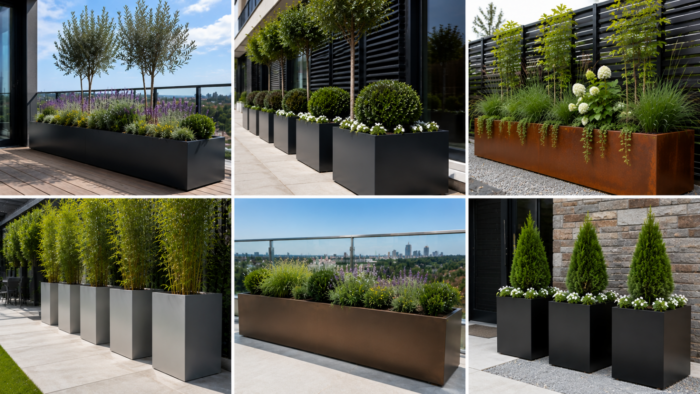
9 Smart Buying Tips for Metal Planters Outdoor
1. Start with the outdoor space, not the product image
Product photography can be useful, but it rarely shows the full story of the site. A planter that looks bold against a plain background may behave very differently beside pale paving, dark brick, reflective glazing or mature planting. For that reason, the first question should always be: where will this planter actually sit?
Metal planters outdoor should be assessed against the outdoor use case. A garden boundary may need visual weight and privacy, while a front entrance may need something more formal and directional. In commercial landscapes, the same planter might be expected to guide movement, frame an arrival point or reinforce a brand-led exterior scheme.
2. Match planter scale to patios, walls and entrances
Scale works best when it relates to nearby architecture. A planter beside a low wall often needs different proportions from one placed next to a double-height glazed façade. Patio planters should also feel balanced against furniture, steps and doors, especially where outdoor living space is compact.
If the planter is too shallow, the planting can appear token. If it is too tall, it can interrupt sightlines or make a small area feel tighter. Metal planters outdoor can work beautifully when they reinforce the geometry of the setting rather than competing with it. That is particularly true for entrances, where a pair of well-proportioned planters can feel more polished than one oversized feature piece.
3. Choose a material that suits the setting
The material should match the outdoor conditions as well as the visual brief. Metal Profiles Ltd supplies three product directions: 3mm Corten Steel Planters, 3mm PPC Mild Steel Planters and 4mm PPC Aluminium Planters. Each may suit different requirements depending on the space, the finish and the handling needs.
In UK gardens and commercial outdoor spaces, material choice often comes down to the surrounding surfaces and the intended visual tone. Metal planters outdoor beside brickwork may need a different character from those next to render, timber cladding or polished paving. It is also worth considering how the planter will sit across seasons, because light, rain and temperature can alter the way the finish reads outdoors.
4. Consider Corten steel for a weathered outdoor character
Corten steel may be considered where a naturally changing weathered patina suits the surrounding landscape, paving or planting scheme. The 3mm Corten Steel Planters page provides useful product context for this material direction. Early weathering run-off and nearby surfaces should still be reviewed before final placement.
This option can work well in softer landscape settings, particularly where the aim is to echo natural tones, textured stone or planting with strong seasonal interest. Metal planters outdoor in Corten steel can provide a grounded, architectural look, but that effect depends on the wider scene and not just the planter itself. They are rarely a neutral choice, which is exactly why they can be so effective in the right outdoor setting.
5. Consider PPC mild steel for controlled colour schemes
PPC mild steel may be relevant where a polyester powder-coated finish is needed to coordinate with paving, glazing, fencing, cladding or exterior metalwork. The 3mm PPC Mild Steel Planters page provides useful context for this material option. The final planter choice should still reflect the outdoor setting, intended planting and finish direction.
For schemes that rely on colour discipline, PPC mild steel can help create a more exact visual link between the planter and the rest of the exterior. That can matter in apartment developments, hospitality terraces and commercial landscapes where a specific design language needs to be carried across multiple features. Metal planters outdoor in a powder-coated finish can help support that consistency without drawing attention away from the planting.
6. Consider PPC aluminium where lighter handling may be relevant
PPC aluminium may be considered where a polyester powder-coated finish and lighter handling are relevant to the wider outdoor requirement. The 4mm PPC Aluminium Planters page provides useful product context for aluminium planter options. The final selection should still be reviewed against dimensions, planting load, access and final location.
That lighter handling may be especially relevant where access is more constrained, or where the project involves a roof terrace, balcony-style setting or an upper-level courtyard. Loaded weight, access, substrate and structural requirements should be reviewed with the relevant project professional where required. Metal planters outdoor are not judged on handling alone, but aluminium can be a useful direction where the wider project calls for a more manageable planter format.
7. Plan drainage, growing medium and watering routines
Drainage should be considered alongside plant type, growing medium and site conditions. Container planting can be affected by rainfall, exposure, seasonal temperatures and watering routines. That means the planter choice should support the planting plan, not work against it.
The right planter can still underperform if the preparation is not aligned with the site. A sunny patio can dry quickly, a sheltered courtyard may hold moisture differently, and a windy roof terrace can increase water demand. Metal planters outdoor should therefore be planned as part of the planting environment, not just as a container. The RHS also provides helpful wider context through its guidance on growing plants in containers, which covers drainage, growing media and ongoing care. The final planting arrangement should still reflect the chosen plants, local exposure, planter position and watering routine.
8. Check access routes before finalising planter size
Access is easy to overlook until the project reaches a practical stage. A planter may look ideal on paper but be awkward to move through narrow gates, side passages, internal corridors or service routes. That is particularly important for larger outdoor architectural planters and commercial outdoor planters that may need to pass through restricted spaces.
The access route can also affect the final dimensions. A slimmer profile may be more practical than a wider format if the site has tight corners, steps or shared circulation. Metal planters outdoor should be sized with the real route in mind, because placement is not just about the final position but also how the planter reaches it.
9. Prepare measurements and photos before requesting an estimate
A clear project brief can make the first discussion more useful because planter size, material, finish, access and final location all affect the requirement. Readers with project-specific requirements can request an estimate for metal planters with dimensions, drawings, photographs, material preference, quantity and wider project context.
Useful information also helps with project coordination. If the planter is part of a new build, refurbishment or landscape refresh, the surrounding surfaces and intended planting should be visible in the brief. Metal planters outdoor are easier to specify accurately when the enquiry reflects the actual site rather than a rough description alone.
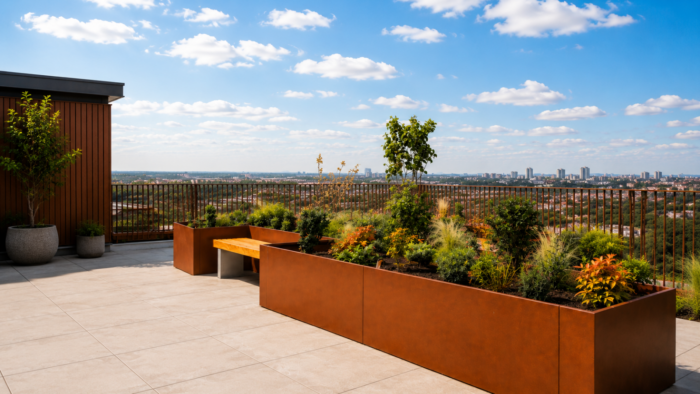
Where Outdoor Metal Planters Work Best
Patios, rear gardens and boundary lines
Patios and rear gardens often need planters to create shape, privacy or softer transitions between seating and planting. In these settings, metal planters outdoor can define edges without adding visual clutter. They may be used to break up long paving runs, frame a dining area or soften a boundary line where fencing or brickwork feels too hard.
Metal trough planters and longer rectangular forms can work well here because they help guide the eye along the space. For garden planters UK projects, the aim is often to make the planter feel like part of the landscape rather than an afterthought placed on top of it. That usually means keeping the scale honest and choosing a material that sits comfortably against the surrounding finishes.
Courtyards, entrances and commercial outdoor spaces
Courtyards and entrances tend to benefit from clearer structure. A planter here often has to do several things at once: signal arrival, reinforce the building exterior and support planting that looks strong from multiple viewpoints. Metal planters outdoor can be useful in those settings because they can read as architectural features rather than loose pots.
Commercial outdoor planters may also need to relate to branding, façade rhythm and pedestrian movement. In hospitality terraces, apartment developments and public-facing outdoor areas, the placement needs to support both atmosphere and circulation. That is why outdoor planter placement should be considered alongside paving lines, door positions, glazing, signage and visibility from inside the building.
Roof terraces and elevated outdoor areas
Roof terraces and other elevated spaces call for more careful review because the planter is part of a broader technical and spatial picture. Loaded weight, access, substrate and structural requirements should be reviewed with the relevant project professional where required. That applies whether the planter is intended for a private terrace, a shared amenity deck or a hospitality rooftop space.
In these settings, metal planters outdoor may need to balance visual presence with practical handling and project constraints. Aluminium planters can be relevant where reduced weight is part of the requirement, while powder-coated finishes may help coordinate with railings, balustrades and exterior furniture. The final choice should reflect the space, not only the planting ambition.
Material, Finish and Colour Choices
Corten steel, PPC mild steel and PPC aluminium
The three main material directions each bring a different outdoor character. Corten steel develops a patina outdoors, which can give a strong weathered effect over time. PPC mild steel offers a polyester powder-coated finish that can be used to support a clearer colour scheme. PPC aluminium also offers a polyester powder-coated finish and may offer lighter handling compared with heavier planter materials.
That variety matters because metal planters outdoor are rarely chosen in isolation. They usually sit beside stone, timber, glass, render or brickwork, so the material needs to complement the rest of the exterior. A robust industrial look may suit one site, while another may need a more understated, refined planter that disappears behind the planting.
When a coordinated outdoor colour scheme is important, product policy and finish information should be reviewed before finalising the planter direction. The Metal Profiles Ltd product policy provides wider ordering and product context. The final finish should still be selected against actual outdoor materials, daylight conditions and project-specific requirements.
RAL and BS colour options for coordinated outdoor schemes
Colour can be one of the most powerful tools in an outdoor scheme, especially where the planter needs to sit beside glazing, cladding, metal railings or painted façades. A well-chosen finish can either echo the surrounding palette or create a deliberate contrast that frames the planting more clearly.
A wide range of RAL or BS colour options may be available, subject to the selected finish and project requirement. That flexibility can support a more tailored result for garden planters UK projects, especially where the planter is part of a larger design language. Metal planters outdoor often work best when colour is treated as part of the architectural composition rather than an isolated feature.
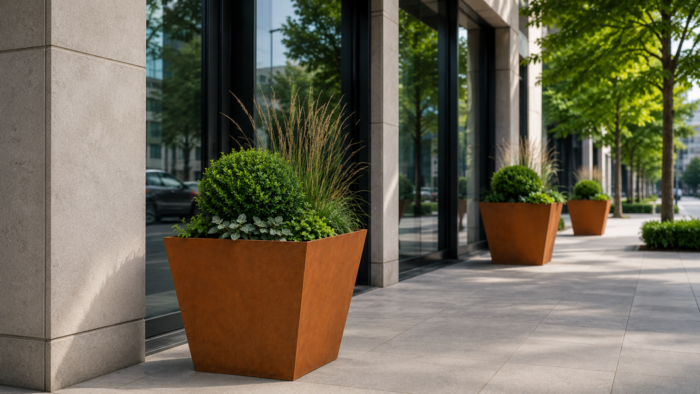
Outdoor Exposure, Drainage and Planting Conditions
Rainfall, sunlight, wind and seasonal temperatures
Outdoor conditions shape how a planter performs over time. Rainfall, sunlight, wind exposure and seasonal temperatures all influence the planting environment, and those factors can vary sharply across the UK. A sheltered courtyard in a city centre will behave differently from an exposed coastal terrace or a windy open garden.
Metal planters outdoor should be planned with the growing conditions in mind, not only the finished appearance. The Royal Horticultural Society’s guidance on growing plants in containers provides useful wider context on container planting, drainage, growing media and ongoing care. The final planting arrangement should still reflect the chosen plants, local exposure, planter position and watering routine.
The surrounding surface also matters. Pale paving, dark paving, gravel, rendered walls and timber cladding each reflect light and heat differently. That can affect how the planter looks and how the planting behaves, so the position should be considered as part of the whole outdoor composition.
Why final placement should be confirmed before filling
Placement and drainage planning should be reviewed before the planter is filled. Once a planter is in position and planted, it is much harder to adjust the relationship between drainage, access and surrounding surfaces. For that reason, the final location should be confirmed with the wider project setting in mind.
This is especially important for metal planters outdoor in commercial or public-facing sites, where movement, maintenance access and visual alignment all matter. It is also relevant in domestic gardens where the planter may sit against brickwork, on porcelain paving, beside a pool edge or in front of a glazed extension. Metal planters outdoor are most effective when the layout is settled before the planting stage begins.
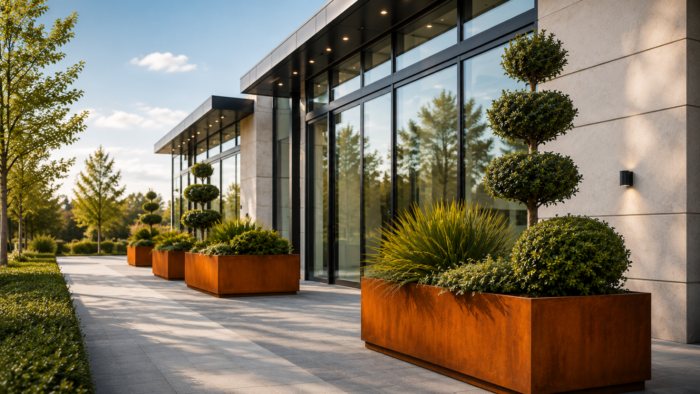
What to Prepare Before Discussing Metal Planters Outdoor
Dimensions, quantity, location, finish and project context
The more precise the brief, the more useful the discussion will be. A planter for a terrace may need a very different approach from one intended for a courtyard entrance or a long boundary line. The best way to begin is to capture the site details, the visual aim and the practical conditions together.
Before making contact, gather the key information that will shape the project:
- Planter length
- Planter width
- Planter height
- Quantity
- Preferred material
- Finish preference
- RAL or BS colour preference
- Final outdoor location
- Access route
- Surrounding surface
- Drainage considerations
- Planting intention
- Photographs
- Drawings
- Wider project context
That information helps make metal planters outdoor easier to assess against the actual setting. It also helps clarify whether the site is best suited to Corten steel, PPC mild steel or PPC aluminium, and whether the planter needs to behave as a raised bed, trough planter, tall planter or larger architectural feature. For project-specific requirements, the final choice should always reflect the outdoor setting rather than a generic product assumption.
FAQ
-
What are metal planters outdoor used for?
Metal planters outdoor are commonly used to define patios, garden boundaries, courtyards, entrances and commercial landscape areas. They can help structure a space, support planting and create a stronger connection between the building exterior and the wider landscape. Their role depends on scale, location and surrounding materials.
-
Which metal is best for outdoor planters?
There is no single best option for every site. Corten steel, PPC mild steel and PPC aluminium each suit different outdoor design directions. The right choice depends on the project setting, preferred finish, planting intention, access needs and how the planter should relate to paving, glazing or cladding.
-
Are Corten steel planters suitable for outdoor spaces?
Corten steel may be considered where a weathered patina suits the wider landscape or architectural scheme. It can work well in gardens, courtyards and feature areas, but early weathering run-off and nearby surfaces should be reviewed before placement. The final choice should reflect the specific outdoor environment.
-
Do metal planters outdoor need drainage planning?
Yes, drainage should be considered alongside plant type, growing medium and site conditions. Container planting can be affected by rainfall, exposure, seasonal temperatures and watering routines. Metal planters outdoor should be planned before filling so the planting arrangement and placement can be reviewed properly in context.
-
Can outdoor metal planters be colour coordinated?
Yes, many projects use colour to coordinate planters with paving, fencing, cladding, glazing or exterior metalwork. PPC mild steel and PPC aluminium may offer polyester powder-coated finish options, and a range of RAL or BS colours may be available depending on the selected product and project requirement.
-
What information helps when requesting metal planters outdoor?
Useful information includes dimensions, quantity, preferred material, finish preference, colour preference, final location, access route, surrounding surface, drainage considerations, photographs, drawings and the wider project context. The clearer the brief, the easier it is to match the planter direction to the outdoor setting.
Metal Profiles Ltd supplies and fabricates metal planters, aluminium roofline products and architectural metalwork for UK projects. Metal planters outdoor may be considered for gardens, patios, courtyards, roof terraces, entrances and commercial landscape requirements. If you have a project in mind, share your preferred material, dimensions, quantity, planting intention, photographs, finish preferences, access information and wider project context. A wide range of RAL or BS colour options may be available, subject to the selected finish and project requirement. For product or project support, Contact Metal Profiles Ltd today.
Discover more from Metal Profiles Ltd
Subscribe to get the latest posts sent to your email.