



Looking along the outer edge of a flat roof, garage roof, extension or low-pitched roof, the point where the roof finish meets the fascia and gutter line may appear straightforward from ground level.
In practice, that perimeter brings together roof materials, water runoff, gutter position, visible finishing, corners and wider weathering details that all need to work together.
Roof edge drip trim may be considered as part of that arrangement, but the selected profile should relate to the full roof build-up rather than being chosen in isolation.
Straight runs, corners, joiners, roof membranes or flashings, fascia alignment, colour coordination and the intended movement of rainwater all affect the final result.
For homeowners, builders, roofing contractors, architects, specifiers, developers and property managers, the roof edge is often one of the most visible and most detail-sensitive parts of the roof.
What Is Roof Edge Drip Trim?
Roof edge drip trim is a perimeter metal profile that may be used to finish the outer edge of a roof and help define how water leaves that edge. It is part of the visible roof-edge arrangement and is usually considered alongside the roof build-up, fascia line, gutter position and neighbouring flashings or membranes.
In UK projects, the term can cover a range of details, including roof edge trim, flat roof drip trim, aluminium drip trim and other aluminium roof trim products. The profile chosen will depend on the roof type, the materials around it and the project-specific geometry. That is why roof edge drip trim should not be treated as a universal answer, even though it is often an important part of a neat, functional roof perimeter.
A well-considered roof edge detail does more than create a tidy appearance.
It helps frame the roof line, supports the visual transition between roof and wall, and can influence how the exposed edge reads once the building is complete.
On modern extensions and commercial canopies, that visible line can be especially important where the roof edge is prominent from the street or neighbouring properties.
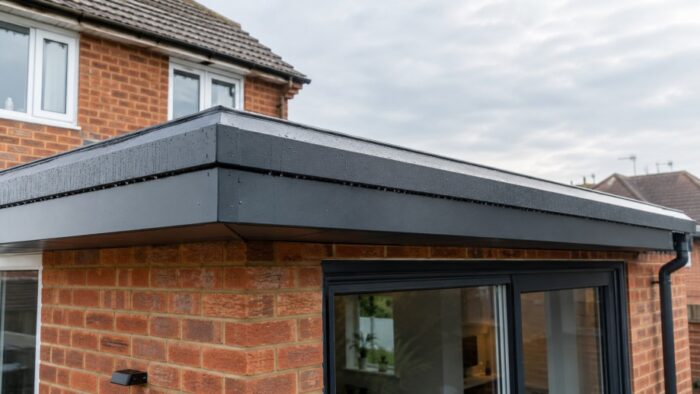
Where Roof Edge Drip Trim Sits on a Roof
Roof edge drip trim sits at the perimeter of the roof, typically where the roofing build-up reaches the outer boundary and water needs to be managed away from vulnerable details. Depending on the design, it may sit close to a fascia board, project over a gutter, or form part of a more complex roof edge flashing arrangement.
Because each roof edge is shaped by its own dimensions and materials, suitability depends on roof geometry, membrane or flashing detail, drainage route and project specification. Some roofs have a simple straight perimeter. Others include returns, changes in level, parapets, corners, upstands or junctions with adjacent walls and canopies. Those conditions affect how a trim profile is selected and how it will look once installed.
Flat roof perimeters and low-pitched roof details
Flat roof drip trim is often considered at the perimeter of flat roofs and low-pitched roof areas where the edge detail is visible and rainwater needs to be directed away from the vulnerable outer line. This can apply to domestic extensions, garages, porches, dormers and small commercial roof sections. The trim is only one part of the overall edge, but it can play an important role in the finished appearance and in the way the roof perimeter is expressed.
Roofline transitions around extensions, garages and canopies
Roof edge trim is frequently used where a roof meets different building elements, such as a side extension, attached garage or entrance canopy. These transitions may involve changes in material, height or visual alignment, so the roof edge detail has to coordinate with adjacent features rather than stand apart from them. Careful review at this stage can help the perimeter line appear deliberate and consistent.
Planning Roof Edge Drip Trim as a Complete Edge Detail
A roof edge should be reviewed as a complete detail rather than only as the visible perimeter of the roof.
Reviewing roof accessories for roof-edge detailing can help identify the related trims, flashings and components that may need to be considered alongside the roof edge.
The final selection should still be based on the roof build-up, drainage route and project-specific geometry.
When roof edge drip trim is planned properly, it works as part of a wider edge arrangement.
This includes fascia position, gutter levels, membrane termination, flashing interfaces and nearby metalwork.
This matters because a trim profile that looks suitable in isolation may not suit the actual roof edge once all the surrounding elements are taken into account.
Roof build-up, fascia lines and gutter relationships
The relationship between the roof build-up, fascia line and gutter position often shapes the final detail more than the trim profile alone. A trim may need to sit visually in line with a fascia, project toward a gutter in the right way, or coordinate with the thickness of the roof build-up. If those elements are not reviewed together, the edge can look awkward even if the trim itself is well made.
Why the rainwater route should be considered early
Rainwater behaviour should be considered alongside the roof build-up, fascia and gutter arrangement. Profile selection can influence how water moves away from the roof edge, but it does not remove the need for a coherent drainage route. Early review helps avoid conflicts between the visible edge line, the water path and the surrounding construction detail.
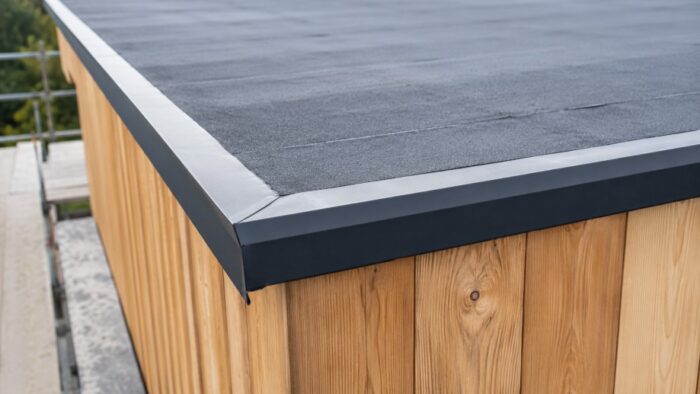
What Roof Edge Drip Trim Can Contribute to a Roof Perimeter
Roof edge drip trim can contribute to a roof perimeter in several practical ways. It may help define the outer line of the roof, provide a tidy visible finish, and create a clearer transition between roof covering and external wall or fascia. Subject to the selected profile and project detail, it can also support a more controlled presentation of the roof edge where exposed membranes or metal finishes are visible.
For many projects, the value of roof edge drip trim lies in coordination. The trim is not a standalone fix, and it should not be treated as a cure for unrelated defects. A roof edge that is already affected by poor detailing elsewhere will still need the underlying design issues reviewed. The trim should therefore be specified as one part of a complete perimeter strategy.
Straight Drip Trim, Corners and Joiners
Long roof edges often need a consistent trim line that works with the roof finish, fascia position and gutter route. The aluminium roof edge drip trim in a 3m length provides a useful reference for straight roof-edge runs where profile depth and finish direction need to be assessed with the wider detail. The selected trim should still be checked against the roof construction, edge dimensions and intended water path.
Straight sections are often the easiest part of a roof edge to visualise, but they still need careful proportioning. The face depth, visible shadow line and relationship to the gutter can all affect whether the edge reads as crisp and balanced. On some buildings, a deeper profile may suit the scale of the elevation, while on others a slimmer line may be more appropriate.
Straight roof edge drip trim for continuous runs
A straight roof edge run benefits from consistency in profile and alignment, especially where the edge is visible over a long distance. The roof edge trim should support the overall geometry of the roof rather than compete with it, and the selected length format should suit the planned arrangement of the perimeter detail.
Visible face depth, roof-edge proportion and alignment
The visible face depth can influence how heavy or light the roof edge looks from the outside. Alignment with the fascia and gutter line is equally important, because even a well-finished profile can appear out of balance if the surrounding elements sit at different visual levels. That is why the roof edge should be assessed as a composed detail, not as an isolated product.
Considering the relationship between the roof build-up, fascia line and gutter position often shapes the final detail more than the trim profile alone.
External corners around roof perimeters
External corners need to maintain the visual continuity of the roof-edge line while working with the actual geometry of the building. The 90-degree external corner for aluminium roof edge drip trim shows the type of matching component that may be considered where a roof perimeter changes direction. The exact corner arrangement should still be checked against drawings and site dimensions.
External corners are often highly visible, so the visual quality of the transition matters. A corner component should sit comfortably within the overall roof line and preserve the intended finish around the perimeter. In practice, the corner detail can be just as important as the straight run when the roof is viewed from the ground or across a courtyard.
Matching a roof-edge trim around outward changes in direction
Outward turns should be considered in relation to the wall line, gutter route and roof finish. The corner detail may need to echo the same finish and proportion as the straight sections so that the perimeter reads as one continuous system. That approach can help the roof edge look planned rather than assembled from unrelated parts.
Internal corners around returning rooflines
Internal corners can be more complex because the trim must follow a returning roof edge without creating an untidy transition. The 90-degree internal corner for aluminium roof edge drip trim provides a useful reference where roof-edge details turn inward around an extension, terrace or other building junction. The final component selection should still reflect the actual roofline layout and adjoining finishes.
Internal corners often occur where the roof returns around a projection or meets another structure. Those transitions can interrupt an otherwise clean perimeter line, so the detail needs to be reviewed from several angles. The objective is usually a coherent visible edge that respects the geometry of the building and the other materials in view.
Roof-edge transitions at inward corners and junctions
Inward turns can be especially sensitive where adjacent walls, parapets or roof coverings meet. The trim arrangement should work with the full junction detail, not simply close the visible gap. That means the corner profile, adjoining finish and surrounding roof elements all need to be understood before the final specification is confirmed.
Joiners and continuous trim lines
Longer roof runs may require a consistent visual line across multiple lengths, which is where a roof drip trim joiner may be relevant. Joiners should be viewed as part of the complete edge arrangement, because the joint location, line continuity and surrounding geometry can affect how discreet the final perimeter appears.
Why joint locations need to suit the overall roof-edge arrangement
Joint positions should fit the roof layout rather than being placed purely for convenience. On a visible roof edge, a poorly considered joint can interrupt the flow of the line or create an unbalanced appearance near a corner or change in level. The trim specification should therefore take the full roof edge into account, including the intended visual rhythm of the perimeter.
Roof Edge Drip Trim is an integral part of the roof’s design, ensuring proper water management and aesthetic appeal.
Roof Edge Drip Trim and Roof Flashing: Key Differences
Roof edge drip trim and roof flashing are related but not identical products. A drip trim is generally part of the perimeter finish and visible edge treatment, while a flashing is often used to manage junctions, cover transitions or support weathering where the roof meets another element. Their roles may overlap in some details, but they should not be assumed to do the same job.
Different roles within a wider roof-edge assembly
The distinction matters because the roof edge assembly usually includes more than one component working together. A roof edge flashing may protect a junction, while the trim helps define the perimeter and support the visible finish. Where the roof design includes both, the profiles should be coordinated rather than selected independently.
Roof Membranes, Fascia and Gutter Interfaces
Membrane and flashing interfaces near the roof perimeter need careful review because the edge detail is where several material lines converge. The roof edge trim, roof membrane and any adjoining flashing should be understood as a coordinated assembly, with the fascia and gutter positions also checked in relation to the visible edge.
The trim does not replace the need for a sound membrane or a suitable flashing detail. Instead, it should sit within the wider roof-and-wall construction detail so that the perimeter reads cleanly and performs as intended. If the fascia, gutter and membrane lines are not aligned thoughtfully, the roof edge can appear cluttered even when individual parts are correctly made.
Membrane and flashing interfaces near the roof perimeter
The interface between the roof finish and the edge profile is especially important on flat roof edge trim details. Membrane terminations, adjacent flashings and visible metalwork should all be considered together, because each element affects the final appearance and the water-management strategy at the perimeter.
Coordinating the trim line with fascia and gutter positions
The trim line should work with the fascia and gutter positions rather than forcing them into an awkward relationship. If the gutter sits too high, too low or too far from the intended line of runoff, the overall detail may become harder to resolve. Coordinated planning helps the edge remain clear, proportionate and practical.
Moisture Resistance and Roof-Edge Planning
Roof edge drip trim should be considered within the wider context of how roofs and walls manage rain and moisture.
For broader England-specific guidance, the Approved Document C guidance on resistance to moisture can be read alongside project drawings and applicable requirements.
The exact roof edge trim, roof membrane or flashing interface, fascia line, gutter position and drainage route should still be reviewed against the full project detail.
A roof edge trim is only one visible component within a wider construction detail. Its contribution is important, but it should not be expected to compensate for unrelated issues elsewhere in the roof build-up. Good roof-edge planning therefore considers moisture movement, exposure, drainage and adjoining materials together, rather than relying on a single profile to resolve everything.
Rainwater behaviour around exposed roof edges
Rainwater behaviour around exposed roof edges can vary depending on roof pitch, edge projection, wind exposure and the surrounding geometry. Profile selection can influence how water moves away from the roof edge, but the rest of the perimeter detail still matters. That is why roof edge planning should include the fascia, gutter route and the way the edge will present under real weather conditions.
Aluminium Finishes and Colour Coordination
Aluminium roof edge drip trim may be supplied in mill finish or powder-coated colour options, subject to the selected product and project requirement. That flexibility can make it easier to coordinate the trim with fascias, gutters, window surrounds and other external metalwork. The best choice is usually the one that supports the intended architectural finish rather than simply standing out for its own sake.
On some schemes, a discreet dark edge line is preferred. On others, the trim may need to blend with surrounding cladding or roofline products. Because the roof edge is so visible, finish selection often has a direct effect on how refined the whole perimeter appears.
Mill finish and powder-coated colour options
Mill finish can suit some project contexts, while powder-coated finishes may be better where a specific colour is needed. A wide range of RAL or BS colour options may be available, subject to the selected finish and project requirement. The important point is to coordinate the chosen finish with the rest of the external envelope rather than treating the trim as an afterthought.
Coordinating trim colour with fascia, gutters and exterior metalwork
Colour coordination can help the roof edge feel integrated with the rest of the building. When the trim, gutters and fascia are visually aligned, the perimeter often reads more clearly from a distance. That is particularly relevant on extensions, canopies and commercial entrance features where the roof edge is prominent in the overall elevation.
Roof Edge Drip Trim for Domestic Projects
Domestic projects often use roof edge drip trim on flat roof extensions, garages, porches and outbuildings where the roof perimeter needs a neat and practical finish. In these settings, the trim may be chosen to suit a modest roof edge or to provide a more deliberate architectural line. The best choice depends on the roof form, the visible height of the edge and the surrounding materials.
Homeowners and domestic builders often find that the roof edge becomes a noticeable part of the final appearance once the rest of the work is complete. This is why the trim, fascia and gutter line should be reviewed together early in the design process, especially where the roof is visible from the garden or street.
Flat roof extensions, garages, porches and outbuildings
Flat roof drip trim is commonly associated with extensions and small buildings, but the detail still deserves proper consideration. The roof edge may be short, yet it remains a highly visible interface between roof and wall. A well-chosen profile can contribute to a tidier, more coordinated finish without dominating the building.
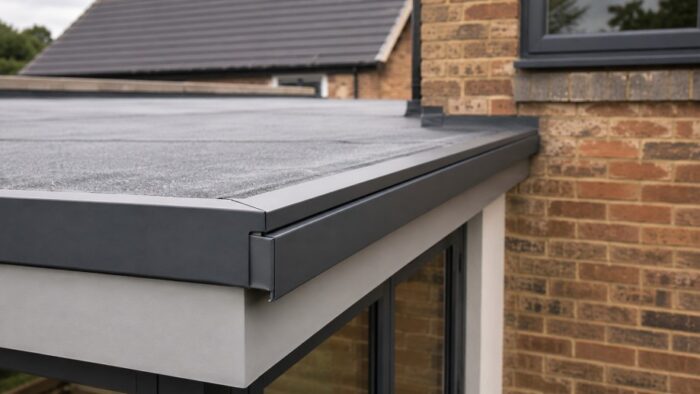
Roof Edge Drip Trim for Commercial and Specification-Led Projects
Commercial and specification-led projects often need roof-edge components to be coordinated carefully across drawings, schedules and external metalwork. The edge detail may be prominent on canopies, entrances, low-slope roof sections and apartment-related structures, so consistency and clarity are important from the outset.
On these projects, roof edge trim is rarely an isolated item. It usually sits within a broader package of roofing, waterproofing, metalwork and drainage coordination. That means the drawings, schedules and product descriptions need to reflect the actual roof arrangement rather than a generic perimeter solution.
Coordinated drawings, schedules and external metalwork details
Architect-led and commercial projects often need roof-edge components to be described clearly across drawings, schedules and related external metalwork. NBS specification support may help connect roof-edge trim requirements with broader project documentation. This can support better coordination between drip trim, flashing details, gutters and adjoining roofline elements.
Product information for architects, contractors and specifiers
For specifiers, the main task is usually to match the roof-edge component to the actual detail. That may include edge depth, visible face, corner conditions, finishes and compatibility with adjacent materials. Clear information at this stage can reduce ambiguity and support more consistent outcomes across tender and delivery stages.
What to Confirm Before Requesting a Roof Edge Trim Estimate
A useful roof edge trim enquiry should include the total run length, roof type, trim face depth, roof-edge photographs, drawings, corner quantities, finish preference and relevant roof-build-up information. Readers with project-specific requirements can request an estimate from Metal Profiles Ltd once these details are available. Confirming the gutter position, drainage route and unusual roofline conditions at the same stage can make the discussion clearer.
It also helps to note whether the project involves straight runs, internal corners, external corners or junctions with other roofline elements. The more complete the information, the easier it becomes to assess whether a standard aluminium roof edge drip trim, a matching corner component or a bespoke roof-edge trim may be more suitable. This is especially relevant where unusual angles, non-standard widths or complex interfaces are involved.
Measurements and photographs give valuable context, but drawings and roof-build-up notes often provide the clearest picture of how the edge should be understood.
Finish preferences should also be confirmed early, particularly where the roof edge is visible from key viewpoints or needs to coordinate with other metalwork.
Measurements and photographs give valuable context, but drawings and roof-build-up notes often provide the clearest picture of how the edge should be understood. Finish preferences should also be confirmed early, particularly where the roof edge is visible from key viewpoints or needs to coordinate with other metalwork.
Corners, roof type, trim quantities and unusual roofline conditions
Corner quantities and roof type can affect how a project is interpreted, especially where the perimeter is not a simple rectangle. Unusual roofline conditions may call for additional review so that the trim selection reflects the real geometry, not just the approximate outline.
FAQ
-
What is roof edge drip trim?
Roof edge drip trim is a perimeter profile used at the outer edge of a roof. It forms part of the visible finishing detail and may help direct rainwater away from vulnerable edge areas, depending on the full roof design.
-
Where is roof edge drip trim used?
It is often used at flat roof perimeters, low-pitched roof edges, extensions, garages, porches and canopies. Suitability depends on the roof build-up, adjacent fascia, gutter position and the specific roof geometry.
-
Does roof edge drip trim work on flat roofs?
It may be suitable for flat roofs, but not every flat roof needs the same profile. The roof edge trim should be reviewed against membrane details, drainage route, fascia line and the project specification.
-
What is the difference between roof flashing and drip trim?
Roof flashing usually addresses junctions and weathering transitions, while drip trim is typically a visible perimeter finish. They can work together, but they are not identical and should not be treated as the same component.
-
Why are corners important for roof edge drip trim?
Corners affect both appearance and continuity along the roof perimeter. External and internal corners need to suit the actual roofline so the finish looks deliberate, aligned and consistent around changes in direction.
-
Does roof edge drip trim relate to gutters and fascia?
Yes, it often does. The trim should be considered with the fascia line and gutter position because these elements influence the visible edge, the route water takes and the overall roof-edge arrangement.
-
Can aluminium roof edge drip trim be powder coated?
Yes, powder-coated finishes may be available, subject to the selected product and project requirement. Aluminium roof edge drip trim can often be specified in colours that coordinate with fascias, gutters and other exterior metalwork.
-
What information should I provide for a roof edge drip trim estimate?
Provide roof dimensions, roof type, face depth, photographs, drawings, corner quantities, finish preference and any unusual roofline conditions. It also helps to confirm gutter position, drainage route and the wider roof build-up.
Metal Profiles Ltd supplies and fabricates aluminium roof edge drip trim, roofline products and architectural metalwork for UK projects. Roof edge trims, roof flashings, gutter-related details and associated exterior metalwork can be considered for domestic and commercial requirements. Share roof dimensions, trim face depth, photographs, drawings, corner quantities, finish preferences and project context. A wide range of RAL or BS colour options may be available, subject to the selected finish and project requirement. For product or project support, Contact Metal Profiles Ltd today.
Discover more from Metal Profiles Ltd
Subscribe to get the latest posts sent to your email.