



If you are asking what are soffits and fascia, you are probably looking at the visible roofline elements around the eaves and trying to understand how they all work together. These parts do more than finish the edge of a roof neatly. They sit alongside the roof edge, gutter positions, downpipe routes, external finishes and the wider roofline detail, so they should be considered as one connected arrangement rather than separate decorative items.
That matters for homeowners, builders, roofing contractors, architects, specifiers and property managers alike. The right approach can affect appearance, compatibility, maintenance planning and project-specific detailing, especially where the roof edge, backing structure or ventilation requirements need to be reviewed carefully. This guide explains what fascia is, what soffits are, where each one sits, how they differ, how they relate to gutters and downpipes, and what to assess before replacement or specification. By the end, you should have a clear, practical understanding of the roofline and the factors that shape a sensible fascia and soffit decision.
What Are Soffits and Fascia?
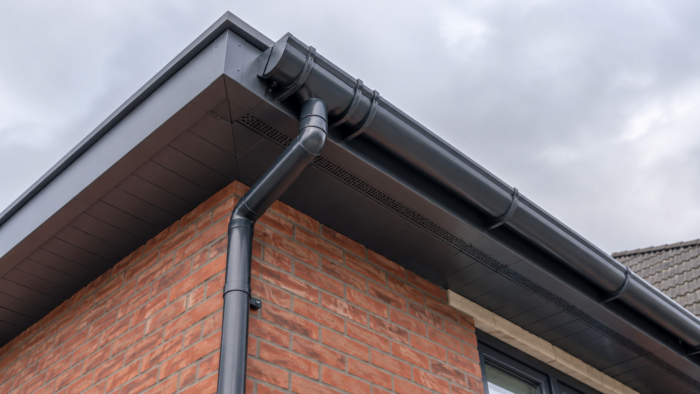
Soffits and fascia are part of the roofline, which is the visible line where the roof meets the outer wall. In simple terms, the fascia is usually the vertical board or finished face at the roof edge, while the soffit is the underside panel fitted beneath the overhang. Together they help create a tidy transition between roof and wall, and they are often the parts people notice first when looking at a property from the street or garden.
When people search for what are soffits and fascia, they often want a definition, but the better question is how these elements function as part of the wider roof edge. The fascia and soffit area can influence how the guttering sits, how the eaves look, and how the roofline is detailed around corners, junctions and changes in level. That is why fascia boards and soffits should be considered alongside the gutter route, the roof edge build-up and any required finish to the surrounding exterior.
The term soffit and fascia is often used together because the two elements visually and practically meet at the eaves. The fascia forms the face at the edge, while the soffit closes the underside. In many projects, both are replaced or specified together to keep the appearance consistent and to align the roofline detail properly.
Where Fascia Sits on a Roofline
Fascia sits at the lower edge of the roof, generally along the point where the roof covering finishes and the outer face of the eaves begins. It is usually visible from ground level and runs horizontally along the building edge, though the exact profile and depth depend on the roof construction and the desired exterior appearance. In roofline planning, it is one of the main visual boundaries between the roof and the wall below.
Fascia and roof-edge considerations
The fascia should be viewed as part of the roof edge detail rather than as an isolated board. Its position can affect how the eaves appear from outside, how junctions are finished, and whether the edge reads as crisp and continuous across the elevation. On some buildings, the fascia is a prominent design feature. On others, it is a subtle finishing element that supports a clean transition between materials.
Because roof construction varies, fascia boards are not always used in exactly the same way. The depth, fixing method and edge detail may differ between houses, extensions, garages and commercial canopies. Any review of fascia and soffit details should therefore include the roof build-up, surrounding trim, gutter alignment and the visible finish to the eaves.
Fascia and gutter support considerations
One of the most common questions is whether fascia relates to guttering. In many roofline arrangements, it does. Fascia boards are commonly positioned along the roof edge and can support guttering arrangements depending on the roofline design. That is why the fascia line and the rainwater goods should be planned together, not as separate decisions made at different stages.
If the gutter line is too high, too low or poorly aligned with the fascia face, the result can look awkward and may complicate the wider roof edge detail. Downpipe routes also need to be considered at this stage, especially where corners, outlets or changes in elevation affect the path of rainwater. A practical roofline review should look at how the fascia, gutter bracket positions, outlets and downpipe directions work as one assembly.
What Soffits Do Beneath the Eaves
Soffits sit beneath the fascia area, closing the underside of the roof overhang. They are usually visible from beneath the eaves and from some ground-level viewpoints, especially on buildings with deeper overhangs or more pronounced roof edges. Their role is often more understated than the fascia, but they are just as important to the overall appearance of the roofline.
A soffit helps create a clean underside finish and can conceal the roof structure from view. That means it contributes to the visual order of the roof edge, particularly where a project calls for a neat, continuous exterior line. On extensions, garages and canopies, the soffit can become a significant design detail because the underside is more exposed to view.
Soffit position and the underside of the roof overhang
If you are trying to visualise what is a soffit, think of the underside face that bridges the gap between the wall and the outer roof edge. It is usually located beneath the fascia board and parallel to the ground. In practical terms, this makes the soffit part of the eaves zone, where weathering, appearance and detailing all meet.
The size of the soffit area depends on the roof overhang. Some roofs have shallow eaves, while others project more noticeably. The greater the projection, the more important the underside finish becomes, especially if the soffit is visible from nearby windows, entrances or public areas. That is why soffits and fascias are often specified together as part of a single roofline package.
Soffits and ventilation context
Ventilation may be relevant in the soffit area, but it does not apply in the same way to every roof. Requirements depend on the roof construction and should be reviewed with the relevant project design, specification or professional advice where required. It is not safe to assume that every soffit provides ventilation, because some rooflines use plain soffits while others incorporate vented elements or separate ventilation strategies.
Where ventilation is needed, the soffit zone may be one of the places it is addressed. The key point is that the roof edge should be considered in context, including the roof build-up, insulation approach, eaves construction and any external detailing that affects airflow and performance.
The Difference Between Soffits and Fascia
The difference between soffit and fascia is easiest to understand by looking at their position and role at the eaves. The fascia is the visible face at the roof edge. The soffit is the underside panel beneath it. Both sit close together, but they occupy different surfaces and serve different finishing functions.
If you want a simple comparison, the fascia is the front edge and the soffit is the underside. The fascia often forms the line that guttering relates to, while the soffit closes the gap below the overhang. Together they create a complete roofline finish. For a more focused breakdown, the difference between soffit and fascia can help when comparing the two in project planning.
This distinction matters because replacement, specification and maintenance checks often depend on knowing which component is affected. A stained soffit, for example, may suggest ventilation or moisture issues, while a distorted fascia line may point to alignment, backing or guttering concerns. In practice, the two components should not be treated as unrelated parts because the visible roofline works best when the full edge detail is planned together.
How Fascia and Soffits Work With the Wider Roofline
Fascia and soffits are not only visual elements. They are part of the wider roofline system that includes the roof edge, gutter positions, outlets, downpipes and surrounding exterior finishes. When these elements are aligned well, the building tends to present a more coherent and well-resolved appearance. When they are not, the roof edge can look uneven, busy or poorly coordinated.
Roof edges, gutter positions, outlets and downpipe routes
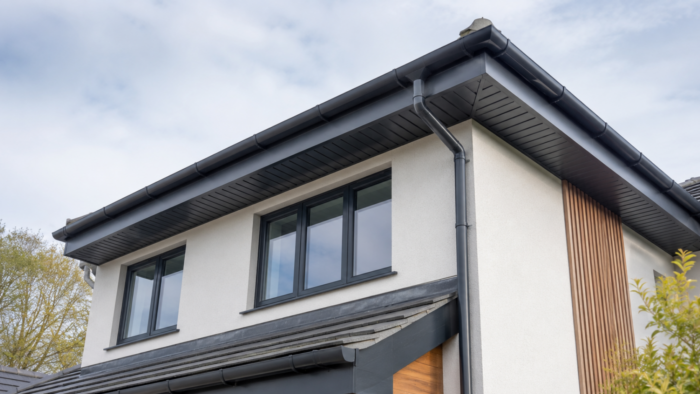
The roof edge is the anchor point for a lot of exterior detail. Guttering needs to sit in a position that works with the fascia line, the roof slope and the drainage route. Outlets need to connect sensibly to downpipes, and downpipe routes should be planned so they do not interrupt windows, entrances or architectural features unnecessarily.
This is why the roofline fascia and soffits should always be reviewed as part of the wider rainwater and façade arrangement. The fascia may define the visible line for gutters, while the soffit helps complete the underside. If the gutter projection, bracket position or outlet location is not considered from the start, the final result can feel improvised rather than integrated.
Why visible roofline details should be planned together
A roofline should be treated as a connected detail because one part often affects the others. The fascia influences the gutter line. The soffit influences the underside finish. The gutter positions influence downpipe routes. The surrounding wall finish and trim details influence how everything reads visually from outside.
For that reason, roofline replacement is not simply a matter of swapping one board for another. The overall edge condition, the backing structure, the corners, the finish, the drainage route and any relevant ventilation requirement should all be checked together. If the roofline is being reviewed on a new build or refurbishment, the design intent should be coordinated at the same time as the practical fixing and weathering details.
Soffits and Fascia for Houses, Extensions, Garages and Canopies
Domestic properties, extensions, garages and canopies may each call for a slightly different roofline approach. A terraced house may need a straightforward fascia and soffit arrangement. A rear extension may need more careful colour coordination with the existing house. A garage or canopy may need a more compact, visually neat solution that suits the scale of the structure.
The roof edge on smaller structures can be more exposed visually because there is less surrounding detail to absorb it. That makes the finish of the fascia and soffit particularly noticeable. On larger homes, the relationship between the roofline and the rest of the façade can become more significant, especially where long elevations or multiple roof junctions are involved.
In each case, a sensible project review should consider the existing roof construction, the intended appearance and the practical edge detail. Fascia soffit installation choices may also vary depending on whether the project is a repair, a full roofline replacement or part of a broader external renovation.
Roofline Considerations for Commercial Buildings
Commercial properties often have longer roof edges, more frequent junctions and more visible specification requirements than domestic homes. Office units, retail units, schools, apartment blocks and mixed-use buildings may all need a roofline that is both tidy and easy to coordinate with the wider exterior design. In these settings, the fascia and soffit detail should be considered alongside façade materials, access, maintenance planning and compliance-led project requirements.
Longer roofline runs, canopies, parapets and specification-led requirements
Longer roofline runs can make alignment and consistency more important. Any variation in the fascia line, soffit finish or gutter position can become noticeable across a larger elevation. Canopies and parapet edges may also need careful detailing because they often sit close to entrances, loading areas or high-visibility façades.
For architects, specifiers and commercial project teams, NBS specification support may be relevant when roofline products need to be described clearly within a coordinated design package. It can also help when exterior metalwork, roof edge details and project-specific finishes need to be aligned with the wider specification.
Aluminium, Timber and uPVC Roofline Materials
Roofline products are available in different materials, and the right choice often depends on appearance, durability expectations, surrounding materials and the overall design intent. Timber can suit some traditional contexts, while uPVC is commonly used in many residential settings. Aluminium may be selected where a metal finish, custom colour or project-specific fabrication is needed.
Material choice should not be treated as a cosmetic decision only. It can affect how the fascia and soffit are detailed, what finish is visible at the eaves and how the roofline relates to other exterior components such as flashing, capping and window surrounds. In some projects, a consistent metal finish across the roof edge and other external elements may create a more coherent look.
For a combined product route, aluminium fascia and soffit products may be worth reviewing where a metal roofline solution is being considered. Metal Profiles Ltd can supply and fabricate aluminium roofline and architectural metalwork products to suit project-specific requirements.
When aluminium fascia and soffit options may be relevant
Aluminium fascia boards and aluminium soffits may be relevant where a durable metal finish is wanted to complement other architectural elements. They may also suit projects that need a cleaner visual line, a coordinated colour scheme or a more tailored fabrication detail around corners, junctions or roof transitions.
That does not mean aluminium is the right answer for every property. It simply means it is one option among several, especially where the wider façade uses metal detailing or where the design brief calls for a more refined finish at the eaves. As always, the roof construction, visible edge detail and project requirements should guide the specification.
Colour Coordination for Fascia and Soffits
Colour can have a noticeable impact on how the roofline reads. A light fascia and soffit may blend into a traditional exterior, while darker tones can help the roof edge appear sharper and more contemporary. The best option usually depends on the building style, surrounding materials and the level of contrast desired against the wall finish and roof covering.
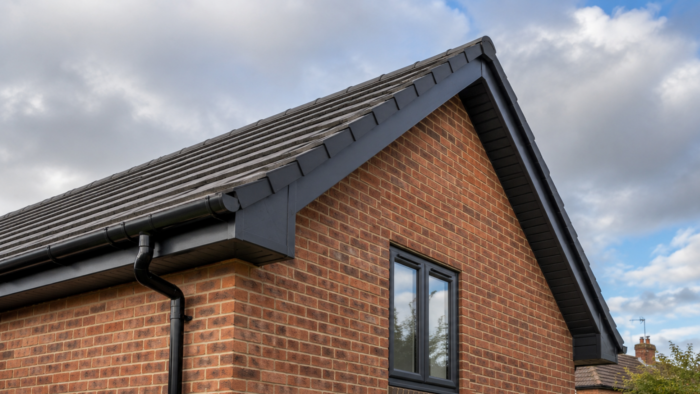
A coordinated colour approach can be particularly useful where the roofline, windows, doors and rainwater goods are all visible together. If the fascia and soffit tones are chosen with the rest of the exterior in mind, the building can feel more balanced and deliberate. This is one reason colour should be assessed as part of the whole roofline rather than as an afterthought.
Black fascia boards and soffits in modern exterior design
Black fascia boards and soffits are often considered on contemporary homes, rear extensions and commercial entrances where a stronger visual outline is desired. They can work well with brick, render, cladding and darker rainwater goods. That said, black is only one option, and the right choice will depend on the project style and the finish coordination already present on the building.
Metal Profiles Ltd can help specify finishes where roofline colour needs to align with other external elements. A wide range of RAL or BS colour options may be available, subject to the selected finish and project requirement. For current standard product planning, it may also be useful to review roofline options in the online shop.
Signs That a Roofline May Need a Review
A roofline review can be useful when the fascia and soffits no longer look consistent with the rest of the building, or when the eaves area shows visible signs of change. Gaps, movement, staining, uneven lines or weathering around the roof edge may indicate that the roofline deserves a closer look. In some cases, the issue may be cosmetic. In others, it may relate to the backing structure, gutter position or ventilation arrangement.
Gaps, visible deterioration, staining, movement and uneven gutter lines
Common signs worth noting include visible gaps at joints, discolouration on soffits, warped or uneven fascia lines, sagging gutter runs and staining that suggests water may not be draining as intended. None of these signs should be treated as proof of a single fault, but they do show that the roof edge should be assessed in context.
A review may also be sensible if the building is being refurbished, extended or repainted, because the roofline often becomes more obvious when other exterior elements are updated. For a broader view of architectural metalwork and exterior detail, Metal Profiles case studies may offer helpful context, though each project should still be assessed on its own merits.
What to Check Before Replacing Fascia or Soffits
Before fascia and soffit replacement, the main task is to look beyond the visible boards and assess the wider roofline detail. Roof-edge condition, backing structure, corners, gutter alignment, downpipe positions, safe access and any relevant ventilation requirements should all be reviewed as part of the same conversation. That helps ensure the replacement or specification suits the building rather than only matching the existing appearance.
It can also help to consider whether the roofline forms part of a larger external works package. If flashing, capping, window surrounds or other roof-edge metalwork are also being replaced, the fascia and soffit choice should complement those elements. This is especially important on projects where the roof edge is seen from multiple angles or where consistent colour and material coordination matters.
The question is not just whether the existing boards should come off. It is whether the whole roofline arrangement still works properly for the building. That means thinking about the visible finish, the practical drainage route, the condition of the supporting structure and the level of access needed for any future maintenance. For roofline planning and project-specific fabrication, about Metal Profiles Ltd may be a useful place to understand the company background and approach.
Moisture Resistance and Roofline Planning
When planning soffits and fascia, it is also worth considering how roof-edge details support wider protection from rain and moisture. The UK Government’s Approved Document C guidance on resistance to moisture provides broader information on moisture resistance for roofs and walls.
What Information Helps With a Roofline Enquiry
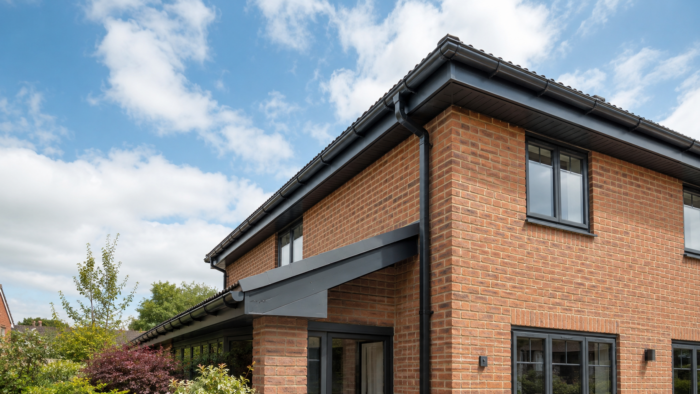
A clear enquiry makes it easier to assess whether soffits and fascia, or a wider roofline replacement, are suitable for a project. Measurements are important, but they are only part of the picture. Photographs, roofline drawings, property details and finish preferences can all help build a better understanding of the requirement.
It is useful to note the building type, the approximate roof edge layout, any existing visible issues and whether the project is domestic or commercial. If the request involves replacement, it helps to identify whether the fascia and soffit areas are to be matched, updated or coordinated with other exterior elements. Colour preferences can also be useful, especially where the surrounding materials or window finishes create a strong visual context.
For architects, builders, property managers and homeowners alike, the most helpful approach is to describe the roofline as a whole. That allows the enquiry to consider the roof edge, gutter positions, soffit detail, downpipe route and any metalwork requirements in one connected review.
FAQ
-
What are soffits and fascia?
They are roofline elements at the eaves. Fascia forms the visible edge face, and soffits sit underneath to close the underside of the overhang.
-
What is the difference between a soffit and a fascia board?
A fascia board is the front-facing board at the roof edge. A soffit is the underside panel beneath it. They perform different visual and practical roles.
-
Where are soffits located on a house?
Soffits are usually fixed beneath the roof overhang, between the outside wall and the fascia board. They are visible from below the eaves.
-
Do fascia boards support guttering?
Fascia boards are commonly positioned along the roof edge and can support guttering arrangements depending on the roofline design.
-
Do all soffits need ventilation?
No. Ventilation requirements depend on the roof construction. They should be reviewed against the project design, specification or professional advice where required.
-
Can soffits and fascia be replaced together?
Yes. They are often assessed and replaced together because the roof edge, gutter line and visible finish are connected.
-
What materials can be used for fascia and soffits?
Common options include timber, uPVC and aluminium. The best choice depends on the property, finish requirements and project-specific detail.
-
What information should I provide for a roofline enquiry?
Measurements, photographs, roofline drawings, property details and finish preferences are all helpful when discussing a fascia and soffit requirement.
Metal Profiles Ltd supplies and fabricates aluminium roofline and architectural metalwork products. Fascia, soffits, roof-edge details and related exterior metalwork can be considered for domestic and commercial requirements. Please provide measurements, photographs, roofline drawings, property details and finish preferences to help with the enquiry. For business and location details, view Metal Profiles Ltd on Google. For product or project support, Contact Metal Profiles Ltd.
Discover more from Metal Profiles Ltd
Subscribe to get the latest posts sent to your email.