



Whether you are specifying a new commercial build, tackling a flat-roof extension or simply trying to make sense of the terminology, this guide covers everything you need to know about box in a pipe systems: what they are, where they are used, how to install them correctly, and why aluminium is the material of choice across the UK.
The phrase “box in a pipe” crops up regularly on building sites and in architects’ drawings. Depending on the context, it can refer to two distinct but related things: a box profile downpipe (a rectangular hollow aluminium section that carries rainwater down from a gutter) or the process of encasing an existing round pipe inside a square aluminium casing to improve aesthetics, weather protection, or both. We will cover both interpretations in detail below.
What Is a Box in a Pipe?
In UK building and construction, the term “box in a pipe” has two main meanings that are often used interchangeably, which can cause confusion when ordering materials. It pays to be clear about which application you actually need before you pick up the phone or place an order online.
Meaning One: The Box Profile Downpipe
This is the most common use of the phrase in the roofing and rainwater goods sector. A box profile downpipe is simply a downpipe with a rectangular or square cross section rather than the traditional circular profile. Made most commonly from extruded aluminium, these sections are used to carry rainwater from a box gutter or standard gutter outlet down to the drainage connection at ground level.
Box profile downpipes pair naturally with aluminium box gutter systems, forming a fully coordinated rainwater drainage package. The rectangular outlet of the box gutter transitions cleanly into the rectangular profile of the downpipe, eliminating the awkward adaptors often needed when mixing round downpipes with box gutters.
Related reading: If you are new to box gutter systems, our complete aluminium box gutter guide explains the different outlet types, sizing calculations and installation best practice.
Meaning Two: Boxing a Round Pipe Inside a Box Section
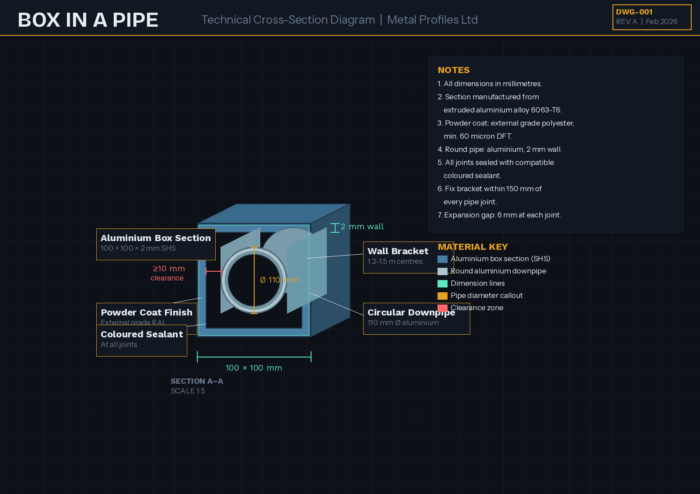
The second meaning is more literal: you are placing a round pipe (a standard circular downpipe or service pipe) inside a square or rectangular aluminium hollow section to conceal it. This technique is used where exposed pipework is considered unsightly or where a pipe needs physical protection on the outside of a building.
Think of gas supply pipework running up an external wall, or heating system pipes on the outside of a commercial unit. Rather than leaving them exposed, the installer places an aluminium box section over the top, producing a clean, weather-resistant finish that is far more durable than a timber boxing and far neater than pipe lagging.
Design Uses of Box in a Pipe Systems
Box profile downpipes and aluminium pipe boxing are no longer purely functional details. Architects and specifiers now choose them deliberately as design elements, particularly on flat-roof contemporary builds, industrial conversions, and large commercial structures. Here is a breakdown of the main design applications.
Contemporary and Commercial Architecture
Round downpipes have a domestic, traditional quality to them. Box profile downpipes, by contrast, read as intentional, architectural choices. On a steel-framed warehouse with standing seam cladding, a rectangular aluminium downpipe in a dark grey RAL finish looks deliberate and considered. It sits flush against the facade in a way that a round pipe never quite manages.
Many architects working on schools, leisure centres, retail parks, and mixed-use developments now specify box profile downpipes as standard, particularly where they run across flat sections of facade and need to integrate with aluminium fascia systems.
Flat-Roof Extensions and Residential Self-Builds
The flat-roof extension market has grown enormously over the last decade, and with it the demand for box profile rainwater goods. A flat-roof rear extension to a Victorian terrace typically uses an internal parapet gutter or a wall-hung box gutter, both of which work best with a box profile downpipe. The rectangular section is easier to conceal within a parapet opening or to run tight against a rendered wall without a visible gap.
See also: Our guide on why aluminium fascia and copings are essential for modern builds explains how box rainwater goods complement a full aluminium envelope system.
Concealing External Service Pipes
On social housing refurbishments, care homes, schools, and commercial buildings, external pipework is commonly boxed in using aluminium hollow sections. This is partly for aesthetics, partly for security (exposed pipes on vulnerable buildings invite damage), and partly for thermal protection where pipework might be at risk of freezing.
Common services boxed in using aluminium sections include:
- Gas supply risers on apartment blocks and commercial premises
- District heating distribution pipework
- Air source and ground source heat pump connections
- Electrical conduit on external walls
- Fire sprinkler supply pipes in exposed locations
Colour-Coordinated Rainwater Systems
One of the most powerful design features of aluminium box profile downpipes is the ability to powder coat them in any RAL or BS colour to match or contrast with the building facade. A dark bronze box downpipe running down an anthracite grey render elevation creates a cohesive, high-quality appearance that is simply not achievable with standard white UPVC systems.
Metal Profiles produces powder-coated aluminium products to external grade specification, meaning the colour holds its integrity for decades rather than yellowing or fading as UPVC inevitably does in UV-exposed locations.
Choosing the Right Box Section Size
Sizing is where many projects go wrong. Whether you are specifying a box profile downpipe for rainwater drainage or sizing a hollow section to conceal an existing pipe, the principles are similar: you need enough internal clearance and the right wall thickness for the application.
Sizing a Box Profile Downpipe for Drainage
Downpipe sizing is determined by the roof catchment area and rainfall intensity. As a general rule of thumb widely used in UK practice (and consistent with the guidance in BS EN 12056-3 on gravity drainage systems), a 65x65mm box profile downpipe will handle a catchment area of approximately 16 square metres, while a 100x75mm section handles up to around 38 square metres. Always verify calculations against the actual rainfall data for your region; rainfall intensity in Scotland is notably higher than in the East of England.
| Box Profile Size | Approx. Max Catchment Area | Typical Application |
|---|---|---|
| 65 x 65 mm | Up to ~16 m² | Small extensions, lean-to roofs |
| 75 x 75 mm | Up to ~22 m² | Domestic rear extensions, garages |
| 100 x 75 mm | Up to ~38 m² | Commercial units, industrial sheds |
| 100 x 100 mm | Up to ~50 m² | Large flat roofs, distribution warehouses |
Note: These are indicative figures based on standard UK rainfall intensity of 75mm/hr. Always confirm with a full hydraulic calculation for larger or critical projects.
Sizing a Box Section to Fit Around an Existing Pipe
When boxing in a round pipe, you need to allow clearance for the pipe itself, any insulation or lagging, fixing brackets, and thermal movement. A minimum of 10mm clearance on each side is a good working rule. So a 68mm round downpipe (the most common size in UK domestic use) would need a minimum internal dimension of 88mm, pointing towards a 90x90mm or 100x100mm square hollow section in practice.
Pro tip: If you are boxing in a pipe that carries hot water (such as district heating), allow for greater clearance and specify a box section with a powder coat finish rated for elevated surface temperatures. Standard external-grade powder coat performs well up to approximately 120°C, which covers most building services applications.
How to Install a Box Profile Downpipe: Step-by-Step
Installing an aluminium box profile downpipe is a straightforward task for a competent builder, roofer, or plumber. The process below covers a typical external wall installation connecting a box gutter outlet to a surface drainage point at ground level. Always follow the manufacturer’s installation instructions for the specific product you are using.
Tools and materials you will need:
- Aluminium box profile downpipe sections (cut to length if required)
- Box gutter outlet or adaptor
- Aluminium downpipe brackets and stainless steel fixings
- Proprietary couplers or sleeves for joining sections
- Coloured sealant compatible with aluminium
- Fine-tooth hacksaw or circular saw with metal-cutting blade
- File or deburring tool
- Spirit level and chalk line
- Drill with appropriate masonry or timber bits

Installation Steps
Plan and Measure
Identify the downpipe position by working back from the box gutter outlet. Mark a vertical chalk line on the wall. Measure the total drop from the underside of the gutter outlet to the drainage connection point. Note any offsets required to clear window sills, projections, or services.
Mark and Fix the Brackets
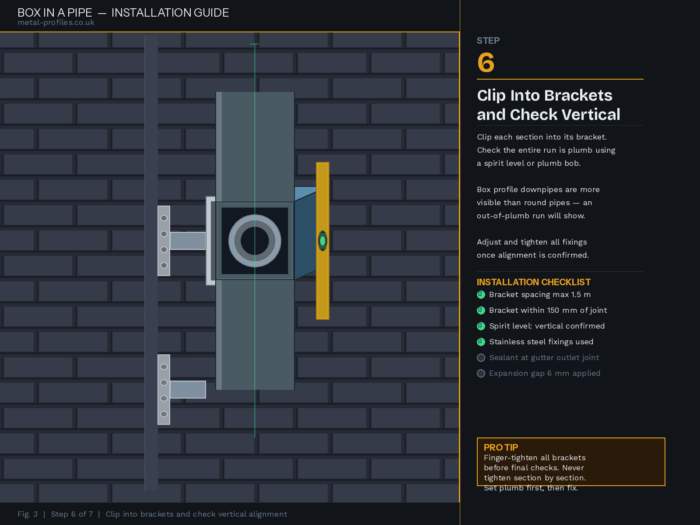
Mark bracket positions at a maximum of 1.2 to 1.5m centres along the chalk line, with a bracket within 150mm of each pipe joint. Drill and plug masonry fixings, or use suitable timber fixings if the substrate is a timber-framed facade. Use colour-coded stainless steel fasteners to match the downpipe finish and prevent bimetallic corrosion.
Cut Sections to Length
Cut aluminium box sections to the required lengths using a fine-tooth hacksaw or a circular saw fitted with a metal-cutting blade. Clamp the section firmly before cutting. Deburr all cut ends with a file or deburring tool; sharp aluminium edges are a common cause of minor injuries on site.
Fit the Top Connection to the Gutter Outlet
Slide the top section of box downpipe into the box gutter outlet. The outlet should have been installed during the gutter installation phase. Apply a bead of coloured sealant around the joint and press the downpipe home. Leave a 6mm expansion gap if the product guide specifies this for thermal movement.
Join Sections Using Couplers
Slide the proprietary aluminium coupler over the lower end of the upper section. Apply sealant and push the next section up into the coupler from below. Do not fully tighten any fixings until all sections are aligned; correct the plumb first.
Clip Into Brackets and Check Vertical
Clip each section into its bracket. Check the entire run is plumb using a long spirit level or plumb bob. Box profile downpipes are more visible on a building face than round downpipes, so an out-of-plumb run will be noticeable. Adjust and tighten all bracket fixings once you are satisfied with the alignment.
Install Offsets and the Shoe at Ground Level
Fit any offset bends required to bring the downpipe in line with the drainage connection. At the base, fit a downpipe shoe or bend to direct water into the surface drain or gully. Seal all connections and ensure the shoe is properly secured.
Common mistake to avoid: Do not over-apply sealant at joints. Excess sealant squeezed out of a joint can trap debris, cause staining, and make future maintenance more difficult. A neat 8mm bead, consistently applied, is all that is needed.
Industrial Applications of Box in a Pipe Systems
Beyond the typical domestic or light commercial context, box in a pipe solutions feature extensively across a wide range of industrial and infrastructure applications. The combination of structural rigidity, corrosion resistance, and low maintenance makes aluminium box sections the preferred choice for building services professionals and facilities managers alike.
Manufacturing and Warehousing
Large industrial sheds and distribution warehouses generate enormous volumes of surface water from their flat or low-pitch roofs. Box profile downpipes, often in sizes from 100x100mm upwards, carry this water efficiently to the drainage network. Their rectangular cross section makes it straightforward to run them internally through the building envelope or in vertical service ducts where a round pipe would require bespoke fitments.
District Heating Networks and Heat Pump Installations
District heating schemes and heat pump installations increasingly use external aluminium boxing to protect and conceal distribution pipework between plant rooms and individual properties. The aluminium box section provides weather protection, reduces heat loss, and gives the building a professionally finished appearance. As the UK continues its move towards heat network infrastructure, this application is growing rapidly.
Key advantages in heat pump applications:
- Non-combustible: aluminium meets fire safety requirements for residential buildings
- Low thermal mass: does not significantly affect the thermal performance of the pipe system
- Powder coat finish: protects against UV degradation in exposed locations
- Recyclability: aligns with the sustainability credentials of renewable heat systems
Social Housing Refurbishment
Housing associations and local authorities across England and Wales use aluminium pipe boxing extensively on external wall refurbishment and re-piping programmes. Gas meter boxes, heating riser pipes, and communal hot water services all require tidy, durable boxing on exposed elevations. Aluminium is specified in preference to timber MDF because it does not rot, does not require painting on site, and can be colour matched to the new external cladding system.
Schools, Hospitals, and Public Buildings
Public buildings face particular scrutiny on fire safety and hygiene grounds. Aluminium is non-combustible and classified as A2 reaction to fire, meaning it meets the requirements of the updated Building Regulations guidance on external wall systems introduced following the Grenfell Tower Inquiry. For healthcare environments, the smooth powder coat surface is easy to clean and does not harbour bacteria in the way that timber boxing can.
Reference: For fire safety requirements on external wall materials in buildings over 18m, see Approved Document B (Fire Safety) from the Ministry of Housing, Communities and Local Government.
Telecommunications and Utilities
Utility companies and telecoms providers regularly install aluminium box sections to protect cables and conduit where they transition from underground to above-ground services. The box section provides impact protection in locations vulnerable to vehicle or pedestrian contact and conceals the service entry point for a clean, professional finish.
Aluminium vs Other Materials: Which Should You Choose?
The market for box in a pipe solutions includes aluminium, steel (mild, galvanised, and stainless), UPVC, and timber-based products. Each has its place, but for external applications on UK buildings, aluminium dominates for good reasons.
| Material | Corrosion Resistance | Weight | Life Expectancy | Best For |
|---|---|---|---|---|
| Aluminium | Excellent (natural oxide layer) | Low | 40+ years | External building applications, rainwater goods |
| Mild Steel | Poor (must be coated) | High | 15-25 years (coated) | Internal structural applications |
| Galvanised Steel | Good | High | 25-35 years | Industrial structures, agricultural buildings |
| UPVC | Good | Very low | 20-30 years | Domestic round downpipes, budget projects |
| Timber / MDF | Poor (rots in moisture) | Medium | 5-15 years | Internal pipe boxing only |
As the table shows, aluminium offers the best overall balance for external box in a pipe applications. It is significantly lighter than steel (reducing structural load on brackets and wall fixings), naturally resistant to corrosion without the need for galvanising, and can be recycled at the end of its service life with no loss of material quality.
Explore the full range: Visit our product shop to browse aluminium box gutters, fascia, soffit, and coping systems that coordinate with box profile downpipe installations.
Maintenance, Sustainability and Long-Term Performance
Maintenance Requirements
One of the most compelling arguments for aluminium box profile downpipes is how little maintenance they demand. Unlike cast iron, aluminium does not rust. Unlike UPVC, it does not become brittle in low temperatures or discolour in UV light. A well-installed aluminium box downpipe in a quality powder coat finish typically needs nothing more than an annual inspection and a wash-down every few years to maintain its appearance.
When inspecting, check for debris accumulation at the base of sections, check that brackets have not worked loose (a particular risk on facades subject to high wind), and check that sealant joints remain intact at gutter outlet connections. For buildings subject to Building Safety Act requirements, maintain records of downpipe condition as part of your building safety case documentation.
Sustainability Credentials
Aluminium is one of the most sustainable structural materials available. Around 75% of all aluminium ever produced is still in active use today, and approximately 35% of the aluminium in circulation has already been recycled at least once. The recycling process uses only around 5% of the energy required to produce primary aluminium, making it highly energy-efficient.
For projects seeking BREEAM credits or pursuing a net-zero carbon construction target, specifying aluminium box downpipes and related rainwater goods contributes positively to the materials sourcing and end-of-life recyclability criteria.
Further reading: Our post on durable aluminium guttering explores the lifecycle cost advantages of aluminium over UPVC and cast iron rainwater systems in more detail.
Frequently Asked Questions
-
What does “box in a pipe” mean in construction?
In UK construction, “box in a pipe” commonly refers to either a box profile (rectangular cross-section) downpipe used in rainwater drainage systems, or the practice of concealing a round pipe inside a square or rectangular aluminium casing. Both applications use box-shaped metal sections to manage, protect, or disguise pipework.
-
What is a box profile downpipe?
A box profile downpipe is a rectangular hollow aluminium section used to carry rainwater from guttering down to ground-level drainage. Unlike round downpipes, box profile versions offer a clean, architectural appearance and connect neatly to box gutter outlets, making them popular on commercial, industrial, and contemporary residential buildings.
-
What size box section is needed to fit around a standard round pipe?
For a standard 68mm round downpipe, a 75x75mm or 80x80mm square hollow section will typically provide enough clearance. Always allow at least 10mm of clearance on each side to accommodate thermal movement and to allow access for future maintenance. If the pipe is lagged or insulated, increase the box section size accordingly.
-
Is aluminium or steel better for boxing in external pipes?
Aluminium is generally the preferred choice for external pipe boxing in the UK. It is naturally corrosion-resistant, lightweight, and can be powder coated in any RAL colour. Steel offers greater structural strength but requires galvanising or coating to resist rust in exposed environments. For rainwater and building facade applications, aluminium is the industry standard.
-
Can I use a box profile downpipe with a half-round gutter system?
Yes, but you will need a suitable adaptor or transition outlet. Box profile downpipes are most naturally paired with box gutters via a box gutter outlet. Connecting them to half-round or OG gutters is possible with the right fitting, but you should confirm compatibility before ordering. Contact our team if you need guidance on the correct adaptor for your situation.
-
Are box profile downpipes suitable for listed buildings or heritage projects?
Round or ogee downpipes are typically specified for heritage and listed building projects because they replicate the appearance of traditional cast iron. Box profile downpipes are best suited to contemporary, commercial, and industrial builds. Always consult your local planning authority before specifying on a listed or conservation area property.
-
How long does an aluminium box downpipe last?
A properly installed, powder-coated aluminium box profile downpipe can last in excess of 40 years with minimal maintenance. Aluminium does not rust, resists UV degradation, and holds its colour well when powder coated to external-grade specification. This makes it a significantly better long-term investment than UPVC, which typically requires replacement after 20 to 30 years.
-
Can box profile downpipes be painted or recoloured after installation?
Technically yes, but it is rarely necessary or advisable. Powder coat finishes applied in a factory environment are significantly more durable than site-applied paint. If a colour change is required, the most effective approach is to order new sections in the desired RAL colour rather than attempting to repaint existing ones. For touch-up of minor scratches, use a matched touch-up paint from the original supplier.
Summary: Getting Box in a Pipe Right First Time
Whether you need a box profile downpipe to carry rainwater from a flat-roof extension, or you are boxing in a gas riser on the outside of a block of flats, getting the specification right from the outset saves considerable time and expense later. The key points to carry away from this guide are these: choose aluminium for any external application; size the box section correctly for the pipe or the drainage catchment; allow for thermal movement and access at joints; use colour-coded fixings and sealant; and install with proper bracket spacing to prevent sagging over time.
At Metal Profiles Ltd, we supply aluminium box gutters, downpipes, fascia, soffit, coping and a full range of accessories to contractors, architects, and self-builders across the UK. If you have a project in mind and are unsure which specification is right for it, our team in Chelmsford is happy to help. You can browse our full product range or read more of our technical guides below.
You might also find useful:
- Box Gutter Guide for Roofing Professionals
- How Much Do Gutters Cost? A UK Price Guide
- The Essential Shapes of Metal Profiles Explained
- How to Install Aluminium Coping: A Step-by-Step Guide
Discover more from Metal Profiles Ltd
Subscribe to get the latest posts sent to your email.