



A bare patio edge, an empty entrance, or a plain courtyard often looks unfinished until planting gives it structure and purpose. That is where metal planters can make a strong difference, because they help define a planting zone while also shaping how the wider space feels. The best result, however, depends on more than visual style alone. Material choice, planter size, drainage planning, plant type, location, exposure, colour coordination and the surrounding outdoor setting all influence whether a planter works well in practice. For homeowners, gardeners, landscapers, builders, architects, hospitality venues, property managers and commercial specifiers, metal planters uk are often chosen because they can support both design intent and project function. Metal Profiles Ltd supplies and fabricates metal planters in Chelmsford, Essex, and the right choice may vary depending on whether the planter is for a private garden, a roof terrace, a hospitality setting or a commercial landscape scheme. This guide explains the main decisions in a practical way so that the final selection is more carefully matched to the space.
Why Metal Planters Have Become Popular for UK Outdoor Spaces
Metal planters are often considered because they can suit a wide range of outdoor settings without looking overly decorative or temporary. They can provide a clear visual edge for planting, help divide seating areas from circulation routes and add a more tailored finish to gardens and commercial exteriors. In many cases, they are chosen for their ability to sit comfortably alongside paving, timber, brick, render, stone and architectural metalwork.
For metal garden planters uk buyers, the appeal is not only appearance. The planter may need to fit a wall line, define an entrance, protect a patio edge or provide structure in a space that has little existing planting. In these situations, metal planters for gardens are often selected as part of the landscape design rather than as isolated decorative pieces.
They are also popular where repeat forms are needed. Outdoor metal planters uk can be used in pairs, rows or coordinated groups, which is helpful for symmetrical entrances, terraces and hospitality schemes. Commercial metal planters may also be selected when a project needs a consistent look across multiple areas, especially where a site benefits from a unified colour direction and a robust visual language.
Types of Metal Planters Available in the UK
Metal planters are available in several material directions, each with a different appearance and project purpose. Reviewing metal planters available across the UK can help compare the core material options, planter formats and project-specific possibilities before making a final choice. The most suitable option should still be based on the intended setting, planting arrangement and finish direction.
Trough planters, square planters, raised beds and tall statement planters
The shape of a planter affects both planting potential and the way the space reads visually. Metal trough planters are often suitable where longer planting runs are needed along boundaries, seating areas or paved edges. They can work well in contemporary layouts where rhythm and repetition matter.
Square planters may be suitable where the aim is to anchor a corner, frame a doorway or create balance on either side of an entrance. Metal raised bed planters can be useful where a more substantial planting structure is needed, especially for areas that benefit from deeper soil volume or a more permanent visual presence.
Tall planters can add vertical emphasis and may help create screening, though they should still be chosen with the planting intention in mind. Metal planters for patios often need a size that feels proportionate to the surrounding furniture and hard landscaping, while metal planters for balconies may need a more careful review of access, loading and layout. Large metal planters uk are often used where a stronger architectural presence is required, but oversizing without considering the site can make a space feel crowded.
Choosing Between Corten Steel, Mild Steel and Aluminium
Selecting the right material is one of the most important decisions because each option behaves differently outdoors. The visual finish, handling characteristics and project suitability can vary considerably. That is why metal planters uk should be reviewed in relation to the site, not just the catalogue image.
Corten Steel Planters for Weathered Character
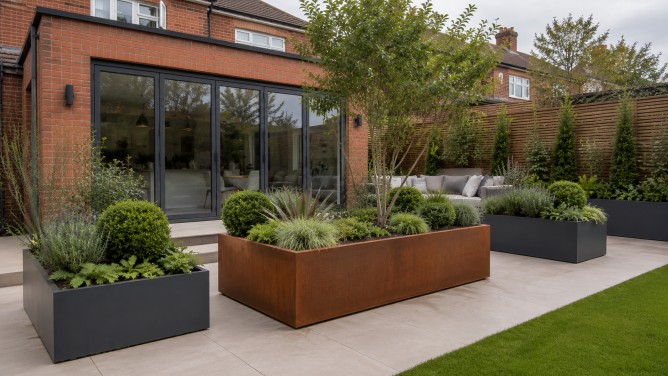
Corten steel may be considered where a naturally changing, weathered appearance suits the outdoor setting. The 3mm Corten steel planter range provides a useful reference for this material direction, including its rusted patina and standard planter formats. Early weathering run-off and the surrounding surface should still be considered before final placement.
Corten steel planters uk can work particularly well in gardens with brick, timber or stone, and they may suit planting schemes that need a warmer, more earthy tone. The surface appearance develops over time outdoors rather than arriving fully formed, so the visual change should be part of the design decision. This makes Corten steel planters suitable for spaces where a natural ageing process is acceptable and even desirable.
Powder-Coated Mild Steel Planters
Powder-coated mild steel may be considered where a controlled colour direction is more important than a weathered finish. The 3mm PPC mild steel planter range shows one route for projects that need a powder-coated steel planter with a clear external colour finish. The selected colour, location and surrounding materials should still be reviewed together.
Powder coated steel planters can suit sharp architectural settings, especially where the planter needs to coordinate with window frames, cladding or fencing. They are often chosen where a darker or more discreet appearance is preferred, but they can also be specified in lighter colours where the scheme needs contrast. As with any finish-based choice, the local exposure and maintenance expectations should be considered before final approval.
Aluminium Planters for Lighter Handling and Colour Coordination
Aluminium may be relevant where lighter handling and a coordinated powder-coated appearance are part of the wider project requirement. The 4mm PPC aluminium planter range provides a useful point of reference for aluminium planter options and available colour direction. Suitability should still be assessed against planter dimensions, planting load and the intended location.
Aluminium planters uk may be selected in settings where handling access matters, such as balconies, roof terraces or projects that require repositioning during the build phase. They can also support colour-sensitive schemes where the planter needs to sit quietly within a larger design composition. That said, aluminium should not be treated as interchangeable with steel, because the material choice still affects the overall project outcome and should be matched to the intended use.
Choosing the Right Planter Shape and Size
A planter that is too small can make planting look cramped, while one that is too large may dominate the setting or complicate access. The right dimensions depend on how the planter will be used, what is being planted and where it will sit in the wider layout. For metal planters for gardens, patios and public spaces, size should be chosen with both function and proportion in mind.
Planting depth, root space and visual proportion
Planting depth matters because different plants need different root volumes and growing conditions. Some schemes may only require shallow structure planting, while others need deeper soil space for shrubs or more substantial displays. It is not safe to assume that every metal planter suits every plant type, especially where the planter is being used for long-term planting rather than seasonal display.
Visual proportion matters too. A low planter can work well beside a seating area or along a path, while a taller form may be more suitable for creating privacy or defining an entrance. Large metal planters uk can help in open spaces where a stronger visual anchor is needed, but the size should still suit the width of the patio, terrace or boundary line. Bespoke metal planters uk may be relevant when standard dimensions do not resolve the layout cleanly.
Metal Planters for Gardens, Patios and Driveway Edges
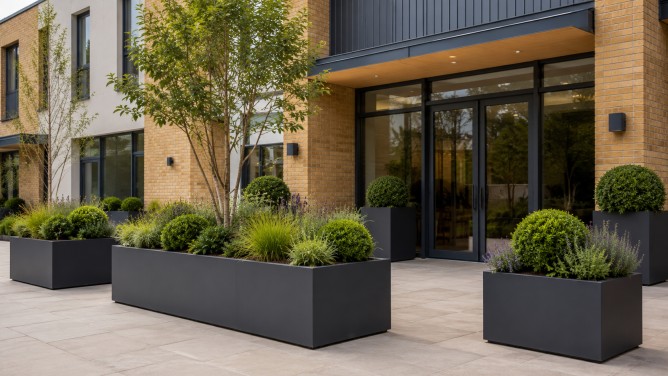
Domestic spaces often need planters that add structure without making the garden feel overdesigned. Metal planters for gardens can help separate lawn from paving, soften the edges of terraces or create a more settled transition between house and garden. They can also be used to echo the lines of brickwork, retaining walls or pergolas.
For metal planters for patios, the planter should feel integrated with the seating zone rather than placed as an afterthought. A rectangular trough may help define a sitting area, while a pair of square planters can frame a threshold or create balance beside doors. For driveway edges, planters may be used to introduce planting where hard surfacing would otherwise dominate, but placement must still allow for vehicle movement, visibility and access.
Metal planters uk are often most effective when the planting choice and the hard landscaping are considered together. A strong planter can look underwhelming if the surrounding paving, edging and furniture are not coordinated. Equally, even a simple form can look highly resolved when it is positioned carefully and filled with the right planting mix.
Metal Planters for Terraces, Balconies and Roof Gardens
Balcony and terrace projects often require more careful judgement because the planter is part of a layered outdoor environment. Metal planters for terraces can define seating areas, screen neighbouring views or introduce seasonal structure where planting opportunities are limited. Metal planters for balconies may need to be narrower or lighter in appearance, depending on the available space and access route.
Roof gardens and upper-level outdoor areas usually need more project-specific review because they involve more than the planter itself. Loaded weight, substrate, access and structural requirements should be checked with the relevant project professional where required. A planter that suits a ground-level courtyard may not be appropriate in an elevated setting without that extra assessment.
Weight, access and surface planning considerations
Weight should be considered together with planter size, planting medium and the building or deck structure beneath it. This is particularly important where planters are delivered to upper floors, lifted through narrow routes or arranged on paving that has defined loading limits. Access can also influence the preferred shape, because long troughs or oversize forms may be difficult to position once filled.
Surface planning matters as well. Placement and drainage planning should be reviewed before the planter is filled, because later adjustments can be awkward once planting has begun. Metal planters for balconies and roof terraces may need a more cautious specification process than garden planters at ground level, especially if the scheme is intended to stay in place for many years.
Drainage, Planting and Seasonal Container Care
Drainage planning is important because container plants can be affected by waterlogging, rainfall, plant type and seasonal changes. The Royal Horticultural Society’s guidance on growing plants in containers provides useful wider context on drainage and container care. The final planting arrangement should still reflect the chosen plants, growing medium, planter position and local conditions.
How rainfall, sun exposure and plant choice can affect container planting
Drainage should be considered alongside plant type, growing medium and site conditions. Container planting can be affected by rainfall, exposure, seasonal temperatures and watering routines. A planter in a sheltered courtyard will not behave in the same way as one on an exposed terrace, even if the planter itself is identical.
Some plants tolerate wetter conditions better than others, while some require more free-draining media and more attentive watering. Sun-exposed positions may increase evaporation and stress, whereas shaded areas may stay damp for longer. For this reason, drainage holes, planter size and the planting medium should be reviewed together rather than treated as separate decisions. Metal planters may be used successfully in many outdoor settings, but the planting plan still needs to suit the environmental conditions.
Colour Coordination and Exterior Design Direction
Colour is often as important as material. The planter may be intended to echo windows, railings, fencing, cladding, doors, garden furniture or architectural accents. For some schemes, a restrained finish helps the planter disappear into the background. For others, contrast is part of the design idea.
Using RAL or BS colours with cladding, frames, paving and garden details
A wide range of RAL or BS colour options may be available, subject to the selected material, finish and project requirement. This can be useful where the planter needs to align with an existing palette rather than introduce a separate visual language. For example, dark tones can sit neatly beside graphite frames or contemporary paving, while lighter colours may suit cleaner and softer exterior schemes.
Colour coordination should also consider how light changes across the day. A finish that reads subtly in shade may appear more pronounced in full sun. In larger schemes, metal garden planters uk may be specified in a coordinated colour family so that entrances, courtyards and terraces feel connected rather than visually fragmented. When used thoughtfully, colour can support the planter’s role as a landscape element rather than just a container.
Bespoke Metal Planters for Non-Standard Outdoor Layouts
Not every site can be served properly by standard sizes. Bespoke metal planters uk may be relevant where a project needs exact dimensions, unusual geometry, long planting runs, corner layouts or a coordinated height across multiple areas. This is often the case in developments, hospitality spaces and carefully planned domestic gardens where the landscape must fit a precise arrangement.
Bespoke metal planters can also help when the design calls for repeated forms that align with paving joints, wall returns or entrance features. They may be suitable for transforming awkward leftover areas into planted zones that feel intentional. In some settings, a project-specific planter requirement may be the simplest way to achieve a clean result without compromising the rest of the layout.
Long runs, corner planters, raised beds and unusual site geometry
Long runs can help define boundaries and circulation, especially when paired with planting that has a repeating structure. Corner planters are often useful where a space needs visual closure or a softer transition between directions. Raised bed planters may be considered where greater height is needed or where planting should read more as a designed feature than a portable container.
Unusual site geometry, such as angled walls, stepped terraces or narrow recesses, can make standard catalogued sizes less effective. In those cases, a customised planter may be more suitable because it can respond to the architecture rather than fight against it. That is often especially relevant for metal trough planters in linear spaces or metal raised bed planters in larger planted zones.
Commercial Landscaping, Hospitality and Specification-Led Projects
Larger schemes often need planter dimensions, materials, finishes and planting layouts to be considered alongside broader exterior design decisions. NBS specification support may be useful for architects and specifiers who need to coordinate product information within a wider project documentation process. The planter selection should still be confirmed against the project drawings, site access and intended use.
Entrances, courtyards, restaurant terraces and public-facing spaces
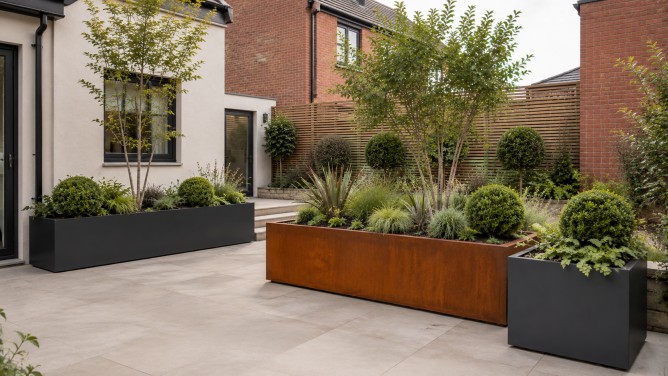
Commercial metal planters are frequently used in places where first impressions matter and where outdoor areas need to feel deliberate and robust. Entrances can benefit from paired planters or a sequence of repeated forms. Courtyards may need planters that define circulation while still allowing seating and access. Restaurant terraces often require a balance between atmosphere, durability and layout flexibility.
In public-facing spaces, the planter should support both the design language and the practical use of the site. That may mean considering how people move through the area, how furniture is arranged and how planting contributes to privacy or enclosure. Metal profiles, finish direction and the scale of the planter can all influence whether the space feels refined, busy or coherent. For these reasons, commercial landscaping enquiries often need a more detailed brief than a domestic order.
What to Prepare Before Requesting a Planter Estimate
A useful planter enquiry should include the intended planter type, overall dimensions, height, preferred material, finish direction and location. Readers with bespoke requirements can request an estimate for metal planters once they have measurements, photographs, drawings or planting-layout information available. Confirming the drainage approach and site constraints at the same stage can make the project discussion clearer.
It also helps to explain whether the planter is for a garden, patio, terrace, balcony, roof garden, entrance or commercial frontage. If the planter needs to coordinate with paving, cladding or other exterior finishes, those details should be shared as well. The more precise the information, the easier it is to assess whether a standard format or a project-specific planter requirement is more suitable.
FAQ
-
What are metal planters?
Metal planters are planting containers made from materials such as Corten steel, powder-coated steel or aluminium. They are used to create structured planting areas in gardens, patios, terraces, balconies and commercial landscapes, often where a clearer architectural finish is needed.
-
Which metal is best for outdoor planters in the UK?
There is no single best option for every site. Corten steel, powder-coated mild steel and aluminium each suit different priorities. The right choice depends on appearance, handling, colour coordination, exposure and how the planter will be used in the wider setting.
-
Are Corten steel planters suitable for patios and gardens?
Corten steel planters may be suitable where a weathered, changing finish works with the surroundings. They can suit patios and gardens, but early weathering run-off and surface conditions should be considered before placement, especially near lighter paving or finished exterior materials.
-
Are aluminium planters suitable for balconies and roof terraces?
Aluminium planters may be relevant where lighter handling and colour coordination are important. For balconies and roof terraces, loaded weight, access and structural requirements should be checked with the relevant project professional where required before final selection and installation.
-
Do metal planters need drainage holes?
Drainage holes are often an important part of container planting, but the exact approach should be reviewed with the plant choice, growing medium and site conditions. Placement and drainage planning should be considered before the planter is filled to avoid awkward changes later.
-
Can metal planters be made to bespoke sizes?
Yes, bespoke metal planters may be relevant where standard dimensions do not fit the space properly. They can help with long runs, corner layouts, raised beds and unusual geometry, especially when the planter needs to work with a specific outdoor design.
-
What information should I provide for a metal planter estimate?
Provide the planter type, dimensions, height, preferred material, finish direction, location and any drawings or photographs you have. It also helps to include drainage preferences, access issues and the intended planting use so the project requirement can be reviewed clearly.
-
Can metal planters be used for commercial landscaping projects?
Yes, metal planters can be considered for commercial landscaping, hospitality terraces, entrances and public-facing spaces. They are often used where repeated forms, coordinated finishes and clear site organisation are needed, subject to the selected material and project detail.
Metal Profiles Ltd supplies and fabricates metal planters, aluminium roofline products and architectural metalwork for UK projects. Metal planters, raised planting features and related exterior metalwork can be considered for domestic, hospitality and commercial requirements. Share your preferred material, dimensions, height, photographs, planting intention, finish preferences and project context. A wide range of RAL or BS colour options may be available, subject to the selected material, finish and project requirement. For product or project support, Contact Metal Profiles Ltd today.
Discover more from Metal Profiles Ltd
Subscribe to get the latest posts sent to your email.