


Roof Soakers: The Complete UK Guide to What They Are, How They Work, Sizing, Materials and Installation

If you have ever had a roof leak and the water turned out to be coming from where the roof meets a wall, rather than from a missing tile or a cracked ridge, there is a very good chance that the soakers were either missing, incorrectly installed, or had simply failed after years of weather exposure. Roof soakers are one of those components that nobody talks about until something goes wrong, at which point you suddenly wish someone had explained them properly the first time.
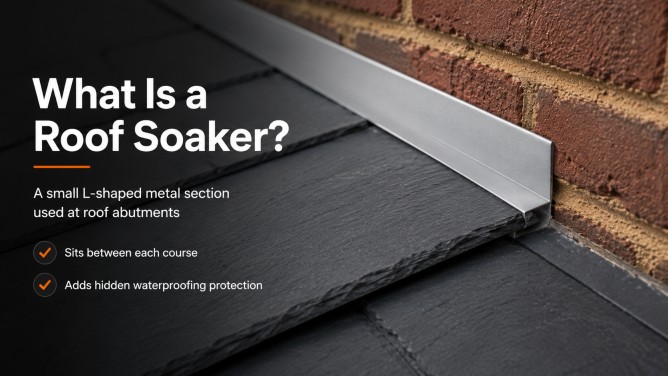
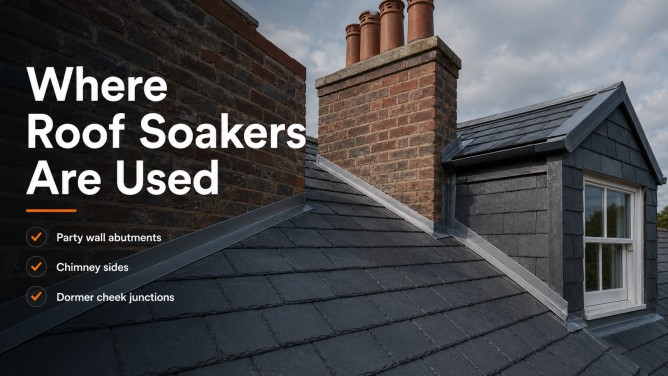
Soakers are small L-shaped metal sections that sit between each individual course of tiles or slates at abutments: the places where a pitched roof slope runs up against a vertical wall, a chimney stack, or a dormer cheek. They work as a hidden layer of waterproofing underneath the visible step flashing above, catching any water that runs sideways off the tiles at the junction and directing it safely down into the gutter rather than letting it find its way into the building structure.
They are not a complicated product. But they do need to be the right size for the tile or slate being used, they need to be installed correctly in the right order, and they need to be made from a material that will last for decades without deteriorating. Get all of that right and an abutment detail is essentially bombproof for the life of the roof. Get it wrong and you have an expensive and often difficult-to-trace leak on your hands.
This guide covers everything about roof soakers: what they are and how they actually work, the different materials available and how they compare, how to calculate the right size for your tile or slate, how to install them properly, what can go wrong and why, and what to look for if you are specifying or buying them. There is also a section on the different types beyond the standard abutment soaker, including hip soakers and valley soakers, and a full FAQ section covering the questions that come up most often.
What Are Roof Soakers? A Straightforward Explanation
A roof soaker is a small, pre-formed metal section, typically L-shaped in cross-section, that is fitted individually between each course of tiles or slates where the roof slope meets a vertical surface. That vertical surface could be a party wall on a terraced or semi-detached house, the side wall of a chimney stack, the cheek wall of a dormer window, or any other vertical structure that a pitched roof slope runs up against.
Each soaker has two parts: a horizontal section (sometimes called the tail) that lies flat under the tile or slate, and a vertical section (called the upstand) that presses against the wall face. The soaker sits in between adjacent tiles in each course, hidden completely beneath the tile covering above it. From the outside you cannot see the soakers at all: what you see is the step flashing, which is the visible metal flashing that laps down over the upstands of the soakers and is tucked into the mortar joints of the wall above.
Why soakers and step flashings work together
Soakers and step flashings are a two-part waterproofing system, not a single element, and understanding why both are needed is the key to understanding how abutment waterproofing actually works.
Rain that falls on a pitched roof does not just run straight down the slope. On a sloped surface with individual tiles or slates laid side by side, water also runs sideways, particularly in driving rain, and this lateral water movement is most problematic right at the edge of the roof where it meets a vertical wall. Without any protection at the junction, water running sideways off the tiles would find its way between the tile edge and the wall, and from there into the wall construction below.
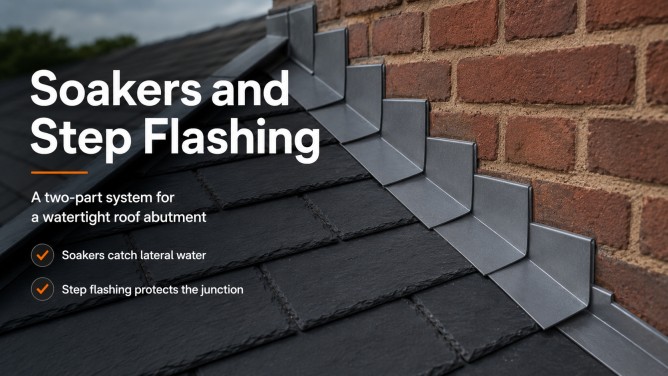
The soaker catches this lateral water. Because the soaker upstand presses against the wall face, any water running sideways off the tiles hits the upstand and is deflected downward. Successive soakers in each course overlap the one below, creating a continuous stepped waterproof layer running down the abutment. The step flashing above then covers the upstands of the soakers, overlapping each one by at least 65mm, and is tucked into the mortar courses of the wall to keep it in place.
Neither element alone is sufficient. Soakers without a step flashing would leave the upstands exposed to wind-driven rain. A step flashing without soakers would have no mechanism to catch the lateral water running off the tile surface below the flashing line. Together, they create a robust, self-draining waterproof detail that has been used on British roofs for well over a century.
Where soakers are not used: single-lap interlocking tiles
It is important to know that traditional abutment soakers are not suitable for all roof tile types. They work specifically with double-lap tile and slate products: plain tiles, natural slates, fibre cement slates, and similar flat two-layer products where each tile overlaps the one two courses below it. In this construction, the soaker sits between the two overlapping tile layers and is held firmly in place by the weight of the tile above.
Single-lap interlocking tiles (concrete interlocking tiles, clay pantiles, large-format single-lap tiles) cannot use traditional soakers because the tile geometry does not create the double overlap needed to support and conceal the soaker. With interlocking tiles, the abutment waterproofing is achieved using either a cover flashing alone (which works because the profiled tile shape prevents water from running sideways between the tile and flashing) or a secret gutter (also called a continuous soaker), which is a trough-shaped section that runs the full length of the abutment under the tiles, collecting lateral water and draining it to the gutter.
| Roof tile abutment waterproofing: Traditional individual soakers with step flashing are for double-lap products only (plain tiles, natural slates, fibre cement slates). Single-lap interlocking tiles need a cover flashing or continuous secret gutter. Using the wrong method for the tile type is one of the most common causes of persistent abutment leaks on UK roofs. |
Materials for Roof Soakers: Lead, Aluminium, and the Alternatives
Soakers can be made from several different metals and materials. The right choice depends on the application, the budget, the site conditions, and in some cases the requirements of the building or local planning authority. Here is how the main options compare.
Lead soakers
Lead has been the traditional material for roof soakers since the practice began, and for good reason. Code 3 lead (which is 1.32mm thick) is the standard specification for soakers used with plain tiles, and Code 4 (1.80mm) is often used for slates where the thinner tile sections require a slightly more robust soaker. Lead is extremely malleable, which makes it easy to form and dress in tight spaces. It is self-sealing around small penetrations, genuinely long-lasting (Code 3 lead soakers have a service life of 50 to 60 years or more in most UK conditions), and it is the material that most qualified lead workers and roofers are most familiar with.
The disadvantages of lead are cost, weight, and the risk of theft. Lead prices have risen significantly over the last decade and continue to be volatile. Lead theft is a genuine practical problem on properties that are vacant for any period during roofing works. And on large re-roofing projects, the weight of lead fixings and flashings adds up, though the individual soakers are light enough that this is rarely a structural consideration.
Lead soakers to British Standard BS EN 12588 are the specification for any work on listed buildings or in conservation areas, where the local planning or heritage authority may specifically require traditional materials. On most mainstream residential and commercial re-roofing work, aluminium is now widely used as a practical alternative.
Aluminium soakers
Aluminium soakers are now the most commonly specified alternative to lead for UK residential roofing, and on many new-build projects they are the default choice. Pre-formed aluminium soakers are manufactured at 90 degrees from 0.5mm aluminium alloy sheet and are available in packs of 25 in a range of standard sizes to suit different tile and slate gauges. They are lighter than lead, easier to handle, and significantly cheaper per unit, which makes a real difference when you are fitting a soaker on every single tile course along an abutment run.
The key practical advantages of aluminium over lead are the weight saving and the cost saving. A pack of 25 aluminium soakers typically costs less than half the equivalent in lead. The 0.5mm thickness is thinner than lead Code 3 (1.32mm) but aluminium soakers are stiffened by the 90-degree pre-form and hold their shape well in the typical locations where soakers are used. Aluminium does not corrode in most UK environments, forming a self-protective oxide layer in the same way as aluminium wall coping and flashings.
One specific limitation worth knowing: aluminium soakers should not be used on buildings in coastal locations with direct salt air exposure, or in highly acidic or alkaline environments such as those found near some industrial processes. Salt accelerates corrosion of aluminium alloys in marine atmospheres. In these locations, lead soakers remain the more appropriate specification, or zinc soakers can be considered as an alternative.
Metal Profiles Ltd supplies aluminium roof flashings and related products for abutment details. See our aluminium roof flashing external corner and aluminium roof flashing 90-degree internal corner products, which are used for the step flashings that work above the soakers.
Zinc soakers
Zinc is a traditional roofing metal with a long history of use on UK buildings, particularly on Victorian and Edwardian commercial buildings and on churches and institutional buildings. Zinc soakers are more commonly specified on heritage restoration projects where zinc is the primary roofing metal, and on buildings where the architect has specified a zinc roofline package. Zinc has excellent corrosion resistance and a service life comparable to lead in most UK environments. It is more expensive than aluminium but less expensive than lead, and it is stiffer and more difficult to form than either.
GRP and synthetic soakers
Glass reinforced polymer (GRP) and other synthetic materials are used for some proprietary soaker systems, particularly the continuous soaker (secret gutter) products designed for single-lap tile abutments. Individual GRP soakers are also available for use with certain tile systems as part of manufacturer-specific abutment kits. GRP soakers are lightweight, chemically inert, and unaffected by the marine atmosphere conditions that limit aluminium. They are particularly useful on coastal buildings or in situations where metal soakers of any kind are considered problematic.
| Material | Thickness | Durability | Best for | Avoid for | Notes |
| Lead (Code 3) | 1.32mm | 50-60 years | All standard tile and slate roofs, heritage, conservation | Coastal (theft risk); high cost projects | Traditional spec; BS EN 12588 required for listed buildings |
| Lead (Code 4) | 1.80mm | 60+ years | Natural slate (recommended over Code 3) | Budget-sensitive projects | Thicker for durability on slates where tile courses are thinner |
| Aluminium | 0.5mm | 30-40 years | Most residential and commercial new-build and re-roof | Direct coastal / marine atmosphere exposure | Most popular alternative to lead; lightweight and cost-effective |
| Zinc | 0.65mm | 40-50 years | Heritage, zinc roofline specs, Victorian restoration | Budget-sensitive projects | Good durability; more rigid than lead to form on site |
| GRP synthetic | Variable | 20-30 years | Coastal buildings, marine atmosphere, some manufacturer systems | Traditional or heritage specifications | Chemically inert; suits locations where metal corrosion is a concern |
Types of Roof Soakers: Abutment, Hip, and Valley
The word soaker in roofing actually covers a few different applications beyond the standard abutment soaker described above. Here is a quick rundown of each type.
Abutment soakers (standard)
These are the standard soakers described throughout this guide: individual L-shaped sections, one per tile course, at a side abutment where the pitched roof slope meets a vertical wall. This is by far the most common application and what most people mean when they refer to roof soakers without further qualification. The horizontal tail goes under the tile and the upstand presses against the wall, with a step flashing covering the upstands from above.
Hip soakers
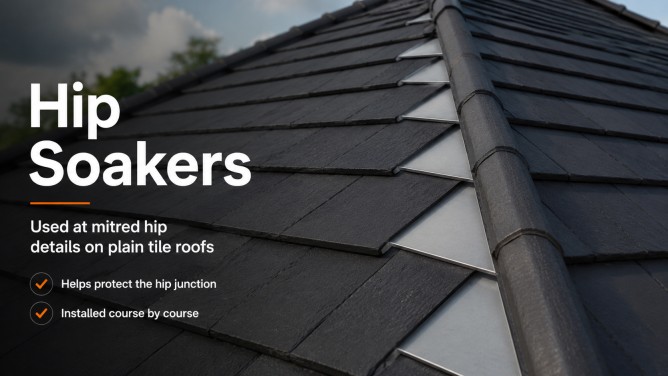
Hip soakers are used at mitred hip details on plain tile roofs. A hip is the angled ridge where two roof slopes meet at an external corner. When plain tiles are used in a mitred hip detail (where the tiles on each slope are cut at 45 degrees to meet neatly at the hip line without a separate hip tile), a soaker is required on every tile course at the hip to prevent water penetrating the mitred joint.
Hip soakers extend at least 100mm to either side of the hip centre line and are held in position by turning over the heads of the tiles below. They are then hidden under the tiles on both slopes. According to the Roof Tile Association guidance, hip soakers are suitable for all plain tile roof pitches. They are not suitable for roof pitches below 50 degrees on valley applications (though on hips they can be used at standard pitches).
Valley soakers
Valley soakers are used at mitred valley details on plain tile roofs, where two roof slopes meet at an internal junction and the tiles on each slope are cut to meet at the valley line without a separate valley tile or valley lining. Valley soakers are placed on every tile course at the valley, extending at least 75mm on each side of the valley centre line.
It is worth noting that valley soakers are not recommended for all situations. The Roof Tile Association specifically states that valley soakers are not recommended on roof pitches below 50 degrees, on valleys longer than 6 metres, or in locations where water discharged from other roof slopes flows into the valley. In those cases, a traditional open valley with a lead valley lining or a manufactured valley trough is more appropriate.
Continuous soakers (secret gutters)
A continuous soaker is not an individual L-shaped section but rather a trough-shaped channel that runs the full length of an abutment under the tiles. It is the correct waterproofing method for side abutments with single-lap interlocking tiles, where individual soakers cannot be used because the tile construction does not create the double overlap needed to support a soaker. The continuous soaker acts as a concealed gutter at the base of the wall, collecting water that runs sideways off the tiles and draining it to the eaves.
Continuous soakers are available in lead, aluminium, GRP, and other materials. The trough extends at least 75mm up the wall face and is covered by a step flashing. The tiles finish close to the wall with a maximum 15mm gap to prevent bird and rodent access. On profiled tiles, a cover flashing alone (without a continuous soaker) may be adequate because the tile profile prevents lateral water movement, but for flat single-lap tiles, the continuous soaker is the correct specification.
How to Size Roof Soakers Correctly: The Calculation Explained
Sizing soakers correctly is genuinely important. A soaker that is too short will not provide adequate coverage under the tile. A soaker with an upstand that is too short will not provide adequate protection against wind-driven rain. Here is exactly how to work out the right size.
Soaker length: tile gauge plus headlap plus turn
The length of the horizontal tail of the soaker is calculated from two measurements: the gauge of the tile or slate, and the headlap of the tile or slate.
The gauge is the exposed length of each tile or slate course, measured from the top of one tile to the top of the next tile below it. For standard plain tiles this is typically 100mm. For natural slates the gauge varies depending on the slate size.
The headlap is the overlap at the head of each tile, where the tile above overlaps the tile two courses below it. For plain tiles the minimum headlap is typically 65mm. For slates it varies with pitch and exposure.
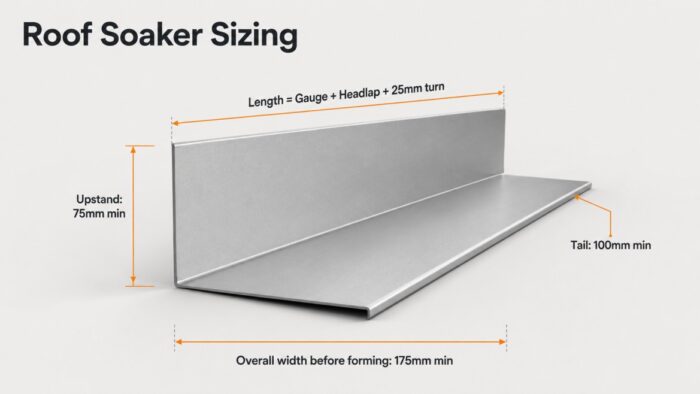
The soaker length formula is: Soaker length = Gauge + Headlap + 25mm (turn over the head of the tile)
So for standard plain tiles with a 100mm gauge and 65mm headlap: soaker length = 100 + 65 + 25 = 190mm.
That 25mm addition is a short fold over the head of the tile, which prevents the soaker from sliding out from under the tile course above it during handling or before the tiles are laid. It is a small but important detail.
Soaker width: horizontal tail and upstand
The width dimension of the soaker has two parts. The horizontal tail (the part that lies under the tile) should be at least 100mm wide. The upstand (the part that presses against the wall) should be at least 75mm to 100mm high. These are the minimum dimensions given by industry guidance and BS 5534 (the British Standard for slating and tiling).
The overall material width before forming is therefore: tail (100mm minimum) + upstand (75mm to 100mm minimum) = 175mm to 200mm minimum total width, before the 90-degree fold is formed.
| Tile / slate type | Gauge | Headlap | Soaker length | Pre-formed size | Upstand |
| Plain tiles (standard) | 100mm | 65mm | 190mm | 150mm x 100mm (approx) | 75mm min |
| Plain tiles (exposed) | 90mm | 75mm | 190mm | 150mm x 100mm (approx) | 100mm min |
| 500mm x 250mm slates | 265mm | 25mm min (pitch-dependent) | 315mm | 280mm x 100mm (approx) | 75mm min |
| 600mm x 300mm slates | 330mm | 25mm min (pitch-dependent) | 380mm | 330mm x 100mm (approx) | 75mm min |
| Fibre cement slates | Varies by size | As manufacturer spec | Gauge + headlap + 25mm | Match to gauge | 75mm min |
| Bespoke / non-standard | Measure on site | Measure on site | Gauge + headlap + 25mm | Fabricate to order | 75-100mm |
| Tip: If you are not sure of the gauge or headlap on an existing roof you are repairing, measure from one tile nail hole to the next down the slope (this gives you the gauge), and count the number of tiles visible per metre of rafter length. Cross-check against the manufacturer’s specification for the tile type if you can identify it. Getting the gauge right ensures the soakers are the correct length for the specific roof they are going on. |
How many soakers do you need?
The number of soakers required for an abutment run is equal to the total number of tile or slate courses along the abutment. Count the courses from the eaves to the ridge on the abutment side of the roof, and that is your soaker count. Add 10 percent for waste, cutting, and any courses that need to be adjusted during installation.
Soakers are usually sold in packs of 25, so round up to the nearest 25 after adding the waste allowance. For a typical single-storey side abutment on a standard UK semi-detached house with plain tile roof, the abutment might be 20 to 30 courses high, meaning one pack of 25 is usually sufficient for a single abutment. A two-storey abutment might require 40 to 50 soakers, so two packs.
How to Install Roof Soakers: A Step-by-Step Guide
Soaker installation is part of the tile laying process, not a separate operation that happens before or after tiling. Soakers go in as you tile, one per course, working up from the eaves to the ridge. Here is how it is done properly.
What you will need before you start
- Pre-formed soakers in the correct size for the tile/slate gauge and headlap (see sizing section above)
- Step flashing material: lead Code 4, aluminium flashing, or zinc flashing in the required width and length for the number of courses
- Mortar or compatible pointing compound for fixing the step flashing tails into the brick mortar joints
- Tin snips or lead knife for any on-site cutting and trimming
- Lead dresser or bending bar for forming the step flashing profiles on site if not using pre-formed sections
- Spirit level and chalk line for marking the tile lines
- Appropriate personal protective equipment for working on a pitched roof
Step 1: Establish the tile gauge and confirm soaker sizes
Before fitting any soakers, establish the tile gauge by marking out the batten positions from the eaves upward. The gauge determines the soaker length, so this step must come first. If the soakers you have on site were sized from drawings and the gauge on the actual roof does not match the drawings (which happens more often than you would expect on older properties or complex roofs), you need to know this before you start, not after half the abutment is tiled.
Lay one soaker against the tile face and check that the tail length equals the gauge plus headlap plus the 25mm turn. If it does not match, the soakers need to be replaced or, for a small discrepancy, adjusted by cutting or folding on site from sheet material. Do not proceed with soakers that are the wrong length: an undersized soaker tail will not be properly retained by the tile above and may slip out.
Step 2: Set the first course at the eaves
The first soaker goes in with the first full tile course above the eaves course. (The eaves course itself is typically a short tile or a double course, and no soaker is needed at the eaves level itself since the water at this point will run straight into the gutter.) Place the first soaker in the abutment position with the tail lying flat over the eaves batten and the upstand pressed against the wall face. The soaker sits with its lower edge level with the exposed face of the eaves tile.
The soaker is not nailed or fixed to the batten. It is held in place by the tile laid on top of it in the next step. This is an important point: soakers rely entirely on the tiles and slates above them for retention. Do not attempt to nail or screw soakers to the roof structure: if you do, the soaker cannot flex slightly with the thermal movement of the tiles and the fixings will work loose over time.
Step 3: Lay tiles and soakers alternately up the slope
This is the core of soaker installation: as you tile up the slope, place a soaker on each course in the abutment position before laying the tile above. The sequence for each course is:
- Lay the tile or slate in the penultimate position in the course (the one next to the wall)
- Place the soaker on top of this tile, with the tail lying flat and the upstand against the wall. The top 25mm of the soaker tail turns over the head of the tile below, which retains it.
- Lay the next course of tiles above. The headlap of these tiles now covers the tail of the soaker, locking it in place.
- Repeat for every subsequent course up to the ridge.
As you work up the slope, check periodically that the soaker upstands are all sitting flush against the wall and are not being pushed out of line by the tile edges. On older brick walls with an uneven face, you may need to trim or slightly fold individual soakers to maintain good contact between the upstand and the wall. A small gap between the upstand and the wall is a potential water ingress point: the upstand is there to deflect water, and it can only do that if it is actually in contact with the wall.
Step 4: Install the step flashing over the soaker upstands
Once all the soakers are installed and all the tiles are laid, the step flashing goes on last. The step flashing is a separate flashing component that covers the soaker upstands from the outside, tucking into the mortar joints of the wall above and lapping down over each soaker upstand by a minimum of 65mm. The step flashing is the only part of the soaker system that is visible from outside.
Step flashings can be formed on site from lead sheet (Code 4 is the usual specification) by cutting individual step-shaped pieces and dressing them into the mortar joints with a lead dresser, or they can be pre-formed from aluminium or other materials. The aluminium roof flashing products from Metal Profiles Ltd are designed for exactly this application: see our aluminium roof flashing external corner and aluminium roof flashing internal corner for the corner elements used where abutment flashings change direction.
The step flashing must:
- Cover each soaker upstand by at least 65mm, measured vertically
- Turn into the mortar joints of the wall by at least 25mm, or be secured with appropriate clips and caulked
- Overlap the lower step section by at least 65mm at each horizontal step
- Be dressed tightly against the wall face with no gaps for wind-driven rain to penetrate
| Never point the top edge of a step flashing into a mortar joint with hard Portland cement mortar. Portland cement mortar expands and contracts at a different rate to lead and aluminium, and it will eventually crack the flashing material or push it out of the joint. Use a flexible sand and lime mortar or a proprietary flexible pointing compound. For aluminium flashings, a silicone sealant bead after mechanical fixing is also acceptable. |
Step 5: Check the whole installation before finishing
Before signing off the abutment detail, check the following:
- All soaker upstands are pressed firmly against the wall face with no visible gaps
- The step flashing covers every upstand by at least 65mm, with no soaker upstand visible below the flashing edge
- The step flashing top edge is tucked securely into the mortar joints with no loose ends
- The steps in the flashing correspond correctly to the tile course lines: each step should be level with the top of a tile course, not mid-course
- No mortar or sealant has been allowed to bridge between the step flashing and the tile surface: this would prevent water from draining freely between the flashing and the tiles
- On a lead installation, the lead flashing has been treated with patination oil to prevent the white lead carbonate staining that fresh lead can deposit on tiles and brickwork below
A final hose test (directing a steady flow of water up the abutment from below while someone inside checks for any water penetrating the ceiling) is good practice on any abutment repair or new installation where there is any uncertainty about the quality of the soaker bedding or flashing detail.
Common Roof Soaker Failures and What Causes Them
Most roof abutment leaks that involve soakers fall into a fairly small number of categories. Knowing what the common failure modes are helps you identify problems quickly and specify the right repair.
Soakers never installed in the first place
This one sounds unlikely but is surprisingly common, particularly on roofs that were re-covered at some point between about 1970 and 1990 when shortcuts in roofing practice were arguably more widespread than they should have been. The original soakers were removed with the old tiles, a new step flashing was tucked into the wall, and the tiles were laid back up to the wall without any soakers. The result is a leak that appears to be fine in light rain but lets water in during heavy or driven rain, because the only waterproofing is the single step flashing with no soaker layer beneath it.
If soakers are missing entirely, the repair requires stripping the abutment tiles back, fitting new soakers on every course, and re-laying the tiles before re-dressing the flashing. There is no quick fix that avoids stripping the tiles.
Soakers the wrong size for the tile gauge
If the soaker tail is shorter than the tile gauge plus headlap, the top of the soaker tail sits within the exposed tile face rather than being hidden under the tile above. This means the top edge of the soaker is not retained by the tile above and the soaker can slide down the slope over time, eventually exposing the upstand junction and creating a water ingress point. Correctly sized soakers have their tail entirely hidden under the tile above with the 25mm turn holding them in place. Check the soaker length against the tile gauge before installation.
Upstands not in contact with the wall
If the upstand is not pressed firmly against the wall face, wind-driven rain can drive under the flashing and between the upstand and the wall, bypassing the soaker entirely. This is particularly likely on old rough-rendered walls, uneven stone walls, or walls that have been repointed with a surface that has projections that prevent the soaker from sitting flat. Where the wall face is very uneven, the soaker upstand may need to be dressed more carefully to the wall profile, or the wall face may need to be prepared before the soakers are fitted.
Step flashing not overlapping the soaker upstands adequately
If the step flashing only partially covers the soaker upstands, the exposed upper portion of the upstands is directly exposed to rain. The minimum specification is 65mm of overlap between the step flashing and each soaker upstand, measured vertically. On exposed or high-altitude sites, more overlap gives better protection. Check the overlap after fitting the flashing and before finishing the installation.
Mortar bridging between flashing and tiles
This is a surprisingly common cause of secondary water ingress. When the mortar used to point the step flashing into the wall joint is applied too generously, it can drip or smear onto the tile surface below the flashing and create a mortar bridge between the flashing underside and the tile. This bridge blocks the drainage path between the flashing and the tiles, causing water to pond at the flashing base and eventually penetrate. Keep mortar tight to the wall joint and wipe away any excess before it sets.
Using the wrong soaker type for the tile type
As explained earlier in this guide, traditional individual soakers are for double-lap products only. Using individual soakers on single-lap interlocking tiles will not work correctly because the tile geometry does not support the soaker. If a property has interlocking tiles and there is an abutment leak, the solution is a continuous soaker (secret gutter) or appropriate cover flashing, not individual soakers. Check the tile type before specifying the repair.
Roof Soakers and Building Regulations
Soaker installation is covered by BS 5534, the British Standard for slating and tiling, which is the primary technical reference for all UK pitched roof work. BS 5534 specifies the minimum dimensions for soakers in terms of the tail coverage and the upstand height, as well as the overlap requirements for the step flashing above.
Under Building Regulations Approved Document C (Site preparation and resistance to contaminants and moisture), roofs must be designed and constructed to prevent moisture from reaching the inside of the building. The correct installation of soakers and abutment flashings is part of satisfying this requirement. On any notifiable building work (new build, extension, or major re-roofing covered by Building Regulations), the abutment waterproofing detail must meet the BS 5534 specification.
For most like-for-like repairs to existing soakers on a domestic property, Building Regulations approval is not required, as replacing existing roofing components on a repair or maintenance basis is typically permitted development. However, if you are replacing a significant proportion of the roof covering or adding an extension that creates a new abutment, the work will be subject to Building Regulations and the soaker specification must comply.
For listed buildings and buildings in conservation areas, lead is often required for soakers and flashings rather than aluminium or other alternatives, as local planning or heritage authorities may specify traditional materials for any work on the external envelope. Always check with the local authority heritage or planning officer before specifying materials on a listed or conservation area property.
Read our guide on aluminium roof flashings for more on the technical specification of flashing products that work with soakers, and our guide to high-quality lead gutter supplies for lead products that are relevant to traditional abutment details.
Roof Soakers in Different UK Building Contexts
Residential new-build
On UK new-build residential projects, soakers are specified as part of the roofing package and are typically pre-ordered with the tiles. On most new-build properties, the plain tile or concrete interlocking tile abutment detail is part of the approved drawing package and the soaker specification follows from the tile choice. For properties with plain tiles or natural/fibre cement slates at any abutment, aluminium pre-formed soakers are the standard specification on most new-build contracts because of their cost and weight advantage over lead.
Victorian and Edwardian terraced housing
Victorian and Edwardian terraced and semi-detached houses are probably the most common context for soaker repairs and replacements in the UK. Most of these properties have natural Welsh slate or plain tile roofs, with side abutments at the party wall on at least one side. The original soakers (where they were fitted at all) are lead, often more than 80 or 100 years old. When soakers of that age fail, they typically do so because the lead has corroded through at the fold line or has been damaged during previous roofing works.
On a Victorian property with a natural slate roof, the repair specification should use Code 3 or Code 4 lead soakers (Code 4 for slates, as noted above) or aluminium soakers of the correct size for the slate gauge. If the property is in a conservation area, check with the local authority before substituting aluminium for lead. If the party wall is an uneven rubble or rough-rendered surface, dress each soaker upstand carefully to the wall profile before tiling.
Commercial buildings with extension abutments
Commercial properties with pitched roofs that adjoin existing buildings or have extensions creating new abutments need exactly the same soaker waterproofing detail as residential properties. The specification may specify aluminium or lead soakers depending on the tile type and the project specification. On commercial projects where the roofing contractor submits a specification for approval, the soaker specification should reference BS 5534 and specify the minimum tail coverage and upstand dimensions clearly.
For commercial projects requiring aluminium flashings at abutments, see our range of aluminium roof flashings and internal corner flashings. These are used for the visible step flashing component that caps the soaker system.
Chimney stacks
Chimney stacks are the most common single location for roof leaks in the UK, and soakers play an important role in chimney abutment waterproofing. A chimney stack has four sides: the two sides running parallel to the ridge (front apron and back gutter or cricket) and the two sides running across the slope (the soaker abutments, one on each side). Individual soakers on each course are the correct detail for the two sloped side faces, while the front apron and rear back gutter use a different, separate waterproofing detail.
On a chimney repair, it is worth checking all four faces of the chimney waterproofing detail when investigating a leak. Water that appears to be coming from a side soaker abutment sometimes originates from the front apron flashing or the back gutter detail and is simply tracking sideways inside the roof before emerging at a point that makes it look like a soaker failure. Hose testing each face of the chimney in isolation is the most reliable way to identify where a chimney leak is actually originating.
Dormer window cheeks
Dormer windows are a very common source of roof leaks on UK residential properties, and the soaker detail on the dormer cheeks (the sloped sides of the dormer where the dormer meets the main roof slope) is a frequent culprit. The soaker specification for a dormer cheek is the same as for any other side abutment: individual soakers on each tile course with a step flashing above. The challenge with dormers is often the geometric complexity of the cheek-to-main-roof junction and the limited working space, which makes it harder to dress soakers and flashings correctly on site.
Frequently Asked Questions: Roof Soakers
-
What are roof soakers?
Roof soakers are small L-shaped metal sections that are fitted individually between each course of tiles or slates at abutments: the places where a pitched roof slope meets a vertical wall, chimney, or dormer cheek. They have a horizontal tail that lies flat under the tile and a vertical upstand that presses against the wall. Water running sideways off the tiles at the abutment hits the soaker upstand and is directed downward rather than into the wall. They work together with a step flashing above, which covers the soaker upstands and is tucked into the wall’s mortar joints.
-
What is the difference between a soaker and a flashing?
Both are waterproofing components at roof abutments but they serve different roles. Soakers are hidden under the tiles, one per tile course, and catch lateral water running off the tile surface. They are not visible from outside once the tiles are laid. Flashings (specifically step flashings at abutments) sit on top of the tiles and are visible from outside. The step flashing covers the soaker upstands and is tucked into the wall above. The two work as a system: soakers provide the primary waterproofing layer and step flashings provide the secondary protective layer and the visible finish.
-
What material should roof soakers be made from?
Lead (Code 3 for plain tiles, Code 4 for slates) is the traditional specification and is required on listed buildings or in conservation areas where local authorities specify traditional materials. Aluminium pre-formed soakers at 0.5mm are the most widely used modern alternative and are lighter, cheaper, and easier to handle. Avoid aluminium in direct coastal or marine atmosphere locations where salt air can accelerate corrosion. Zinc and GRP soakers are alternatives for specific applications. For most standard UK residential re-roofing, pre-formed aluminium soakers are entirely appropriate.
-
How do I calculate the correct soaker size?
The soaker length formula is: Gauge + Headlap + 25mm. The gauge is the exposed length of each tile course (typically 100mm for plain tiles). The headlap is the overlap at the head of each tile (typically 65mm for plain tiles). So for standard plain tiles: 100 + 65 + 25 = 190mm length. The soaker width (before the 90-degree fold) should be at least 175mm: 100mm tail plus 75mm upstand as the minimum. Always confirm the actual gauge on site before ordering soakers, as the gauge varies with tile size, pitch, and specification.
-
Are roof soakers used with all types of roof tiles?
No. Traditional individual soakers are for double-lap products only: plain tiles, natural slates, and fibre cement slates. They are not suitable for single-lap interlocking tiles (concrete or clay interlocking tiles, pantiles, large-format single-lap tiles) because the tile geometry does not create the double overlap needed to support and conceal the soaker. Single-lap interlocking tiles use either a cover flashing alone (which works because the tile profile prevents lateral water movement) or a continuous soaker (secret gutter) trough running the full length of the abutment.
-
Are soakers nailed or fixed to the roof?
No. Soakers are not nailed, screwed, or fixed to the roof structure. They are held in place entirely by the tile or slate above, which locks the soaker tail under its headlap. The 25mm fold at the top of the soaker tail turns over the head of the tile below, which retains the soaker during installation before the tile above is laid. Trying to nail or screw soakers to the battens will prevent them from flexing slightly with thermal movement of the tile covering and will cause the fixings to work loose over time.
-
How long do roof soakers last?
Lead soakers (Code 3 or Code 4) have a service life of 50 to 60 years or more in most UK conditions and typically outlast the roof covering above them. Aluminium soakers at 0.5mm have a shorter service life of approximately 30 to 40 years, which is still long enough to outlast most tile roof coverings between major re-roofing works. In practice, soakers are usually replaced when the roof covering above is stripped and re-laid, rather than as a standalone operation. The step flashing above the soakers often fails before the soakers themselves do, as it is exposed to the weather while the soakers are protected.
-
Do I need planning permission to replace soakers?
In most cases, replacing soakers as part of a like-for-like repair or maintenance operation on a domestic property is permitted development and does not require planning permission. However, if the property is listed, any change to the external envelope including roofing details requires listed building consent. In conservation areas, changing the soaker material (for example from lead to aluminium) may require approval. When in doubt, check with your local planning authority. On any new extension that creates a new abutment, the soaker detail is covered by the Building Regulations application for the extension.
-
Can aluminium soakers be used on a conservation area property?
This depends on the specific conservation area designation and the policy of the local planning authority. Some conservation areas specify that all metal roofing accessories including soakers and flashings must be lead, particularly on buildings that would otherwise have had lead details originally. Others are more flexible and permit aluminium as a practical alternative on non-visible roofing details. The safest approach is to check with the local authority’s planning or conservation officer before committing to the specification. If lead is required, use Code 3 (for plain tile roofs) or Code 4 (for slate roofs) to British Standard BS EN 12588.
-
What is a continuous soaker and when is it used?
A continuous soaker (also called a secret gutter) is a trough-shaped channel that runs the full length of an abutment under the tiles, collecting water and draining it to the gutter. Unlike individual soakers which work one per tile course, a continuous soaker is a single long channel. It is used at side abutments with single-lap interlocking tiles, where traditional individual soakers cannot be used because the tile geometry does not support them. It can also be used as an alternative to individual soakers with plain tiles and slates where a continuous channel is preferred by the specifier.
Discover more from Metal Profiles Ltd
Subscribe to get the latest posts sent to your email.