


The top of a wall is one of the most exposed parts of any building. It catches rain falling directly from above, absorbs wind-driven water from the side, and has no shelter from the sun. Yet it is also one of the most overlooked details in construction. A lot of builders and homeowners spend considerable time thinking about the walls themselves, the roofing, the windows, and then put something on the top of the parapet or garden wall more or less as an afterthought.
That tends to be an expensive oversight. Water that gets into the top of a masonry wall travels downward through the structure, causing cracking from frost, damp patches internally, staining on the face of the wall, and in serious cases, structural deterioration. Getting the capping right from the start is a lot cheaper than dealing with the consequences of getting it wrong.
Aluminium capping is one of the most practical and long-lasting solutions available. It is lightweight, comes in any colour, does not rot or rust, and handles the thermal expansion cycles that kill lesser materials over time. This guide covers everything you need to know: what aluminium capping is, how it differs from coping, the types available, the applications it suits, how to install it properly, and what separates a well-specified capping system from one that causes problems a few years down the line.
What Is Aluminium Capping?
Aluminium capping is a protective covering installed along the top of a wall, parapet, pier, or other raised masonry element. Its job is to shed water away from the top surface of the wall and prevent ingress into the masonry, concrete, or blockwork below. It also gives the wall a finished, professional appearance.
The word capping is quite broad. In construction, it is used to refer to anything that covers the top of a vertical element. So you get wall capping (covering the top of a long run of boundary or parapet wall), pier capping (the cap that sits on top of an individual pier or column), and roof capping (covering the ridge or apex of a pitched roof structure).
Aluminium is a particularly good choice for all of these because it can be formed into almost any profile, powder-coated in any RAL colour, and will last for 40 to 50 years without any significant maintenance. Compare that to the timber sawn capping some builders still use, which starts degrading within a few years if it is not regularly painted, or concrete capping, which is heavy, tends to crack at the joints, and is a pain to install at height.
Aluminium capping versus aluminium coping: what is the difference?
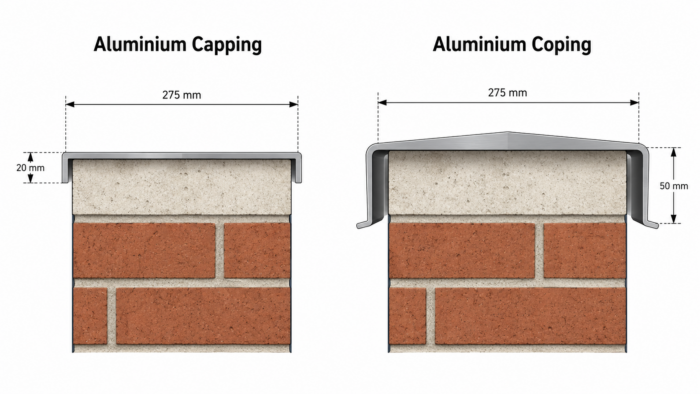
These two terms get used interchangeably in the UK construction industry, which causes a fair amount of confusion. Here is the practical difference.
Coping refers to a profile that caps the top of a wall and returns down both sides of the wall face, typically by at least 40 to 50mm. This gives it a physical overhang and a drip edge that carries water away from the face of the wall. Copings are the more protective option because water has to travel back up and under the return before it can get to the wall face.
Capping refers to a profile that sits on the top of the wall but with a shallower or no return down the wall face. It protects the top surface of the wall from direct rainfall but does not have the same physical barrier against wind-driven water tracking down the wall face.
In practice, many architects and builders use the terms interchangeably, and some products are marketed as capping when they technically function as coping. What matters practically is the profile geometry: does it overhang the wall face and provide a drip edge? If yes, it offers more protection regardless of what it is called.
Our aluminium flat coping range is a good example of a product that provides capping-style protection with the additional benefit of a coping-style return. Available in 1m, 2m, and 3m lengths, it works across both domestic and commercial applications and is the product most people are looking for when they search for aluminium capping for a parapet or boundary wall.
Types of Aluminium Capping
Aluminium capping comes in several distinct types, each suited to different applications and architectural contexts. Understanding which type you need before you order is important: the geometry of the profile needs to match both the wall it goes on and the visual outcome you are trying to achieve.
Flat Wall Capping
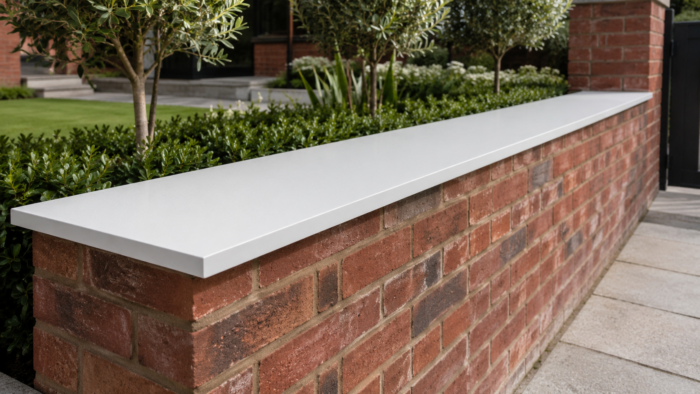
Flat capping sits horizontally on the top of a wall. The top surface is level, with returns on each side that come down a short distance over the wall face to provide a visual finish and a small degree of protection. On walls that are not particularly exposed, flat capping is a clean, modern look that works well with contemporary architecture.
The limitation of a truly flat top is that it does not actively encourage water to drain away. On a wide wall in a very wet or exposed location, water can sit on a flat capping for longer than is ideal. In those situations, a slight fall built into the installation (or a sloped profile) is a better choice.
Our aluminium flat coping in 3m lengths handles this application, and is available with purpose-made 90-degree corner pieces and 135-degree corners for changes in direction.
Sloped / Pitched Capping
A sloped or pitched capping profile has a top surface that falls to one side or to both sides from a central ridge, ensuring water drains off quickly regardless of how much rain falls. This is a more robust weatherproofing solution, particularly for wider walls, exposed locations, and anywhere the wall will be carrying a significant volume of rainwater.
On narrower walls (up to around 250mm) a single fall to one side works well. On wider walls, a dual pitch that sheds water to both sides is better because a single-fall profile on a wide wall requires the water to travel a long way before it reaches the edge, which creates more time for any joint failures to be exploited.
The aluminium sloped coping bracket from our range supports this type of installation and ensures a consistent fall is maintained along the full length of the wall, even where the wall surface itself is not perfectly level.
Secret-Fix Capping
Secret-fix capping uses a hidden fixing system: brackets are fixed to the wall or to the top of the wall before the capping sections are clicked or locked over them. No fixings are visible on the face of the capping once installed. This produces a very clean architectural look, which is increasingly specified on contemporary commercial and residential buildings where exposed fixings are considered visually intrusive.
The trade-off is that secret-fix systems are slightly more involved to install because the bracket spacing and alignment has to be right before the capping goes on. If a section needs to be removed later for any reason, it takes a bit more effort. But for a permanent installation on a building where appearance matters, it is the preferred detail.
Pier Capping
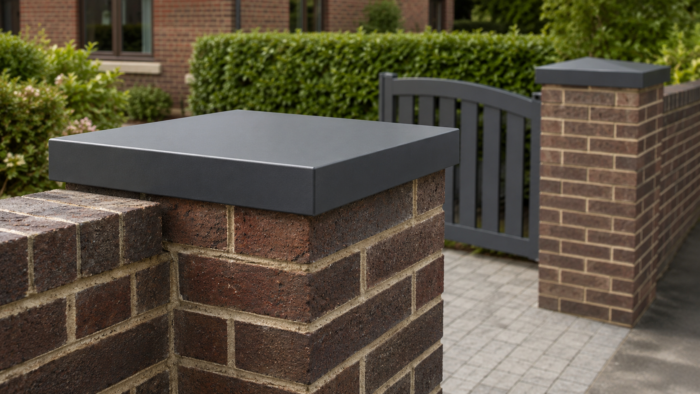
Pier capping is a specialist application. A pier or column cap is essentially a box that fits over the top of an individual masonry column, returning on all four sides rather than running as a continuous strip. It is the detail at the end of a run of garden walling, either side of a driveway entrance, at the corners of a boundary wall, or supporting a gate.
Getting pier capping right is important because piers are very exposed: they project above the general wall line, they have four exposed faces, and if the top cap does not fit properly the water gets in at the cap joint and starts working its way down through the pier. Aluminium pier caps can be fabricated to very precise dimensions, which means a proper fit with the correct return on all four sides.
Bespoke and Curved Capping
Standard rectangular capping works on straight walls. But a lot of interesting architecture does not have straight walls. Curved boundary walls, circular columns, irregular plan shapes, radius parapets on commercial buildings: all of these need capping that has been formed to match the curve.
Aluminium is one of the easiest materials to form into curved profiles. A radius can be pressed or roll-formed into a sheet, or achieved by cutting kerfs into the back face and bending the profile around the curve. Bespoke fabrication to a specified radius is available and, for curved walls, is generally the only option that gives a clean result.
Why Aluminium? Material Comparison for Wall Capping
People ask fairly regularly whether aluminium is actually worth it over cheaper alternatives. Here is an honest comparison.
| Criteria | Aluminium | Natural Stone | Concrete | Timber |
| Lifespan | 40-50+ years | 50+ years | 20-30 years | 8-15 years |
| Weight | Very light | Very heavy | Heavy | Moderate |
| Maintenance needed | None | Occasional resealing | Joint repointing | Paint every 3-5 yrs |
| Colour options | Full RAL range | Limited naturals | Painted only | Painted only |
| Thermal expansion | Managed with joints | Very low | Low-moderate | Low but rots |
| Fire classification | A2 non-combustible | A1 | A1 | C (combustible) |
| Frost resistance | Excellent | Good (dense types) | Variable | Poor (absorbs water) |
| Bespoke profiles | Easy to press/form | Difficult, costly | Difficult | Limited |
| Recyclability | 100% | Yes | Limited | Yes |
| Typical cost (supply) | £12-22/m | £30-80/m | £8-18/m | £5-10/m |
Stone looks the most impressive in that table on lifespan, but the cost and weight columns explain why aluminium has largely replaced it for new-build parapet and boundary capping. Getting stone capping to the top of a parapet wall on a three-storey building is a significant logistical exercise. Getting aluminium capping up there is a much more straightforward operation.
Timber is cheap but the maintenance reality catches up with most people within five to ten years. Paint it every few years or it starts to rot at the joints and ends. Replace it every ten to fifteen years if you are lucky. Over a 40-year period, aluminium is considerably cheaper than timber when you factor in the total cost of maintenance and replacement.
See our full post on why aluminium wall copings are the best choice for a deeper look at the material comparison, including performance in coastal and polluted environments.
Where Aluminium Capping Is Used: Applications by Building Type
Parapet Walls on Flat Roof Extensions
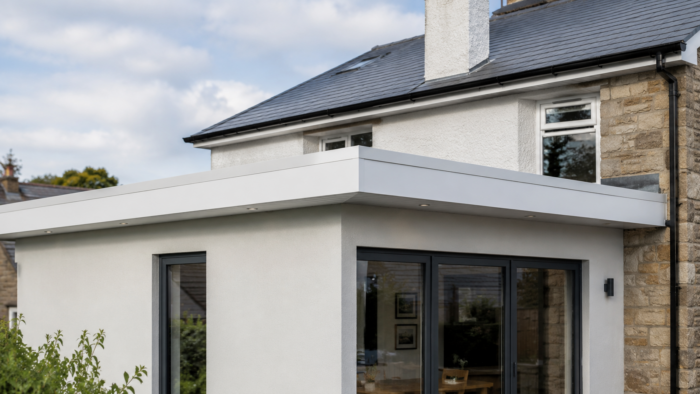
This is probably the most common domestic application. Single-storey flat roof extensions almost always have a low parapet wall running around part or all of the roof perimeter, and that parapet needs capping to prevent water getting into the masonry at the top.
The capping on a flat roof extension parapet is also visible from outside the building. A well-chosen aluminium capping in a colour that matches the fascia boards and window trims ties the whole extension together visually. A mismatched or tired-looking capping makes the whole thing look like it was finished in a hurry.
For this application, the capping also needs to be specified alongside the roofing membrane detail. Where the membrane laps up against the wall (the upstand), the junction between the membrane and the capping needs to be watertight. A colour-matched sealant at this junction and at all capping joints is an essential part of a properly finished installation.
Boundary and Garden Walls
Garden and boundary walls are different from parapet walls in one key way: they are not attached to the building structure. That means they go through larger temperature cycles (exposed on all sides to sun, frost, and wind), and there is nobody looking at them from the inside who would notice a leak developing.
On garden walling, capping is important partly for waterproofing and partly for appearance. A capped wall looks finished. An uncapped wall with a rough concrete or mortar top looks unfinished and weathers badly. In areas where there is any frost risk (which in the UK is most areas from October to April), an uncapped wall absorbs water, that water freezes, and the freeze-thaw cycle cracks the mortar and eventually spalls the masonry face.
Aluminium garden wall capping in a matching or contrasting colour to the masonry is increasingly popular on residential landscaping projects. The anthracite grey RAL 7016 finish on a brick wall has become a particularly common combination in new-build developments across Essex, London, and the south-east in recent years.
Commercial and Industrial Buildings
Commercial and industrial buildings with flat roofs almost always have parapet walls at roof level, and those parapets need capping. At a commercial scale, the capping runs are longer, the wind loads are higher (particularly on taller buildings), and the specification needs to account for the building safety regulations that now apply to buildings over certain heights.
Commercial aluminium capping is typically specified in heavier gauges (2mm or above), with closer fixings intervals and engineered bracket systems rather than simple site-cut fixing. The visual appearance matters on commercial buildings because the capping is often visible from the street or from adjacent buildings: a commercial property with well-detailed capping looks cared-for and professionally finished.
See our post on benefits of using aluminium copings in construction for more on the commercial specification context.
Schools, Healthcare, and Public Buildings
Public buildings have particular requirements around fire safety (non-combustible external materials for buildings above certain heights), accessibility (no sharp edges at accessible height), and longevity (budgets for maintenance are usually tight and replacement needs to be infrequent). Aluminium capping meets all three criteria well.
The A2 fire classification of powder-coated aluminium means it is compliant with the restrictions on combustible external materials that were tightened significantly following the 2017 fire safety regulations. For a school or hospital building of any significant height, aluminium capping is now effectively the default specification where the capping is part of the external wall assembly.
Conservation Areas and Heritage Buildings
People sometimes assume that aluminium capping would not be accepted in conservation areas or on buildings where traditional materials are expected. In practice, powder-coated aluminium can be finished in colours that closely match traditional stone, lead, or slate: RAL 7015 (slate grey), RAL 7006 (beige grey, approximating Portland stone), or bespoke heritage finishes that make the aluminium less visually distinct from traditional materials.
Always check with the local planning authority if you are proposing aluminium capping on a listed building or in a designated conservation area. Find your local council via Gov.uk if you are not sure who to contact.
How to Install Aluminium Capping: Step-by-Step
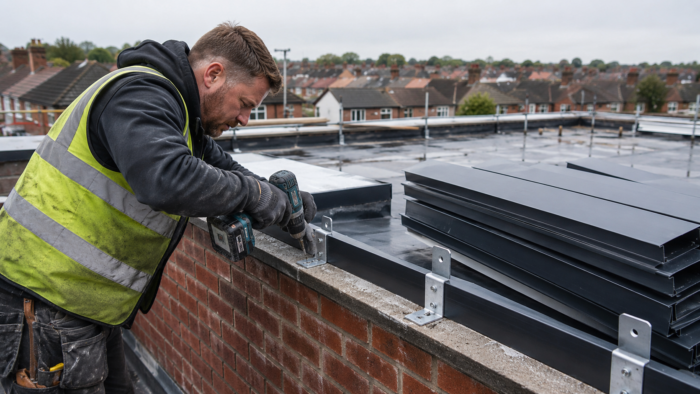
Installing aluminium capping is a reasonably straightforward task for anyone with basic construction skills, but there are details that matter and steps that should not be skipped. Here is a complete walkthrough.
Tools and materials you will need
- Aluminium flat coping sections in the appropriate length and colour
- Flat coping brackets or sloped brackets depending on the profile specified
- Corner pieces (90-degree and/or 135-degree) for direction changes
- Stainless steel fixings (always stainless, not galvanised or plain steel)
- Colour-matched sealant for joints and perimeter edges
- Touch-up spray for cut ends
- Fine-toothed hacksaw, tin snips, or non-ferrous metal blade on a mitre saw
- Tape measure and chalk line
- Cordless drill with masonry bit
- Spirit level
- Safety gloves and eye protection
Step 1: Assess the wall top
Before anything else, look at the condition of the wall top. Is the masonry sound? Is the mortar bedding solid? Are there any existing capping pieces or old mortar that need to be removed first? Old cement-sand capping should be carefully broken off and the surface swept clean before new aluminium capping goes on.
Check the wall for level along its length. Minor variation is fine and can be accommodated by the bracket system. A significant twist or slope along the wall run needs to be assessed: in some cases it is better to address the masonry before fitting capping rather than trying to compensate for a badly out-of-level wall with the brackets.
Also check the wall width. Aluminium capping needs to overhang the face of the wall by at least 40 to 50mm on each side to provide adequate weather protection. If the capping width you have ordered does not comfortably cover the wall with that minimum overhang, you need a wider profile.
Step 2: Mark out bracket positions
Brackets should be positioned at 600mm centres as a general rule, with brackets within 150mm of each end of every capping section and within 150mm of every joint between sections. Mark the bracket positions along the wall with a chalk line or pencil before drilling.
On longer runs, lay out all your sections on the ground first and plan the joint positions so they fall at a bracket rather than between brackets. Joints in mid-span without bracket support below them are weaker and more likely to flex.
Step 3: Fix brackets to the wall
Drill into the masonry with a masonry bit and fix brackets using stainless steel anchor fixings or screws into plugs. Brackets must be fixed into sound masonry, not into crumbling mortar joints. If the masonry surface is inconsistent, use slightly longer fixings to reach solid material.
Check each bracket for level as you fix it. Use a long spirit level or string line to ensure the brackets form a consistent level plane along the full wall run. Capping that runs level looks sharp and professional. Capping that dips and rises along its length catches the eye in the wrong way.
| Use only stainless steel fixings with aluminium capping. Galvanised or plain steel fixings will corrode against the aluminium in wet conditions, creating rust staining on the face of the capping and eventually weakening the fixing. This is one of those details that is very easy to get right from the start and very annoying to fix later. |
Step 4: Install corner pieces first
If your wall has any corners, fit the corner pieces before the straight runs. Corner pieces are fixed in place over the brackets at each corner, with sealant applied to the joint where the corner piece will overlap the straight section. Starting with corners means the straight sections can be cut to fit accurately between fixed corners rather than trying to cut both ends of a run simultaneously.
Step 5: Cut straight sections to length
Measure between corners (or between corner and end) and cut each straight section to length. Use tin snips for shorter cuts, a fine-toothed hacksaw for clean straight cuts, or a mitre saw with a non-ferrous metal blade for the fastest and cleanest results. For all cut ends, apply colour-matched touch-up spray to seal the exposed aluminium.
Leave a 3 to 5mm expansion gap between sections at every joint. This is not an air gap that lets water in: it will be filled with flexible sealant. But the gap needs to be there to allow the aluminium to move with thermal expansion without buckling against adjacent sections.
Step 6: Fit capping sections over brackets
Each capping section clicks, clips, or screws over the fixed brackets depending on the system. For clip-on or secret-fix systems, the capping is pressed firmly over the bracket heads until it locks. For face-fixed systems, the fixings go through the return of the capping into the wall face or directly into the bracket. Refer to the fixing detail supplied with the specific product.
Check the run with a spirit level or long straightedge as you go. Any section that is sitting high or low should be adjusted at the bracket rather than shimmed under the capping after the fact.
Step 7: Seal all joints and perimeter edges
Once all sections and corners are in place, apply colour-matched flexible sealant to every joint between sections, at both ends of every corner piece, and at the perimeter edge where the capping meets the wall face or any adjacent surface. Tool the sealant smooth with a wet finger or sealant tool.
Do not skip the sealant at joints. This is where capping systems fail: not at the centre of sections but at the joints where water finds a way in. Good sealant, properly applied, is what keeps the system watertight for years.
| Never use rigid, fast-setting sealant or cement mortar to fill capping joints. Aluminium expands and contracts with temperature changes, and a rigid filler will be cracked by that movement within one or two winters. Always use a flexible, paintable exterior-grade sealant. |
Step 8: Check from ground level
Step back and view the finished capping from normal viewing distance (ground level, from across the street if relevant). Any obvious dips, rises, colour variation from handling marks, or sealant smears are much easier to spot from a distance than they are close up. Deal with any issues now rather than after the scaffolding comes down.
A quick pass with touch-up paint on any scuffed areas from installation and a final wipe of the sealant joints with a damp cloth will bring the installation up to a clean, finished standard.
Thermal Expansion in Aluminium Capping: What You Need to Know
Aluminium expands and contracts with temperature changes at a rate of roughly 23 micrometres per metre per degree Celsius. In the UK, an exposed wall capping might go from around minus 10 degrees on a cold winter night to 60 degrees or more on a south-facing summer day. That is a 70-degree swing, and across a 3m section of capping it translates to about 5mm of movement.
Five millimetres does not sound like much. But across a 20m run of capping, the cumulative movement is around 30mm. If the capping is fixed rigidly at both ends of that run with no accommodation for movement, it will buckle in the centre as it expands. If the fixings are very tight, it may pull through them as it contracts. Either way, the result is a capping that looks wrong and may eventually leak at the joints.
How to handle it correctly
- Expansion gaps at every joint: Leave 3 to 5mm between sections and fill with flexible sealant. The sealant is watertight but accommodates movement.
- Oversized fixing holes: Where fixings go through the capping itself, drill holes 1 to 2mm larger than the fixing shank so the section can move slightly around the fixing without binding.
- Bracket systems: Using a bracket-and-clip system rather than direct fixings through the capping means the capping floats over the bracket. The brackets are fixed rigidly to the wall but the capping is free to move relative to them.
- Do not over-fix: More fixings than necessary does not always mean more secure. Over-fixing on a long run with no expansion accommodation makes the thermal expansion problem worse, not better.
- Match colours in the same production run: This is not about expansion but about colour consistency. Powder coat batches can vary very slightly. Order all sections for a project at the same time so they all come from the same batch.
Specification Guide: Choosing the Right Aluminium Capping
What width do I need?
The width of the capping needs to cover the full wall width plus enough overhang on each side to provide weather protection. For a brick wall with a nominal 215mm width (including render or pointing), a capping width of 300 to 350mm provides a 40 to 65mm overhang on each side, which is the generally accepted minimum for effective weather protection.
Wider walls need wider capping. A double-skin cavity wall of 300mm or more needs a correspondingly wider capping profile. In general, the minimum overhang guidance is: at least 40mm each side in a sheltered domestic location, and at least 50mm in an exposed or elevated location.
What thickness?
Our aluminium capping products are produced at 2mm gauge, which is appropriate for wall capping widths up to around 400mm. For wider profiles, or for applications in high wind-load environments (coastal, elevated, or large commercial buildings), 3mm offers additional stiffness and resistance to wind loading.
Thin capping on a wide wall will flex visibly between fixings, creating an uneven rippled appearance that looks wrong and will eventually fatigue the material at the fixing points. If in doubt, go to the next gauge up rather than trying to get away with a lighter section.
Powder coat specification
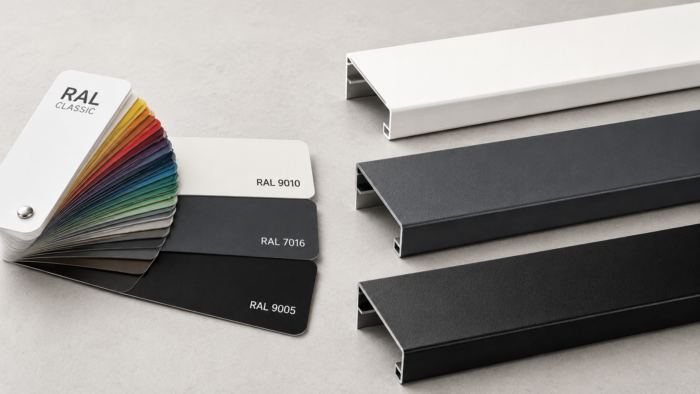
All our aluminium products are finished with external-grade polyester powder coat. External-grade matters: interior-grade powders will chalk and fade within a few years when exposed to UV. If you are specifying capping for a commercial project, ask for confirmation of the powder coat grade and its UV resistance rating.
The most popular UK colours for aluminium capping are RAL 9010 (white), RAL 7016 (anthracite grey), RAL 9005 (jet black), RAL 1013 (oyster white), and RAL 7015 (slate grey). We can produce in any RAL colour: contact us or request an estimate to confirm availability and lead time for your specific colour.
Secret fix or face fix?
Secret-fix systems are specified when the appearance of the capping face needs to be completely clean with no visible fixings. They cost more to buy and take slightly more care to install, but the result is noticeably smarter on buildings where the capping is a prominent visual element.
Face-fix systems are faster to install and are perfectly appropriate for most applications. Using colour-coded fasteners that match the capping colour means the fixings are present but not visually intrusive.
Building Regulations and Aluminium Capping
Aluminium capping sits at the interface between the building structure and the external environment, which means it touches several parts of the Building Regulations.
Fire safety: Approved Document B
Powder-coated aluminium achieves A2-s1,d0 fire classification under EN 13501-1, classifying it as non-combustible. For buildings over 11m in height (the current threshold for restrictions on combustible external materials under Approved Document B as amended following the Grenfell fire enquiry), this classification means aluminium capping is fully compliant without needing additional fire testing or justification.
For lower buildings, the classification is less critical but aluminium’s non-combustibility is still an advantage over timber capping in terms of fire spread at the building perimeter.
Moisture resistance: Approved Document C
Approved Document C requires that the external fabric of a building resists moisture penetration. Aluminium capping, correctly installed with sealed joints and adequate overhang, directly contributes to compliance with this requirement for the wall top. It is the primary barrier between direct rainfall and the masonry below.
Wind loads
At height, wind loads on capping are significant. Strong winds can get under a capping section and exert an uplift force that tries to peel it off the wall. The fixing system needs to be designed to resist this. For high-rise commercial buildings or coastal locations, an engineer may need to calculate the wind load and confirm the fixing spacing and type. BS 6399 Part 2 or its current replacement, BS EN 1991-1-4, covers wind loading on structures. Access the current British Standards via the British Standards Institution.
Conservation areas and listed buildings
Any external change to a listed building requires listed building consent. Changes to a building in a conservation area that affect the character of the area may require planning permission under Article 4 Directions. The advice is always to check with the local planning authority before specifying aluminium capping on buildings of historical interest. Find your local planning authority via Gov.uk.
Common Problems with Aluminium Capping (and How to Prevent Them)
| The problem | Why it happens | How to prevent it |
| Sections buckling or bowing along the run | Thermal expansion with no accommodation at joints or fixings | Leave 3-5mm expansion gaps, use flexible sealant, oversized fixing holes |
| Water getting in at joints between sections | Joint sealant missing, wrong type, or already cracked | Use flexible exterior-grade sealant at all joints, never rigid mortar or fast-setting filler |
| Rust staining appearing below the capping face | Steel or galvanised fixings corroding against the aluminium | Always use stainless steel fixings throughout, no exceptions |
| Capping sections shifting or lifting | Fixings into mortar joints rather than masonry, or under-fixed near ends | Fix into sound masonry, increase fixing frequency near ends, bracket within 150mm of each end |
| Colour variation between sections on long runs | Sections ordered from different batches at different times | Order all sections for a project together so they come from the same production batch |
| Gaps appearing at corners over time | Corner piece not sealed properly or corner piece size wrong | Apply sealant to all four edges of corner pieces, use purpose-made corners not site-cut mitres |
| Capping sitting unevenly along the wall | Brackets not levelled before capping was placed | Check each bracket with a spirit level before placing capping, use string line across full run |
| Scratches visible on face of capping | Handling damage during installation not touched up | Treat all handling scuffs with matched touch-up paint before project sign-off |
Matching Aluminium Capping to the Rest of Your Building
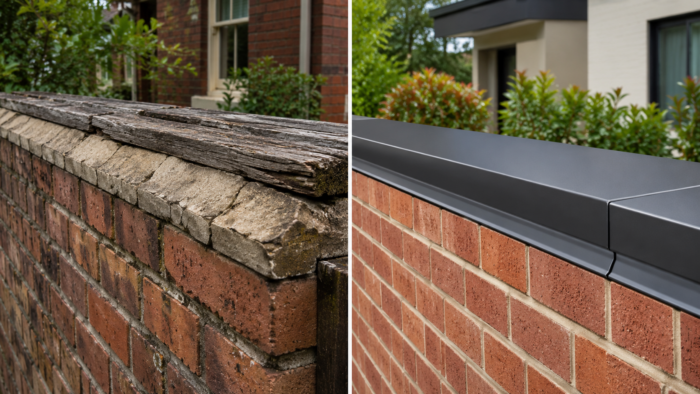
One thing that comes up regularly when people are choosing aluminium capping is the question of matching it to other elements on the building. This is more important than it might seem. A parapet wall capping in one shade of grey, fascia boards in a slightly different grey, and window frames in yet another grey makes a building look like it was assembled from a catalogue of left-overs rather than designed as a whole.
Getting it right is straightforward: pick your RAL colour first, then order all the aluminium products for the project from the same supplier in the same colour. Our range covers the full roofline and includes aluminium flat coping in 1m, 2m, and 3m lengths alongside corner pieces, flat brackets, sloped brackets, fascia boards, soffits, and matched accessories including sealant, touch-up spray cans, and colour-coded fixings.
Browse everything in our online shop, or if you need help choosing the right products for your specific project, request an estimate and our team in Chelmsford will come back to you with a proper product list and price.
For further reading on the aluminium coping and capping system, see also our full installing aluminium coping guide and our post on why aluminium fascia and copings are essential.
Frequently Asked Questions
-
What is aluminium capping used for?
Aluminium capping is used to protect the top surface of walls, parapets, piers, and other raised masonry elements from water ingress. It sheds rainwater away from the wall top, prevents freeze-thaw damage to the masonry, and provides a clean finished appearance. It is used on domestic extensions, boundary walls, commercial buildings, and anywhere an exposed wall top needs weather protection.
-
What is the difference between aluminium capping and aluminium coping?
Coping refers to a profile that wraps over the wall top and returns down both faces of the wall, providing an overhang and a drip edge that actively carries water away from the wall face. Capping typically has a shallower return or sits flat on the wall top without the full wrap-over. In practice the terms are often used interchangeably, and the key factor is whether the profile overhangs the wall face enough to protect it from wind-driven rain.
-
How long does aluminium capping last?
Powder-coated aluminium capping typically lasts 40 to 50 years or more in UK conditions without significant maintenance. The aluminium itself does not rust or rot, and an external-grade powder coat will hold its colour and finish for many years in normal atmospheric conditions. In very aggressive environments such as coastal or highly polluted urban areas, the finish may dull slightly over decades but the structural performance of the aluminium is not affected.
-
What fixings should I use with aluminium capping?
Always use stainless steel fixings. Galvanised or plain steel fixings corrode at the contact point with aluminium in wet conditions, producing rust staining and eventually failing. Colour-coded stainless fixings are available that match the capping colour, reducing the visual impact of any face fixings.
-
How wide does aluminium capping need to be?
The capping needs to cover the full wall width and overhang each face by at least 40 to 50mm. For a standard single-skin brick wall of 215mm, a capping of around 300 to 350mm wide is typically correct. Wider walls need wider capping. In exposed locations, a larger overhang of 50 to 60mm each side gives better protection against wind-driven rain.
-
Can I use aluminium capping on a garden wall?
Yes, and it works very well for this application. Aluminium capping on a garden or boundary wall gives a finished, professional appearance and protects the masonry from the freeze-thaw cycles that cause cracking and spalling on uncapped walls. It is available in a wide range of RAL colours so it can be matched to the wall, gate, or fencing materials.
-
Does aluminium capping need any maintenance?
Effectively none. Powder-coated aluminium does not need painting or anti-corrosion treatment. A visual check of the sealant at joints every year or two is sensible: flexible sealant does eventually dry out and crack, usually over 10 to 20 years, and resealing a joint is a quick and cheap job compared to repairing water damage to the masonry below.
-
What RAL colours are available for aluminium capping?
The full RAL colour range is available through powder coating. The most popular choices for UK wall capping are RAL 9010 white, RAL 7016 anthracite grey, RAL 9005 black, RAL 1013 oyster white, and RAL 7015 slate grey. Contact us to confirm availability and lead time for any specific colour.
-
How much does aluminium capping cost in the UK?
Supply prices for aluminium wall capping in the UK typically range from around £12 to £22 per metre for standard profiles in stock colours. Bespoke profiles, non-standard sizes, or unusual colours will cost more. Brackets, corner pieces, sealant, and fixings are additional. Getting a full material list priced together is the most accurate way to budget a capping project.
-
Is aluminium capping suitable for conservation areas?
Aluminium capping can be suitable in conservation areas, particularly when finished in colours that match traditional materials. Listed building consent is required for any changes to a listed building. For buildings in conservation areas, check with the local planning authority before specifying aluminium capping if the change would affect the character of the building or area.
Discover more from Metal Profiles Ltd
Subscribe to get the latest posts sent to your email.