


Here is a scenario that comes up more often than it should. A homeowner or facilities manager specifies a door canopy, the installer fits it in a day, and everything looks fine until the first serious spell of UK weather. The canopy leaks at the bracket fixing points. The deflection under wind load makes a noise. Or the canopy itself is undersized and the doorstep is soaked despite the canopy being there. The problem was not the installation. The problem was in the specification, and it was avoidable.
A door canopy is not a complex product, but there are more ways to get one wrong than most people expect going in. The projection length determines how much weather protection it provides. The bracket design determines how it handles wind uplift. The material choice determines whether it still looks good in ten years. And on commercial entrances, there are structural and regulatory dimensions that a residential specification mindset tends to miss entirely.
This guide covers all of it. We will look at the different types of door canopy available in the UK market, the materials and their honest trade-offs, what sizing decisions actually change about the performance, how installation works and what goes wrong, the specific considerations for commercial and industrial entrances, and what distinguishes a product that lasts decades from one that needs attention after the first winter.
Metal Profiles Ltd manufactures aluminium architectural products from our base in Chelmsford, Essex. We supply door canopies, entrance canopies, fascia, soffits, copings, and aluminium rainwater goods to contractors, developers, and architects across the UK. The perspective in this guide comes from making and supplying these products rather than simply describing them.
What Is a Door Canopy and Why Do Buildings Need One?
A door canopy is a fixed overhead shelter structure installed above a doorway to protect the entrance from rain, wind-driven water, and in some applications, direct sun. It is fixed to the building fabric rather than being freestanding, and it projects outward from the wall face far enough to provide a zone of weather protection in front of the door opening.
The functional case for a door canopy is straightforward. In the UK, the combination of frequent rainfall, regular horizontal wind-driven rain, and the practical reality that people spend time in front of a door before it opens (searching for keys, accepting deliveries, greeting visitors) means that an unprotected entrance is a genuine daily inconvenience. A well-specified door canopy keeps people dry during this brief transition, protects the door, door frame, and threshold from sustained water exposure, and reduces the amount of water tracked into the building.
What a door canopy actually protects against
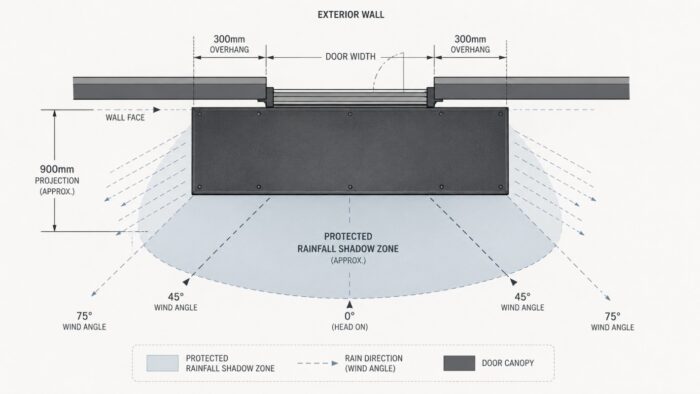
The main protection a door canopy provides is from directly falling rain. A canopy projecting 900mm from the wall face keeps the area immediately in front of the door dry in still air or light wind. In the UK, however, light wind is not always the condition at hand. The additional benefit of a deeper projection is the angle of rain that can still reach the door under wind-driven conditions.
In practical terms, a 600mm projection canopy keeps the doorstep dry in still rain but offers limited protection in a typical British rainstorm with a 20 to 30 km/h wind. A 900mm projection starts to provide meaningful protection in moderate wind. For entrances on exposed elevations, on buildings in coastal locations, or on commercial entrances where footfall means people are always approaching, a 1200mm or deeper projection is the more useful specification.
Beyond rain protection, canopies serve secondary functions: reducing UV and sun glare at south-facing entrances, providing an area of shade for external display or signage in retail settings, concealing pipe runs and service connections at commercial entrances, and creating a defined arrival zone that sets the visual tone for the building beyond the entrance.
The difference between a door canopy and an entrance canopy
These terms are sometimes used interchangeably but they have a practical distinction worth understanding. A door canopy is a relatively compact overhead shelter, typically covering a single door width and projecting up to 1500mm from the wall. It is sized to protect the doorstep and immediate threshold area.
An entrance canopy is a larger structure, typically spanning multiple door widths, projecting more substantially from the building face, and often incorporating glazing panels or a more substantial structural frame. Entrance canopies are standard on commercial buildings, hospitals, hotels, and public buildings where the functional requirement is to shelter multiple people arriving simultaneously or queuing at an entrance desk.
The product range from Metal Profiles Ltd covers both scales. The structural approach and material choices are similar, but the engineering requirements and regulatory context differ significantly between a residential door canopy and a full commercial entrance canopy. We will cover both.
Types of Door Canopy: Profiles, Structures and Materials
The UK market offers door canopies in a wide range of forms, from mass-produced plastic and fibreglass kits to bespoke aluminium structures fabricated to specific architectural requirements. Understanding the main types helps you make a specification decision that matches both the functional requirement and the building character.
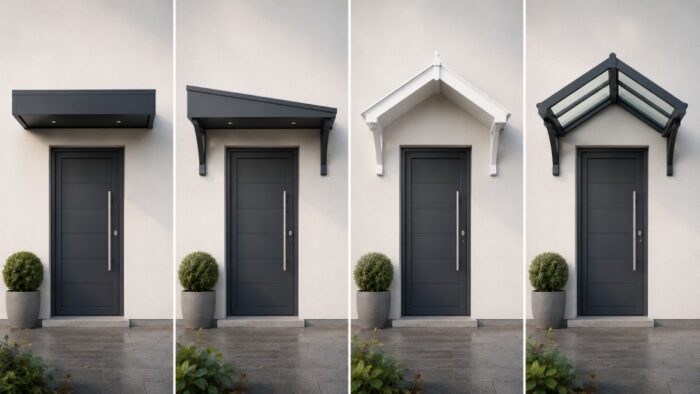
Flat aluminium door canopies
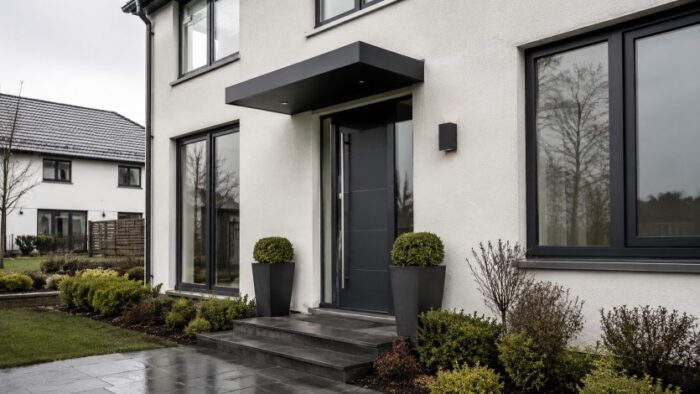
A flat canopy has a horizontal roof surface and a fascia face that runs vertically from the roof edge down to the soffit level. From the front, you see only the fascia panel. From below, you see the flat aluminium soffit. The profile is clean and contemporary, and it suits modern buildings with flat-roof architectural language very well.
The practical consideration with a flat canopy in the UK is drainage. A horizontal surface collects water and must drain correctly. On a quality aluminium flat canopy, the roof deck incorporates a slight fall (typically 1 in 40 toward one side or toward the back) to ensure water runs off reliably rather than ponding on the surface. An aluminium box gutter or drip edge at the leading face throws the water clear of the fascia and the doorstep below.
Metal Profiles Ltd manufactures flat aluminium door canopies in standard and custom sizes, with the roof deck formed to provide drainage fall and the fascia and soffit panels in any RAL powder-coated colour.
Mono-pitch and lean-to canopies
A mono-pitch canopy has a single sloping surface, rising from the leading edge to the wall fixing point. This is structurally simpler than a flat canopy because the drainage direction is defined by the pitch, and there is no requirement for a separate drainage fall to be incorporated into the deck. The pitch also sheds snow load more effectively than a flat surface.
Mono-pitch canopies suit a wide range of building types. The slope angle is typically between 5 and 15 degrees, enough to ensure reliable drainage and snow shedding without the canopy looking steeply inclined when viewed from the street. On a two-storey house with a standard door height, a 10-degree mono-pitch canopy projecting 900mm gives a natural-looking profile that does not interfere visually with the first-floor window above.
The leading edge of a mono-pitch canopy is the lowest point of the structure, which means the gutter or drip edge at the front deals with the full rainfall load from the canopy roof. Sizing the gutter correctly for the canopy roof area ensures the drainage does not overflow and drip onto visitors at the front of the canopy.
Pitched or apex canopies
A pitched canopy has two sloping faces meeting at a ridge, forming an apex or gable at the front. This is the most traditional profile and it suits period residential properties, traditional brick buildings, and any entrance where the flat or mono-pitch option would look out of character. A pitched canopy over a Victorian front door with matching brick piers is a considered design choice. The same style on a contemporary glass and steel office building would look wrong.
Pitched canopies in aluminium can be manufactured with matching aluminium ridge cappings, hip flashings, and verge trims that give a clean, maintenance-free result. The visual weight of a pitched canopy at an entrance is greater than a flat profile, which can be an advantage (creating a formal, significant entrance) or a disadvantage (looking heavy and domestic on a commercial building).
Canopy systems with polycarbonate or glass infill
Some door canopy designs use a structural aluminium frame with transparent or translucent infill panels. Polycarbonate is the most common infill material on budget and mid-range canopy systems: it is lightweight, impact-resistant, and transmits diffused daylight to the entrance below. The practical downside of polycarbonate is its tendency to yellow and become opaque over time with UV exposure, particularly on cheaper grades.
Glass infill panels (toughened safety glass to BS EN 12150) give a significantly higher quality appearance and maintain optical clarity indefinitely, but they add weight to the structure, require more substantial frame members to carry the glass load, and need careful design to prevent the glass from shattering debris falling onto visitors below in the event of breakage. For commercial entrances where appearance matters, glazed canopies are the standard. For residential applications where cost is a consideration, polycarbonate systems are widely used.
Bespoke aluminium entrance canopies
Bespoke door and entrance canopies are designed and fabricated to specific project dimensions, usually for commercial developments, high-specification residential projects, and public buildings where a standard product either does not fit the aperture, does not match the required architectural language, or cannot meet the structural requirements of the specific location.
A bespoke aluminium entrance canopy for a hotel or office building typically involves structural calculations by an engineer, connection details designed to transfer wind uplift and self-weight loads into the building structure, powder coating to a specific project RAL colour, and fabrication to tight dimensional tolerances. Metal Profiles Ltd works on projects across this range, from residential additions to commercial entrance features on new-build developments.
Aluminium vs Other Door Canopy Materials: An Honest Comparison
The material a door canopy is made from determines its service life, maintenance requirement, structural performance, fire classification, and visual quality over time. Here is a straightforward comparison of the materials commonly used in the UK market.
Aluminium door canopies
Aluminium is the correct specification for any door canopy that is expected to perform well and look good for the lifetime of the building. The combination of light weight, corrosion resistance, structural rigidity, powder-coat longevity, and non-combustible fire classification makes aluminium the premium material choice for both residential and commercial applications.
- Corrosion resistance: Aluminium forms a natural oxide layer that prevents further corrosion. Unlike steel, a scratch through the powder coat reveals more aluminium, not a surface that will then rust. Coastal environments, industrial areas with atmospheric pollutants, and high-humidity locations that cause rapid deterioration in other materials are all handled well by aluminium.
- Any colour, permanently maintained: External-grade polyester powder coating on aluminium does not fade noticeably for 20 or more years and does not crack or peel in the way liquid paint does on timber. A powder-coated aluminium canopy in anthracite specified today will still be the same colour in 2040 without any repainting.
- Structural performance: Aluminium extrusions in the 6082-T6 alloy used for structural canopy frames have high strength-to-weight ratios. A slim aluminium canopy frame can carry significant wind uplift and snow loads without the visual bulk that a timber or steel frame of equivalent structural capacity would require.
- Non-combustible: Aluminium achieves A2-s1,d0 classification under BS EN 13501-1. On commercial and public buildings where the fire performance of external cladding elements is part of the building’s compliance case, aluminium door canopies can be specified without additional testing or documentation. Timber, GRP, and most plastic canopy systems are classified as combustible.
- Low maintenance: An aluminium door canopy needs no annual painting, no sealing, no oiling, and no treatment of any kind in normal outdoor use. The occasional clean with a damp cloth and mild detergent keeps it looking sharp.
Timber door canopies
Timber canopies are still specified on period residential properties where the traditional material suits the character of the building. A well-detailed timber canopy with appropriate hardwood or treated softwood, correctly primed, painted, and maintained, can last 20 or more years. The key word is maintained. Timber canopies need repainting every five to seven years to prevent moisture ingress leading to rot, and the joint details between the roof panel, the fascia, and the wall fixing are the most common failure points.
For listed buildings and properties in conservation areas, timber may be the required material to maintain the character of the building. In all other cases, the ongoing maintenance commitment of a timber canopy versus a maintenance-free aluminium alternative is a practical argument for aluminium that is difficult to counter on a long-horizon cost basis.
GRP (Glass Reinforced Plastic) door canopies
GRP canopies are widely available in the mid-market residential sector. They are cost-effective, relatively light, and available in period styling that is difficult to achieve in aluminium at the same price point. The limitation of GRP is its long-term surface quality: GRP canopies can develop surface crazing and discolouration after several years of UV exposure, and the colour pigments are typically not as stable as a quality powder coat.
GRP is classified as combustible (typically Class B or C under EN 13501-1), which rules it out for commercial buildings and residential buildings above 11m where the external cladding must meet limited combustibility or non-combustibility requirements.
uPVC door canopies
uPVC canopy systems are at the lower end of the market in terms of structural performance and appearance longevity. They suit cost-sensitive residential applications but are not appropriate for commercial or high-specification residential use. uPVC is combustible, has limited colour options, and the cheaper bracket systems typically used with uPVC canopies offer limited resistance to wind uplift.
| Factor | Aluminium | Timber | GRP | uPVC |
| Fire classification | A2-s1,d0 non-combustible | D/E combustible | B/C combustible | D combustible |
| Maintenance | None | Paint every 5-7 years | Light clean only | Light clean only |
| Lifespan | 40+ years | 15-25 yr maintained | 20-30 years | 15-25 years |
| Colour options | Any RAL powder coat | Any paint colour | Limited moulded range | Very limited range |
| Corrosion resistance | Excellent | Poor without treatment | Good | Good |
| Structural rigidity | Excellent | Good | Moderate | Poor |
| Bespoke sizing | Yes – cost-effective | Yes | Limited by moulds | Very limited |
| Commercial suitability | Yes | Listed/heritage only | Residential only | No |
| UV resistance | Excellent (powder coat) | Moderate | Moderate | Limited |
| Cost (initial) | Mid to high | Mid | Lower to mid | Lower |
Sizing a Door Canopy: What Dimensions Actually Change About Performance
The most common specification mistake with door canopies is choosing a projection length based on what looks proportionate in the brochure photograph rather than on what actually protects the entrance under UK weather conditions. A canopy that looks perfectly sized on a sunny day in the catalogue is often inadequate when horizontal rain arrives in November.
Projection depth: the most critical dimension
The projection of a canopy (the distance it extends from the wall face) is the primary determinant of how much weather protection it provides. The following guidance is based on practical performance in UK outdoor conditions:
- Up to 600mm projection: Provides shelter from vertically falling rain only. Inadequate for any exposed elevation. Suitable only in very sheltered positions such as a recessed entrance within a wider porch structure.
- 600mm to 900mm projection: Adequate for a sheltered residential front door. In normal UK conditions this keeps the doorstep reasonably dry. In wind-driven rain or on an exposed elevation, people at the door will still get wet on one side.
- 900mm to 1200mm projection: The practical minimum for most UK residential applications. Provides meaningful protection in moderate wind-driven rain and keeps the doorstep genuinely dry in most conditions.
- 1200mm to 1800mm projection: Appropriate for exposed elevations, coastal locations, and anywhere with consistently high wind. Also useful for commercial entrances where people need to wait briefly before the door opens.
- Over 1800mm projection: Typically only on commercial entrance canopies. Requires substantial structural bracketing, and the engineering should be reviewed by a structural engineer for wind uplift at the bracket fixings.
A rule of thumb that experienced contractors use: the canopy projection should be at least as wide as the door is wide, and ideally wider than the door on both sides. A 900mm wide canopy over a 900mm door opening provides reasonable overhead cover but leaves the person at the door exposed at the sides in windy rain. A canopy 300mm wider on each side (1500mm total width over a 900mm door) provides significantly better coverage.
Width: covering more than just the door
The canopy width is typically specified to be at least 200 to 300mm wider than the door opening on each side. The minimum effective width depends on where visitors approach from and the architecture of the entrance. On a conventional residential front door with a path running straight to the door, the visitor is typically centred in front of the door when they arrive. On a commercial entrance with a wide approach, people approach from multiple directions and angles, and a wider canopy performs better for a larger proportion of arrivals.
On commercial buildings, the canopy width often corresponds to the entrance lobby width, which may span multiple door sets. A 4m wide entrance canopy over a double pair of doors gives arriving visitors adequate cover while co-ordinating with the entrance lobby proportions.
Height above the door
The height at which the canopy is fixed affects both the visual proportion of the entrance and the effective protection it provides. A canopy fixed immediately above the door frame is closer to the head of a person standing at the door, which means it provides more protection against wind-driven rain from above. A canopy fixed 400 to 500mm above the door frame gives more visual clearance and suits taller proportioned entrances.
On residential properties with standard 2100mm door heights, a canopy fixed at 2200 to 2400mm above the threshold gives a good proportion. On commercial entrances with 2400mm door heights and double-height entrance lobbies, the canopy may be fixed at 2800 to 3200mm or higher, which requires longer brackets and more careful attention to wind uplift at the fixing points.
| For residential front door canopies in the UK, the most frequently specified dimensions are: 900mm projection x 1200mm width for a single door, and 1200mm projection x 1800mm width for a double door or a particularly exposed elevation. These are practical starting points but should be adjusted based on the specific exposure and approach geometry of the site. |
Structural sizing and bracket design
The brackets are the critical structural element of any door canopy. They transfer the loads from the canopy roof (self-weight, wind uplift, and snow load) into the building fabric via fixings into the wall. An undersized or poorly fixed bracket is the most common cause of canopy failure under storm conditions.
For standard residential canopies up to 1200mm projection, two brackets on each side (four brackets total) with M10 stainless fixings into masonry or into an appropriately sized timber frame is typically adequate. For canopies projecting more than 1200mm, three brackets on each side or a structural header beam along the top of the canopy may be needed. For commercial canopies projecting more than 1800mm or spanning more than 3m, structural engineering calculations should be commissioned.
The fixing substrate matters as much as the bracket size. A bracket fixed into a single skin of brickwork with inadequate embedment will fail under wind uplift well before a properly designed bracket in the same size. For commercial canopies, the building structure may need to be consulted to confirm that the fixing points can carry the imposed loads.
Door Canopy Installation: What Goes Right and What Goes Wrong
A door canopy installation looks straightforward. The bracket holes are pre-drilled, the fixings are supplied, the instructions seem clear. And yet a significant proportion of canopy problems in the first year of service trace back to installation rather than product quality. Here is where the problems usually are.
Wall fixings and substrate
The single most common cause of canopy failure is inadequate fixings into an inadequate substrate. Cavity wall construction, the UK’s most common external wall type in post-war residential buildings, requires fixings that either go all the way through to the inner leaf or are specifically designed for cavity wall use. A fixing that anchors only in the outer single-skin brick leaf is not adequate for a canopy under wind uplift loads.
Solid brick or stone walls generally provide a good fixing substrate if the masonry is sound. Rendered walls need the render chased back or the fixing driven through the render into the masonry below, since render alone provides inadequate anchor capacity. Stud-framed walls (common on commercial buildings and modern timber-frame residential) require the fixing to locate into the structural stud framing, not just the plasterboard or cladding panels.
Before fixing any canopy bracket, identify the wall construction and confirm the fixing specification is appropriate for it. For commercial installations and any installation above single-storey level, a structural engineer or the building contractor should confirm the fixing design.
Waterproofing the wall junction
Every bracket fixing penetrates the wall fabric at a point where water can track in if the joint is not sealed correctly. On a canopy that is 20 years old and starting to develop damp in the wall directly behind the bracket position, the original fixing sealant has almost always failed. Using a low-modulus silicone sealant to seal around every fixing penetration, and checking the seal condition every few years as part of a basic maintenance regime, prevents this progressive failure.
For canopies with a header beam or back rail that sits against the wall face, the junction between the back of the beam and the wall needs a continuous bead of sealant or a compressible neoprene strip to prevent water running down the wall and tracking behind the beam. Without this, a damp patch develops in the wall directly behind the back of the canopy over time.
Getting the level right
A canopy that is slightly out of level creates drainage problems. On a flat or mono-pitch canopy where the drainage direction is designed in, an installation that is out of level by more than a couple of millimetres can redirect the drainage to the wrong side. This either causes water to drip at the wrong point, or on a flat canopy creates a low point where water ponds rather than draining to the outlet.
The best practice is to use a laser level to set the bracket positions before drilling. Set the high end of the canopy first, then work across to the outlet end with the level running between the bracket lines. On a long entrance canopy, checking the level at multiple intermediate points rather than only at the two ends prevents a bowing or twisting installation.
Thermal movement and fixings
Aluminium expands and contracts with temperature at approximately 0.000023mm per millimetre per degree Celsius. For a 2000mm long aluminium canopy over a typical UK temperature range of 60 degrees Celsius, the total movement is approximately 2.8mm. This is not large, but it matters at the bracket connections and at any joint between canopy panels.
Canopy designs that do not allow for thermal movement at panel joints can develop visible buckling or stress cracking at the joints after a few seasons of temperature cycling. Quality aluminium canopy systems incorporate either slotted holes at fixing points or designed expansion joints between panels. If the system being installed does not appear to allow for thermal movement, raise the issue with the supplier before installation.
Common installation mistakes at a glance
- Fixing into inadequate substrate without checking wall construction type.
- Failing to seal around bracket fixing penetrations.
- Installing with insufficient fall on a flat canopy, creating a ponding problem.
- Using too few brackets for the projection length.
- Fixing brackets at unequal spacing, creating uneven load distribution.
- Not allowing expansion gaps at panel joints on longer canopies.
- Using the wrong fixing type for the substrate (e.g. frame fixings in masonry).
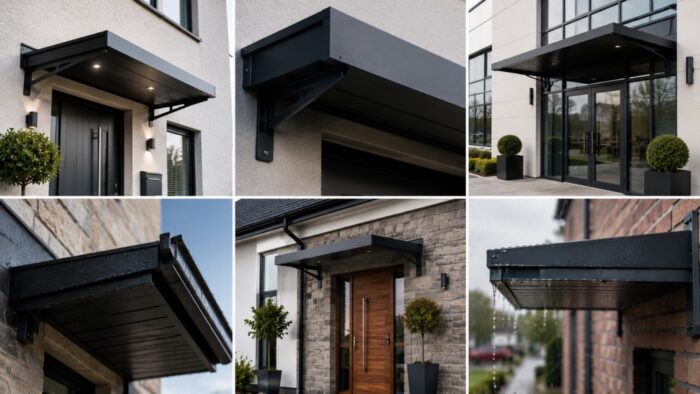
Commercial Door Canopies and Entrance Canopies: What Changes at Commercial Scale
The step up from a residential door canopy to a commercial entrance canopy is not simply a matter of making the same product bigger. The structural requirements, the regulatory context, the aesthetic expectations, and the design process are all different. Here is what changes.
Structural design and engineering sign-off
On a commercial building, a door canopy is a structural element of the building’s external fabric. Wind loading on a commercial building facade is typically higher than on a residential property, partly because commercial buildings tend to be taller (where wind speeds are greater), and partly because the building types that need large entrance canopies (offices, hospitals, hotels) are often on exposed urban sites.
Any commercial entrance canopy projecting more than 1200mm, spanning more than 2m, or mounted above ground-floor level should have structural engineering calculations carried out. These calculations confirm the bracket sizing, the fixing specification, the canopy frame section sizes, and the connection to the building structure. Metal Profiles Ltd can provide canopies as part of a package that includes structural fabrication drawings for engineering review.
For the broader framework on structural requirements for external building elements, the Planning Portal guidance on permitted development and extensions provides a useful reference on when planning permission is triggered for entrance structures on commercial buildings.
Fire compliance for commercial buildings
On commercial buildings, including retail, office, hospitality, and healthcare premises, the materials used in external building elements including door canopies may need to meet fire performance requirements. The specific requirements depend on the building height, use, and its proximity to a boundary.
Under Approved Document B (fire safety) and the Building Regulations 2010, the external walls of buildings above certain heights must meet limited combustibility requirements. On buildings above 11m in height or 18m depending on use and occupancy, external cladding and attached structures including canopies may need to meet A2-s1,d0 or better classification under BS EN 13501-1. Aluminium door canopies achieve A2-s1,d0 as standard. GRP and timber canopies typically do not meet this requirement and should not be specified on regulated commercial buildings.
Aesthetic co-ordination with the building facade
On commercial buildings, the door canopy is part of the architecture rather than an add-on. It needs to co-ordinate with the window frames, cladding panels, copings, and other aluminium elements on the facade. This is where the ability to specify any RAL colour and batch-match the powder coating with other facade components becomes commercially significant.
A hotel entrance canopy specified in a specific BS or RAL colour to match the curtain wall system requires the canopy fabricator to colour-match precisely, which means providing a colour reference to the coating applicator before production rather than selecting from a standard range. Metal Profiles Ltd works with architects and main contractors on this kind of coordinated specification for commercial facade packages.
Explore our aluminium architectural products range which includes door canopies alongside fascia, soffits, copings, and rainwater goods as co-ordinated systems in matching colours.
Signage, lighting, and service integration
Commercial entrance canopies often need to carry signage, external lighting, CCTV cameras, intercom systems, and sometimes roof-mounted services. The canopy structure needs to be designed with these loads and service connections in mind from the start, not retrofitted as an afterthought after the canopy is installed.
A canopy that has lighting recessed into the soffit panel, power fed through concealed conduit within the canopy structure, with fixings at the specified positions to match the electrical design, is a clean, professional result. A canopy with surface-mounted conduit and light fittings attached with jubilee clips after the fact looks exactly like what it is.
For commercial projects, the canopy fabrication drawing should include all service penetration positions, conduit routing paths, and fixing points for secondary attachments before fabrication begins.
Design Uses: Getting the Canopy Right for the Building
The right door canopy for a building is determined by the building’s architectural character as much as by the functional requirement. Choosing the wrong profile, the wrong colour, or the wrong projection proportion is a visible and long-lasting mistake.
Contemporary residential properties
On contemporary new-build residential properties, typically designed in a rendered or brick exterior with large windows and clean lines, the flat aluminium door canopy is almost always the right choice. The profile suits the architectural language. In anthracite grey, it co-ordinates with dark window frames. It keeps the entrance looking considered and designed without competing with the building’s primary architectural moves.
For a contemporary house in Essex or anywhere in the South East, a flat aluminium canopy at 900mm to 1200mm projection in RAL 7016 anthracite, fixed with slim parallel brackets at matching colour, is a clean specification that looks right and performs reliably. Our aluminium canopy and fascia product range covers these residential applications.
Victorian and Edwardian terraced houses
On a Victorian or Edwardian terrace, the entrance is often already defined by the original porch structure, bay window, or tiled step detail. Introducing a flat aluminium canopy can look jarring against the period character of the building. In these situations, the options are a traditional styled canopy (GRP or timber in a period profile, properly maintained), or a restrained aluminium canopy whose simplicity avoids competing with the period detailing.
Some Victorian and Edwardian properties in conservation areas have permitted development restrictions that limit external alterations including canopy additions. Check with the local planning authority before specifying a canopy on a property in a conservation area.
Social housing and residential developments
On social housing developments and residential schemes where the specification covers many identical units, door canopies are typically specified in a standardised size and colour as part of the facade package. Aluminium powder-coated canopies in a consistent RAL colour matching the window frames and doors provide a co-ordinated appearance across the development with minimal ongoing maintenance.
For a housing development of 50 or more units, Metal Profiles Ltd can supply door canopies as part of the overall facade package, batch-powder-coated with fascia, soffits, and copings to ensure colour consistency across the full development.
Industrial and distribution buildings
Industrial and distribution buildings typically have large roller shutters, personnel access doors, and multiple entrance points around the perimeter. Door canopies on industrial buildings are usually functional rather than architectural: they protect employees using personnel doors from the weather and provide shelter for brief waits during deliveries.
For industrial applications, the canopy specification is typically straightforward: a mono-pitch aluminium canopy at sufficient projection to keep the doorstep dry (900mm to 1200mm is standard), in a grey or anthracite colour to match the cladding, with robust fixings appropriate for the building’s steel frame or masonry construction. The functional requirement is primary; the aesthetic is secondary.
See how we have approached this on similar projects through our case studies section on the Metal Profiles Ltd website.
Planning Permission and Building Regulations for Door Canopies
Most door canopy installations on residential properties do not require planning permission, but there are exceptions that are worth understanding before work starts rather than after.
Residential: when planning permission is not needed
Under the Town and Country Planning (General Permitted Development) (England) Order 2015, adding a door canopy to a dwelling falls within permitted development rights in most cases, subject to the following conditions:
- The canopy does not extend forward of the principal elevation of the building if this would project beyond the building line.
- The property is not a listed building or in a conservation area where article 4 directions restrict permitted development.
- The canopy structure itself is not of a scale that triggers a different use class or creates an enclosed porch that would require its own approval.
In practice, a standard door canopy fixed to the wall face and projecting outward over the doorstep satisfies these conditions in the vast majority of residential cases. If in doubt, a pre-application enquiry to the local planning authority costs nothing and provides certainty.
Residential: when planning permission is needed
Planning permission is required for door canopies on: listed buildings (listed building consent is required for any external alteration); properties in conservation areas where an Article 4 Direction removes permitted development rights for external works; flats and maisonettes (which have limited permitted development rights); and any situation where the canopy would project beyond the building line of the principal elevation.
Commercial buildings
Planning permission for a door canopy on a commercial building depends on the use class, the size of the canopy, and whether it would materially affect the appearance of the building. Under Class A permitted development rights for commercial buildings, minor alterations to the exterior are sometimes permitted without a full planning application, but for any canopy of significant size or visual impact, a planning application is the appropriate route.
Building Regulations approval may also be needed for larger commercial entrance canopies if they fall within the definition of a ‘structure’ under the Building Regulations. The local building control body or an approved inspector can confirm whether a specific proposal requires a Regulations submission.
Door Canopies from Metal Profiles Ltd
Metal Profiles Ltd manufactures aluminium door and entrance canopies from our workshop in Chelmsford, Essex. We supply both standard range and bespoke canopies to homeowners, contractors, developers, and architects across the UK.
Our canopy range covers flat, mono-pitch, and bespoke profiles in any RAL colour, with standard and extended bracket systems for projections from 600mm to over 2000mm. All canopies are powder-coated in our production facility with external-grade polyester powder coat, available in any RAL classic colour. For commercial projects requiring batch-matching with other facade components, we can co-ordinate the powder coating production run with other facade elements.
For more information on our aluminium architectural product range, including door canopies, copings, fascia, and rainwater goods, visit us at Metal Profiles Ltd. You can also connect with us on LinkedIn for project updates and new product news, or follow us on Instagram to see recent installations.
To discuss a specific project, contact us directly. We are happy to review dimensions, confirm structural adequacy, advise on colour matching, and provide a quotation. Lead times for standard canopies are typically two to three weeks. Bespoke commercial canopies requiring structural drawings may require four to six weeks from design confirmation to delivery.
| Metal Profiles Ltd is based in Chelmsford, Essex, and supplies aluminium architectural products across the UK. Our Google Business listing includes contact details, recent project photographs, and customer reviews: see our profile at https://share.google/kNPbtranQaAIR4GTl |
Door Canopy Cost Guide for UK 2026
The cost of a door canopy in the UK depends on the material, size, projection, finish, and whether it is a standard off-the-shelf product or a bespoke fabrication. The figures below are indicative supply-only costs.
| Canopy type / size | Material | Indicative supply cost (inc. VAT) | Notes |
| Flat canopy 900x1200mm | Aluminium powder coat | £280 – £480 | Standard residential size |
| Flat canopy 1200x1800mm | Aluminium powder coat | £420 – £680 | Wide or exposed elevation |
| Mono-pitch 1000x1400mm | Aluminium powder coat | £320 – £520 | Good for terrace houses |
| Mono-pitch 1200x2000mm | Aluminium powder coat | £480 – £780 | Double door residential |
| GRP pitched canopy 900x1200mm | GRP moulded | £150 – £320 | Period styles available |
| Glazed canopy frame 1200x1500mm | Aluminium + polycarbonate | £380 – £640 | More light in entrance |
| Commercial entrance canopy per m2 | Bespoke aluminium | £600 – £1,400/m2 | Includes brackets, excl. install |
| Bespoke aluminium canopy (per unit) | Any size, any RAL | POA | Quote within 24-48 hours |
| Installation (residential, single) | Labour only | £150 – £350 | Variable by location |
Frequently Asked Questions About Door Canopies
-
What size door canopy do I need for a UK front door?
For a standard UK residential front door (approximately 900mm wide), the practical minimum is a canopy 1200mm wide (300mm overhang each side) with at least 900mm projection from the wall. On an exposed elevation or in a location with frequent wind-driven rain, a 1200mm projection and a 1500mm wide canopy is a more useful specification. Bigger is almost always better from a functional standpoint, subject to the visual proportion of the canopy against the building.
-
Does a door canopy need planning permission in the UK?
In most cases on a standard residential property, a door canopy falls within permitted development rights and does not need planning permission. Exceptions include listed buildings, properties in conservation areas with Article 4 directions, and flats or maisonettes. Always check with your local planning authority if you are uncertain. On commercial buildings, check the specific permitted development rights that apply to the building’s use class.
-
Which is better: aluminium or GRP for a door canopy?
Aluminium is the better long-term choice in almost every situation. It does not crack, does not yellow, is non-combustible (A2-s1,d0 fire classification), and holds its powder-coat colour for 20 or more years without maintenance. GRP is less expensive initially and offers period styling that aluminium cannot always match at the same price point. For a listed property or a period terrace where a traditional profile is required and cost is the primary consideration, GRP with good quality pigment can be a reasonable choice. For new build, contemporary properties, and all commercial applications, aluminium is the correct specification.
-
How long does an aluminium door canopy last?
A properly installed aluminium door canopy with an external-grade powder-coat finish should last 40 or more years. The aluminium itself does not rust. The powder coat does not fade noticeably for 20 or more years. The main maintenance requirement is ensuring the fixing seals are checked every few years and reapplied if needed, and the drainage outlet is kept clear of debris. Beyond that, aluminium door canopies are genuinely maintenance-free.
-
Can I fit a door canopy myself?
A standard residential door canopy installation is within the capability of a competent DIY-er with the right access equipment. The key requirements are: correctly identifying the wall construction and using the right fixings; using a spirit level to ensure the brackets are level; applying sealant correctly around all fixing penetrations; and allowing for drainage fall on a flat canopy. For canopies above single-storey height, or on commercial buildings, a professional installation by a qualified contractor is the appropriate approach.
-
Does a door canopy affect the value of my home?
A well-specified, properly installed door canopy in a material and colour that suits the property can improve kerb appeal and make a positive contribution to the first impression of the property. An undersized canopy, a canopy in the wrong style for the building, or a canopy that is deteriorating through lack of maintenance can have the opposite effect. From a practical standpoint, a canopy that genuinely protects the entrance adds everyday quality of life value to a property that is difficult to quantify but real.
-
What is the best colour for an aluminium door canopy?
The most consistently effective choice for a contemporary property is a canopy in the same colour as the window frames. If the windows are anthracite grey (RAL 7016), the canopy in the same colour creates a coherent architectural language. White (RAL 9010) suits traditional and period properties where white-painted woodwork is the existing palette. Black (RAL 9005) works on high-contrast contemporary schemes. For a commercial building, match the canopy to the specification colour of the wider facade system. Avoid specifying a canopy in a colour that was chosen independently of the rest of the building’s colour palette.
Discover more from Metal Profiles Ltd
Subscribe to get the latest posts sent to your email.