



An aluminium box gutter is one of those products that is very easy to overlook until you see it done properly. When the sizing is right, the joints are correct, and the whole system sits clean and flush with the roofline, a good box gutter installation is almost invisible. Which is exactly how it should be. The water runs off the roof, into the gutter, down the pipe, and away. No overflows, no staining on the brickwork, no pooling at the foundations.
When the sizing is wrong, the joints are leaking, or the brackets are too far apart and the whole run has sagged by 10mm, you know about it. Water pours over the front face in heavy rain. There are tide marks on the fascia. The building owner is not happy. And whoever specified or installed the system has an uncomfortable conversation ahead of them.
Box gutters are not complicated, but they do need to be done properly. This guide covers everything you need to know before specifying or installing an aluminium box gutter system: what they are, how they work, the standard sizes and when to use each one, how to size a system correctly using the British Standard calculation method, installation steps, the common mistakes that cause the failures described above, and the specific design and compliance considerations that apply to commercial and industrial buildings.
Metal Profiles Ltd supplies aluminium gutters, downpipes, fascia, soffits, copings, and a full coordinated roofline system from our base in Chelmsford, Essex. We supply contractors, architects, developers, and specifiers across the UK. This guide comes from hands-on experience with these systems rather than theory.
What Is an Aluminium Box Gutter?
An aluminium box gutter is a rainwater collection channel with a rectangular or square cross-section, fabricated from aluminium alloy sheet, and installed at the roofline to collect and convey rainwater from the roof surface to the downpipe drainage system. The term ‘box’ refers specifically to the profile shape: a channel with flat sides, flat base, and typically vertical front and rear faces, giving it a box-like cross-section when viewed from the end.
Box gutters are distinct from other common UK gutter profiles in both appearance and hydraulic performance. A half-round gutter has a semicircular cross-section that tapers to a point at the bottom. An ogee gutter has a decorative curved front face borrowed from Victorian architectural tradition. A box gutter has flat faces and right-angled corners, which gives it a clean, angular appearance and a hydraulically more efficient channel shape.
Why box gutters carry more water than other profiles
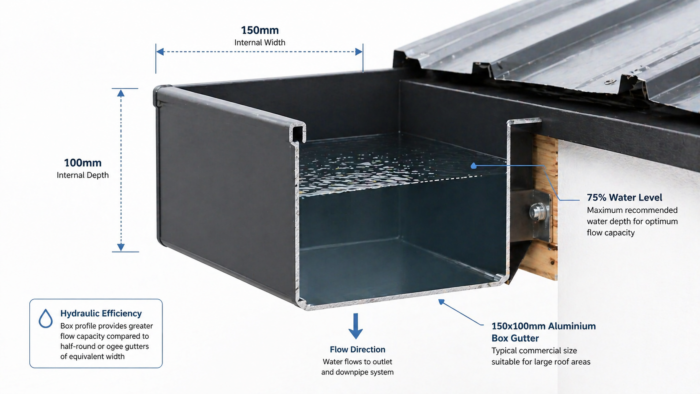
The hydraulic advantage of a box gutter over a half-round or ogee comes from how the cross-sectional area is used. In a half-round gutter, the semicircular profile means the channel depth is at its maximum only at the very centre. Toward the edges, the depth tapers rapidly. In a box gutter, the full internal depth is maintained across the entire width of the channel, so the full cross-sectional area is available for water flow.
In practice, this means a 125mm wide box gutter can handle significantly more water flow than a 125mm half-round gutter of the same nominal front width. This is why box gutters are the standard choice for commercial buildings, industrial units, and any project where roof areas are large and rainfall drainage capacity is a genuine engineering consideration.
The rectangular form also makes box gutters well-suited to situations where the gutter needs to be integrated flush with the roofline or hidden behind a parapet wall, since the flat rear face sits neatly against a fascia board and the clean top profile can be finished flush with the roof level.
Where aluminium box gutters are typically used
- Commercial and industrial buildings: Warehouses, factories, distribution centres, retail units, and office buildings. The large roof areas typical of commercial construction require the higher flow capacity that box gutters provide.
- Steel-frame and cladded buildings: The angular profile of a box gutter suits the straight lines of a steel-frame building far better than a traditional rounded profile. Most commercial steel-frame construction in the UK specifies aluminium box guttering as standard.
- Contemporary residential new build: On architect-designed and high-specification residential new build, box gutters are specified for their clean, architectural appearance and their ability to carry more water than equivalent-width half-round gutters.
- Extensions and flat-roofed structures: Box gutters are commonly used on residential extensions, single-storey rear additions, garage roofs, and conservatories where the roofline detail needs a low-profile, flat-faced gutter that sits neatly against a shallow fascia.
- Concealed eaves gutter details: Where the architectural intent is to hide the gutter behind a parapet or fascia capping system, the flat top of a box gutter allows it to be installed flush with or below the roof level, with the gutter visible only from below.
| Metal Profiles Ltd supplies aluminium box gutters in standard sizes from 100x75mm up to 200x150mm and in custom bespoke profiles for projects with unusual drainage requirements. All products are powder-coated in any RAL classic colour, batch-matched with fascia, soffit, and downpipe components for a fully consistent roofline specification. Contact our team at sales@metal-profiles.co.uk or call 07907 239290 to discuss your project. |
Aluminium Box Gutter Sizes: Standard Profiles and What Each One Is For
Understanding the standard size range and when each size is appropriate is fundamental to correct specification. Undersized gutters overflow in heavy rain. Oversized gutters cost more than necessary and can look out of proportion on smaller buildings. Getting the size right means working through the hydraulic sizing calculation for your specific roof area and rainfall intensity, not guessing based on what the previous gutter was.
Standard size range
Aluminium box gutters in the UK are manufactured to standard profiles defined by their external width and internal depth. The most commonly available standard sizes are:
| Profile (W x D) | Internal cross-section | Approx. flow capacity | Typical effective roof area | Typical application |
| 100 x 75mm | Approx 65 x 60mm internal | ~1.3 l/s | Up to ~60 m2 (single outlet) | Small residential extension, garage, conservatory |
| 115 x 75mm | Approx 80 x 60mm internal | ~1.8 l/s | Up to ~80 m2 | Residential single-storey, garden room |
| 125 x 100mm | Approx 90 x 85mm internal | ~2.8 l/s | Up to ~130 m2 | Residential and small commercial |
| 150 x 100mm | Approx 115 x 85mm internal | ~3.8 l/s | Up to ~175 m2 | Commercial units, light industrial |
| 150 x 115mm | Approx 115 x 100mm internal | ~4.6 l/s | Up to ~210 m2 | Medium commercial, steel frame buildings |
| 180 x 115mm | Approx 145 x 100mm internal | ~6.0 l/s | Up to ~275 m2 | Large commercial and industrial |
| 200 x 150mm | Approx 165 x 135mm internal | ~9.0 l/s | Up to ~410 m2 | Large industrial, distribution, warehouse |
| The flow capacity figures and effective roof area estimates in the table above are indicative and based on standard UK South East rainfall intensity of 0.022 litres per second per square metre with a single end outlet. For accurate specification, always carry out a proper hydraulic sizing calculation using BS EN 12056-3:2000 with the actual roof area, pitch multiplier, and local rainfall intensity for the specific project site. Oversizing is preferable to undersizing, but should be proportionate. |
Standard section lengths
Aluminium box gutter sections are typically available in 1m, 2m, and 3m lengths. The choice of section length affects the number of joints in a given run and therefore the number of potential leak points. Longer sections mean fewer joints, which is generally preferable, but longer sections are also more difficult to handle on site and require more careful attention to expansion gap allowance at each joint.
For a run of 12m, using 3m sections gives three joints. Using 2m sections gives five joints. If the fascia board has awkward fixing positions or the building geometry requires sections of specific lengths, shorter sections allow more flexibility. For long straight commercial runs where simplicity and speed of installation matter most, 3m sections are usually the practical choice.
Section lengths and thermal expansion
Aluminium has a coefficient of thermal expansion of approximately 0.000023mm per millimetre per degree Celsius. Over a realistic UK temperature range of around minus 5 degrees Celsius in winter to plus 40 degrees Celsius in direct sun in summer, that is a range of approximately 45 degrees. For a 3m (3000mm) aluminium box gutter section, the total movement over that temperature range is approximately 3.1mm.
This is why a 3 to 4mm expansion gap must be left between the plain ends of adjacent gutter sections at every joint. If the sections are pushed up tight against each other with no expansion gap, the system will buckle in summer as the aluminium expands. This is one of the most common installation errors on aluminium box gutter systems and one of the most avoidable.
How to Size an Aluminium Box Gutter: The BS EN 12056-3 Method
Getting the sizing right is arguably the most important part of the specification process. An undersized system will overflow on the first heavy rain event. An oversized system wastes money and may look out of proportion. The correct approach is to follow the calculation method set out in BS EN 12056-3:2000, which is the British Standard governing roof drainage design.
The process involves several steps, and while the maths is not complicated, it does require some specific data about the building and the site. Here is a simplified walkthrough of the key steps.
Step 1: Calculate the effective roof area
The effective roof area is not simply the plan area of the roof as seen from above. For a pitched roof, the rainwater collection area is larger than the plan area because the slope presents a greater surface to the rain. A pitch multiplier is applied to the plan area to give the effective roof area.
Common pitch multipliers are:
- Flat roof (0 to 5 degrees): multiplier of 1.0
- 10 degree pitch: multiplier of 1.02
- 20 degree pitch: multiplier of 1.06
- 30 degree pitch: multiplier of 1.15
- 45 degree pitch: multiplier of 1.41
For a pitched roof that drains to one side only, the effective roof area is the plan area of one slope multiplied by the pitch multiplier. For a roof that drains to both sides into a central valley gutter, calculate each slope separately.
Step 2: Find the design rainfall intensity for the site
UK rainfall intensity for gutter sizing is based on a 2-minute storm event with a return period of one year (the intensity used in BS EN 12056-3 for standard roofs). For the South East of England, this is typically 0.022 litres per second per square metre. For other parts of the UK, the intensity varies.
Indicative design rainfall intensities for the UK from the Met Office rainfall data:
- South East England (including Essex and London): 0.022 l/s/m2
- South West England: 0.021 to 0.024 l/s/m2 depending on locality
- Midlands: 0.020 to 0.022 l/s/m2
- North West England and North Wales: 0.024 to 0.028 l/s/m2
- Scotland and Northern Ireland: 0.026 to 0.035 l/s/m2 in wetter areas
For a precise design intensity for your specific project location, use the Met Office rainfall frequency estimation tool or request site-specific data from a hydraulic engineer.
Step 3: Calculate the design flow rate
Multiply the effective roof area by the design rainfall intensity to get the required flow rate in litres per second:
Required flow rate (l/s) = effective roof area (m2) x design rainfall intensity (l/s/m2)
For a 200 m2 effective roof area in the South East:
200 x 0.022 = 4.4 litres per second required flow capacity
Step 4: Select the gutter size
Compare the required flow rate against the published flow capacity data for the box gutter profiles you are considering. The selected gutter must have a published flow capacity at least equal to the required flow rate calculated above.
Using the size guide table in the previous section, a 200 m2 effective roof area in the South East requires 4.4 l/s, which falls within the capacity range of a 150x115mm box gutter profile (rated at approximately 4.6 l/s). The 150x100mm profile at approximately 3.8 l/s would be marginal at this area and should not be used. Going up to the 180x115mm profile at 6.0 l/s would provide a useful safety margin and might be the right choice for an exposed site or a building with a complex roof geometry where water may concentrate.
Outlet and downpipe sizing
The gutter sizing only deals with the collection channel. The outlet and downpipe need to be sized to handle the same flow rate. For standard single outlet configurations, the downpipe diameter must be adequate to convey the flow away from the gutter without backing up and causing the gutter to fill beyond its design depth.
Typical downpipe sizing guidance for aluminium box gutter systems:
- Up to approximately 2.0 l/s: 75mm round downpipe
- 2.0 to 4.0 l/s: 100mm round downpipe
- 4.0 to 7.0 l/s: 100mm rectangular downpipe or 125mm round
- Over 7.0 l/s: 150mm downpipe or multiple outlets
| On commercial projects, it is worth considering using two smaller outlet and downpipe arrangements rather than one large outlet at the end of a long run. A centre outlet with two half-length gutter runs effectively doubles the drainage capacity for the same gutter profile, because each half of the run only needs to carry the flow from its own section of roof. This approach can allow a smaller gutter profile to be specified where a single-outlet design would require a larger one. |
Types of Aluminium Box Gutter: Profiles, Configurations and Special Forms
Not all aluminium box gutters are the same profile. Beyond the standard rectangular box, there are several variations that are worth understanding as they suit different architectural situations.
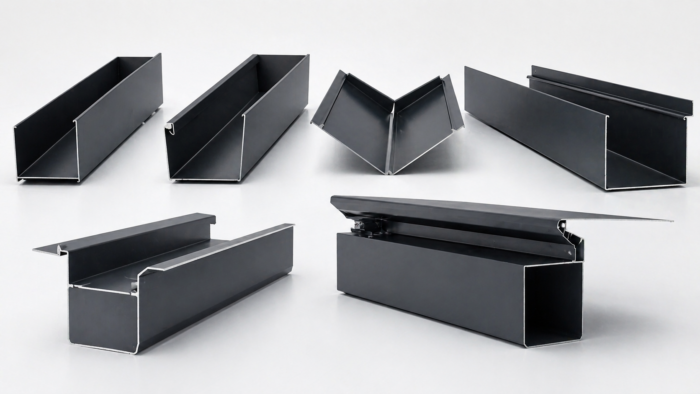
Standard pressed box gutter
The most widely used form. Pressed from 1.2mm to 2mm aluminium sheet into a rectangular profile, supplied in standard lengths with factory-drilled fixing holes at 750mm centres on the back face. The joggle joint system, where one end of each section is formed into a larger-diameter spigot that accepts the plain end of the next section, provides the standard method of jointing in pressed aluminium box gutter systems.
Pressed box gutters are available in profiles from 100x75mm up to 200x150mm and beyond in custom sizes. They are the default specification for most commercial and residential applications where a standard rectangular gutter profile meets the architectural and hydraulic requirements.
Shaped or bevelled box gutter
A shaped box gutter has a sloping front face rather than a vertical one. The slope is typically at 70 to 80 degrees from horizontal, giving a slightly softer, more architectural appearance than the fully rectangular profile. This profile is popular on contemporary residential architecture where the box gutter is visible from below and the specifier wants a softer roofline detail than a hard-edged rectangular form.
Hydraulically, the shaped profile performs similarly to a standard box gutter of equivalent cross-sectional area. The internal cross-section remains rectangular at the base of the channel, which is where the water flows.
Concealed eaves or flush-fit box gutter
In some architectural details, particularly on buildings with a pronounced parapet wall or on flat-roof extensions where the roof is finished flush with a fascia capping system, the gutter can be installed so that it sits below the roofline level and is concealed from view from the street. Only the soffit, the fascia face, and the top edge of the gutter are visible from below.
This concealed detail requires careful thought about the outlet position (outlets need to be accessible for maintenance without dismantling the fascia system) and about the drainage fall (a concealed gutter with no accessible clean-out point is a maintenance problem waiting to happen). Metal Profiles Ltd can advise on the detail design for concealed gutter installations.
Valley gutter
An aluminium valley gutter is a wider, shallower channel formed in the internal angle where two roof slopes meet. Valley gutters are technically a specialised form of box gutter: the same pressed aluminium construction, the same jointing and expansion principles, but with a wider and often lower-profile to suit the valley geometry.
Valley gutters handle concentrated water flow from both adjacent roof slopes simultaneously, which means they need to be sized for the combined effective area of both slopes draining into the valley. Undersized valley gutters are a common cause of significant water ingress on larger buildings.
Parapet gutter
A parapet gutter runs along the inside face of a parapet wall, draining water from the flat roof area behind the parapet down through a through-parapet outlet or a drain at the base of the parapet. These are often internal gutters in the sense that they are not visible from outside the building, but they handle significant water volumes in heavy rain and must be sized accordingly. Because they are internal, any failure or overflow routes water into the building structure rather than harmlessly over the edge, which makes correct sizing and reliable joint sealing particularly important.
Aluminium Box Gutter Installation: Step-by-Step
This guide covers the installation of a standard pressed aluminium box gutter on a fascia-fixed residential or commercial application. For parapet gutters, valley gutters, or concealed eaves installations that require bespoke bracket arrangements or structural fixings, additional project-specific guidance from the fabricator is recommended.
All work at height must comply with the Health and Safety Executive guidance on safe working at height. For any commercial installation or work above single-storey level, a scaffold tower or full scaffold is required.
What you will need
- Aluminium box gutter sections in the specified profile and lengths
- Fascia brackets at the specified centres (750mm maximum, additional bracket within 375mm of every joint and fitting)
- Running outlets positioned above the downpipe connections
- Stop ends for the gutter terminations
- Angles (90-degree internal and external) for corner details
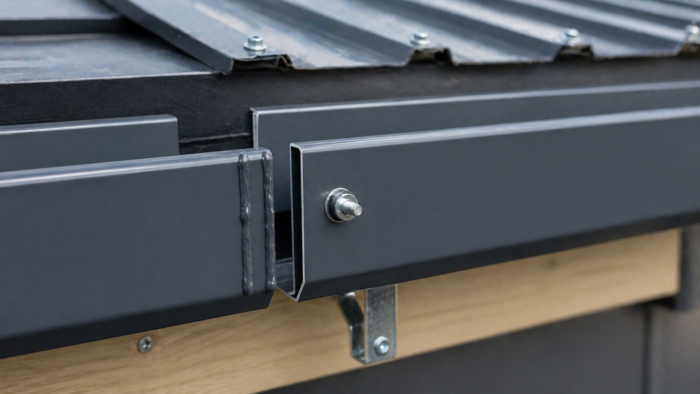
- M6 x 20mm aluminium bolts, neoprene washers, and nuts for joggle joints
- Low modulus silicone sealant (Arbosil 1096 or equivalent)
- Stainless steel countersunk screws (M5 x 25mm) for direct-fix applications
- Spirit level and chalk line
- Tin snips or fine-tooth aluminium saw blade for cutting to length
- Acetone and clean cloths for surface preparation at joints
- Scaffold tower or appropriate access equipment
Step 1: Survey the fascia and mark out the bracket positions
Before any brackets go up, check the condition of the existing fascia boards. The fascia must be structurally sound to carry the gutter loads. Probe any suspect sections with a screwdriver: soft or spongy timber needs replacing before the gutter is installed. A gutter fixed to a rotted fascia will fail within one or two winters, regardless of how good the gutter system itself is.
Snap a chalk line along the fascia to mark the top line of the gutter brackets. The fall to the outlet must be set at this stage. For a standard installation, a fall of 1 in 350 is the minimum toward the outlet. A slightly steeper fall of 1 in 200 or 1 in 150 helps the system self-clear debris and reduces the risk of standing water in the gutter between rain events. Check the starting height at the high end allows adequate clearance under the bottom course of tiles or the roof edge membrane.
Mark bracket positions along the chalk line at 750mm centres maximum. Always position an additional bracket within 375mm of every gutter joint and within 375mm of every outlet or angle fitting. These additional brackets at fittings prevent the gutter from deflecting at the joint or fitting position under load.
Step 2: Fix the outlet first
Fit the running outlet before fixing any gutter sections. The outlet position is fixed by the drainage connection below, and everything else in the gutter run is measured from the outlet. Fix the outlet to the fascia at the chalk line height, ensuring it is level side to side. Mark the downpipe position below before fitting.
Step 3: Fix the brackets
Fix the fascia brackets at the marked positions using the correct fixing for the substrate. Into timber fascia boards, use M5 x 25mm stainless steel countersunk screws. Into metal purlins or steel fascia, use appropriate self-tapping stainless screws. All fixings must be stainless steel: zinc-plated or galvanised fixings against aluminium will cause bimetallic corrosion and will leave rust staining on the fascia within a couple of years.
Set each bracket to the chalk line fall, checking regularly with a spirit level. Work from the high end of the run toward the outlet. At corners, fit the angle fitting first and then measure back from the corner for the adjacent straight run bracket positions.
Step 4: Fix the stop end at the high (non-outlet) end
The stop end closes off the gutter at its termination point. Fit the stop end to the first section of gutter before offering the gutter up to the brackets. Apply a bead of sealant around the interior face of the stop end where it will contact the gutter section, fit the stop end flush with the gutter end face, and secure with the supplied fixings.
Step 5: Offer up and fix the gutter sections
Working from the stop end toward the outlet, offer up the first gutter section to the fixed brackets. Clip the gutter onto the bracket heads from above. For direct-fix applications where the gutter is screwed through pre-drilled holes directly to the fascia, align the drilled holes with the marked positions and drive the stainless screws.
At each joint between gutter sections, the procedure is:
- Clean both mating faces thoroughly with acetone on a clean cloth and allow to dry completely. Any grease, moisture, or contamination will prevent the sealant from adhering correctly.
- Apply two 6mm continuous beads of Arbosil 1096 Low Modulus silicone sealant along the plain end of the gutter, running parallel to the length of the gutter and clear of the fixing holes.
- Slide the joggle-formed spigot end of the adjacent section over the prepared plain end. Do not push up fully tight: leave a 3 to 4mm expansion gap between the butt ends of the two sections. The sealant bead should compress to form a watertight seal without being squeezed out completely.
- Insert M6 x 20mm aluminium bolts through the pre-drilled holes in the joggle joint, fit neoprene washers on both faces, and tighten nuts until a small bead of sealant is visible emerging from around the joint. Apply a small bead of sealant around each bolt head.
| Do not use standard grey silicone from a DIY store for aluminium box gutter joints. A low modulus sealant such as Arbosil 1096 is specified because it remains flexible through the thermal movement cycles of the gutter over its service life. Standard high-modulus silicone will crack at the joint within a few seasons as the aluminium expands and contracts. |
Step 6: Handle angles and bends
At corner angles, use factory-formed 90-degree angle fittings rather than attempting to cut and mitre the gutter on site. Factory fittings give a cleaner, stronger, and more watertight result than a site-cut mitre joint. Apply sealant to the interior faces of the angle fitting before assembling, in the same way as for a straight joggle joint. Remember the additional bracket within 375mm on each side of the angle fitting.
Step 7: Install the downpipe
Once the gutter run is complete, fit the aluminium downpipe from the outlet to the drain connection. Fix the downpipe with downpipe brackets at a maximum of 1.5m centres, reducing to 1.0m in exposed or high-wind locations. Use matching aluminium offset bends to bring the downpipe in against the building face if the outlet projects forward of the wall. Leave a small expansion gap at each downpipe joint and apply the specified sealant.
For the connection to the underground drainage system, a swan-neck offset or a downpipe shoe should divert the water away from the building base at a minimum distance of 200mm before it enters the drain or soak-away.
Step 8: Test the system
Before signing off the installation, test the entire system with water. Run a hose into the gutter at the high end of the run and confirm: water flows toward the outlet without backing up or pooling; all joints are watertight; the outlet and downpipe convey the water away without overflow or backing up; and the downpipe discharges at the correct drain connection point.
In the unlikely event of a joint leak during testing, mark the position, allow the area to dry fully, remove the bolt and clean away all existing sealant, and re-apply with fresh sealant before re-testing.
| Annual maintenance: aluminium box gutters require minimal maintenance but benefit from an annual inspection and clear-out in autumn after leaf fall. Check for debris accumulation in the gutter channel, particularly at and around outlets. Clear any blockages before winter. Check that the outlet screen, if fitted, is clear. Inspect joints for any signs of sealant degradation, particularly on older installations. A gutter that is kept clear of debris and has its joints in good condition will perform reliably for 40 or more years. |
Common Aluminium Box Gutter Mistakes and How to Avoid Them
The majority of aluminium box gutter failures on UK buildings come from a relatively small number of recurring mistakes. Understanding them means you can avoid them on new installations and diagnose them when called to inspect a failing system.
Insufficient fall toward the outlet
A box gutter that runs level or with a slight fall away from the outlet will have sections of standing water in it permanently between rain events. Standing water accelerates joint and sealant degradation, encourages algae and moss growth in the gutter, and means that in the first heavy rain after a dry period, debris that has dried out in the standing water section mobilises and can block the outlet.
The minimum fall toward the outlet should be 1 in 350. A fall of 1 in 200 or steeper is better if the roof geometry allows it. On a long run, check the fall at multiple points as you fit brackets rather than only at the start and end.
Bracket spacing too wide
750mm is the maximum bracket centre distance for aluminium box gutters. On many poorly installed systems, brackets are placed at 1000mm or more, which results in visible sag between brackets, particularly when the gutter is full of water. A full 150x100mm box gutter contains a significant weight of water per metre length. At 1000mm bracket centres, the section between brackets deflects noticeably under full load.
Remember the additional brackets within 375mm of every joint, outlet, and angle fitting. These are not optional. Without them, the fitting positions are the most likely point of deflection and eventual joint failure.
Missing expansion gaps
As discussed in the sizing section, a 3 to 4mm expansion gap must be maintained at every joggle joint between gutter sections. Systems installed with sections pushed up tight against each other will develop buckled sections in hot summer conditions as the aluminium expands. This is one of the easiest mistakes to avoid and one of the most expensive to fix once the gutter run has been installed.
Wrong sealant type
Using high-modulus silicone or standard grab adhesive at joints is a very common source of gutter joint failures. These products do not accommodate the thermal movement of the aluminium and will crack within one or two years. Always use a low-modulus silicone sealant specified for aluminium rainwater systems. Arbosil 1096 is the industry standard; other products with equivalent low-modulus specification are also acceptable.
Steel fixings against aluminium
Zinc-plated or galvanised steel screws in contact with aluminium in the presence of moisture cause bimetallic corrosion at the fixing point. Within a few years, the fixing shows rust staining on the surrounding aluminium and the fixing itself begins to corrode. The joint eventually becomes mechanically weak. Always use stainless steel (A2 grade minimum, A4 for highly exposed coastal locations) for all fixings into aluminium gutter systems.
Ignoring the fascia condition
Fitting new aluminium box gutters to a rotted or structurally compromised fascia is one of the most common false economies in roofline installation. The gutter system is only as good as what it is fixed to. If the fascia is soft, the brackets will eventually work loose as the fasteners pull through the compromised timber. The gutter will sag, the falls will become inconsistent, and joint integrity will deteriorate. Replace damaged fascia sections before fitting new guttering.
Design Uses: Aluminium Box Gutters Across Different Building Types
Commercial and industrial buildings
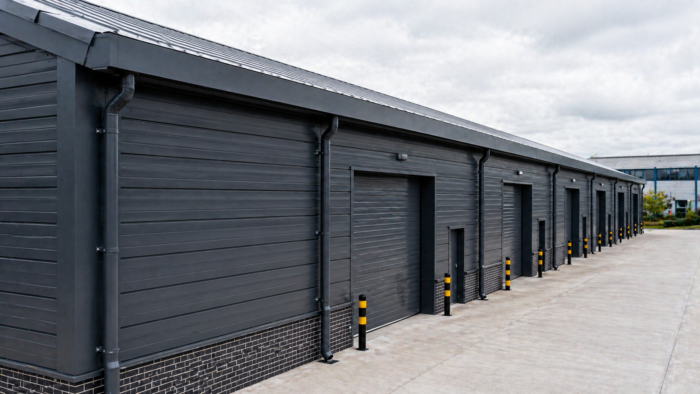
The majority of aluminium box gutter installations in the UK are on commercial and industrial buildings. Steel-frame warehouses, distribution centres, retail sheds, factory units, office blocks, and similar structures typically have large roof areas, high rainfall volumes, and an architectural style that suits the angular profile of a box gutter far better than a traditional half-round or ogee.
On these buildings, the gutter specification is usually part of the overall cladding and roofline package. The fascia profile, the gutter size and colour, the downpipe diameter and positions, and the connection to the underground drainage system are all co-ordinated elements of the same specification. Metal Profiles Ltd supplies box gutters, downpipes, fascia, and soffit as a coordinated system in matched powder-coat colours for commercial building projects. See our aluminium rainwater goods and roofline range for the full specification.
Residential new build and high-specification renovation
On residential new build, box gutters are specified as a contemporary alternative to half-round on architect-designed and high-specification projects. The angular profile suits the clean lines of a modern building. In anthracite grey (RAL 7016) or jet black (RAL 9005), aluminium box gutters coordinate effectively with dark window frames, charcoal render, and contemporary building materials.
The higher flow capacity of a box gutter versus a same-width half-round is also relevant on houses with large, steeply pitched roofs, where a standard half-round profile would need to be oversized to handle the concentrated rainfall from a steep pitch.
Extensions and single-storey additions
Single-storey rear and side extensions, garden rooms, outbuildings, and conservatories all commonly use box gutters. For extensions where the roof is flat or low-pitch and the fascia is shallow, a 100x75mm or 115x75mm box gutter provides adequate capacity for the smaller roof area while maintaining a low-profile appearance that suits the shallow fascia detail.
Box gutters are particularly practical on extensions because they can be installed at the very bottom of the fascia board, with no overhang projecting beyond the building line. This is useful where the planning clearance above a window or door is minimal and a projecting gutter would obstruct the visual or require a downstand.
For guidance on how box gutters integrate with aluminium fascia and soffit on residential extensions, see our related guide: What Is a box gutters? Complete UK Guide.
Fire compliance and high-rise buildings
On residential buildings above 18m in England, all external materials including rainwater goods must meet A1 or A2-s1,d0 fire classification under BS EN 13501-1. Aluminium achieves A2-s1,d0 as standard without additional treatment or testing. uPVC and timber rainwater goods do not achieve this classification and are not compliant for use on high-rise residential buildings under Approved Document B.
This is an increasingly significant specification consideration as more UK residential developments are built above 11m and 18m. Aluminium box guttering specified from Metal Profiles Ltd meets the fire compliance requirement as standard. For the full regulatory context, see Approved Document B and the guidance on external fire performance from the NFRC (National Federation of Roofing Contractors).
Aluminium Box Gutter vs Other Materials and Gutter Types
| Factor | Aluminium box | uPVC box | Galvanised steel box | Cast iron half-round |
| Weight | Light | Very light | Heavy | Very heavy |
| Fire classification | A2-s1,d0 (non-combustible) | Class D (combustible) | A2 or A1 | A1 |
| Rust risk | None | None | Yes, if coating fails | Yes, if not painted regularly |
| Lifespan | 40+ years | 20-30 years | 20-25 years with intact coat | 50+ years if maintained |
| Maintenance | Minimal – clear annually | Clear annually | Inspect coating annually | Paint every 5-10 years |
| Colour options | Any RAL powder coat | Limited range | Any powder coat | Any paint colour |
| High-rise compliant | Yes (A2-s1,d0) | No | Yes | Yes |
| Thermal movement | Moderate – expansion gaps needed | High – more gaps needed | Low | Low |
| Bespoke sizes | Yes – cost-effective | Limited | Yes | Very expensive to custom cast |
| Aesthetic | Clean modern angular | Functional | Industrial | Traditional heritage |
The comparison between aluminium and uPVC box gutters comes up frequently in discussions about residential extensions and new build. For most domestic applications, uPVC is a functional and cost-effective choice and there is nothing wrong with specifying it on a standard residential project. The case for aluminium over uPVC strengthens considerably as the building height increases, as the specification level rises, as the importance of colour-matching across a coordinated roofline system increases, and where fire compliance for high-rise buildings is a requirement.
Aluminium Box Gutters from Metal Profiles Ltd
Metal Profiles Ltd supplies aluminium box gutters and a full coordinated aluminium roofline system from our facility in Chelmsford, Essex. Our products are supplied to contractors, architects, developers, and self-builders across the UK.
Our aluminium box gutter range covers standard profiles from 100x75mm to 200x150mm and bespoke sizes for projects with unusual requirements. All products are powder-coated in any RAL classic colour, with batch-matching across all components in a project order. We supply gutters, downpipes, outlets, stop ends, angles, brackets, and all associated fittings.
We also supply a coordinated roofline system alongside the guttering, including aluminium fascia boards in our standard Types 1 to 4, aluminium soffit boards in solid and vented versions, and aluminium copings for parapet wall details. All products batch-powder-coated together for guaranteed colour consistency across the full roofline.
For technical advice on sizing, specification, or installation details for a specific project, contact our team at sales@metal-profiles.co.uk or on 07907 239290. We are happy to work through BS EN 12056-3 sizing calculations with you or to advise on profile selection for an unusual building geometry.
2026 UK Cost Guide for Aluminium Box Gutters
Prices for aluminium box guttering depend on profile size, length, colour, and quantity. The table below gives indicative supply-only prices for standard profiles as a planning guide. Contact Metal Profiles Ltd for a project-specific quotation.
| Product | Specification | Indicative price (inc. VAT) | Notes |
| Aluminium box gutter 100x75mm, 3m | Pressed, any RAL | £18 – £28/length | Residential extension size |
| Aluminium box gutter 125x100mm, 3m | Pressed, any RAL | £24 – £36/length | Residential and small commercial |
| Aluminium box gutter 150x100mm, 3m | Pressed, any RAL | £32 – £48/length | Commercial roofline |
| Aluminium box gutter 200x150mm, 3m | Pressed, any RAL | £55 – £80/length | Large industrial / warehouse |
| Aluminium downpipe 75mm round, 3m | Pressed, any RAL | £14 – £22/length | Standard residential |
| Aluminium downpipe 100mm round, 3m | Pressed, any RAL | £18 – £28/length | Commercial applications |
| Running outlet (round or rectangular) | Matching RAL | £8 – £18 each | Per outlet position |
| Stop end | Matching RAL | £5 – £12 each | Per termination |
| 90-degree angle fitting | Matching RAL | £12 – £22 each | Per corner |
| Fascia bracket | Stainless or aluminium | £2 – £5 each | Per bracket position |
| Bespoke profile gutter (per metre) | Any size, any RAL | POA | Quote within 24-48 hours |
Frequently Asked Questions About Aluminium Box Gutters
-
What is an aluminium box gutter?
An aluminium box gutter is a rainwater collection channel with a rectangular cross-section, pressed from aluminium alloy sheet and installed at the roofline to collect water from the roof and convey it to the downpipe drainage system. It differs from a half-round or ogee gutter in both its square profile and its higher hydraulic flow capacity for a given channel width.
-
What size aluminium box gutter do I need?
The correct size depends on the effective roof area draining to the gutter and the local rainfall intensity. The calculation method set out in BS EN 12056-3:2000 gives the required flow rate in litres per second, which is then matched against the published flow capacity data for different gutter sizes. As a rough guide: a 100x75mm profile suits small residential extensions up to about 60 m2; a 125x100mm profile suits residential roofs up to about 130 m2; a 200x150mm profile is needed for large industrial roofs up to about 400 m2. Metal Profiles Ltd can assist with BS EN 12056-3 calculations for specific projects.
-
How far apart should box gutter brackets be?
The maximum bracket spacing for aluminium box gutters is 750mm centres. An additional bracket must be positioned within 375mm of every gutter joint, outlet, and angle fitting. In high-wind or snow-load areas, reduce to 600mm centres. Using too-wide bracket spacing is one of the most common causes of visible sag in box gutter installations.
-
What expansion gap should I leave between aluminium box gutter sections?
Leave a 3 to 4mm expansion gap at the joggle joint between each pair of gutter sections. Aluminium expands approximately 1.4mm per metre over a typical UK temperature range. Without expansion gaps, the gutter will buckle in hot summer conditions. This gap is accommodated by the sealant at the joint, which remains flexible and watertight through the movement.
-
What sealant should I use for aluminium box gutter joints?
Use a low modulus silicone sealant specified for aluminium rainwater systems. Arbosil 1096 is the industry standard product for this application. Standard high-modulus silicone or grab adhesive will crack at the joint within one or two seasons as the aluminium goes through thermal movement cycles. The low modulus sealant remains flexible and watertight throughout.
-
Are aluminium box gutters fire rated?
Yes. Aluminium achieves A2-s1,d0 reaction to fire classification under BS EN 13501-1. This is the non-combustible classification required for external materials on residential buildings above 18m under Approved Document B. uPVC guttering is classified as combustible (Class D) and is not compliant for use on high-rise residential buildings.
-
How long does an aluminium box gutter last?
A quality powder-coated aluminium box gutter, correctly installed and maintained with an annual clear-out, should last 40 or more years. The aluminium itself does not rust. The powder-coat finish is rated for 20 or more years of external exposure without fading or peeling. The sealant at joints may need renewing on older installations after 20 or more years, but this is a straightforward maintenance task.
-
Can aluminium box gutters be used on a residential house?
Yes. Box gutters are used extensively on residential extensions, new build houses, and as replacements on standard residential rooflines. They are particularly popular where a clean contemporary roofline detail is wanted, where the roof area is larger than a standard half-round profile can handle effectively, or where coordinating the gutter colour with other aluminium roofline components (fascia, soffit, copings) is part of the design brief.
-
How do I join aluminium box gutter sections?
Standard pressed aluminium box gutters use a joggle joint system: one end of each section is formed into a larger-diameter spigot that accepts the plain end of the next section. Clean both mating surfaces with acetone, apply two beads of low modulus silicone sealant to the plain end, slide the sections together leaving a 3 to 4mm expansion gap, and secure with M6 x 20mm aluminium bolts, neoprene washers, and nuts tightened until sealant just starts to emerge at the joint edges.
Discover more from Metal Profiles Ltd
Subscribe to get the latest posts sent to your email.