


Aluminium Box Gutter: 7 Types, Sizes & Complete Installation Guide UK

There is something very satisfying about a well-designed aluminium box gutter. When you see it installed correctly on a modern building, the clean rectangular profile sitting flush with the fascia line, no visible drips, no staining on the brickwork below, you can appreciate exactly why architects and specifiers keep coming back to it for commercial and high-specification residential projects.
But box gutters are also one of those products where getting the specification wrong is genuinely costly. An undersized system overflows in heavy rain. A poorly installed joint leaks within one winter. The wrong bracket spacing and the whole run sags visibly. Unlike half-round gutters where mistakes are fairly forgiving, box gutters need to be done properly from the start, and that means understanding the system properly before anything gets fixed to a fascia.
This guide covers everything: what an aluminium box gutter is, how it differs from other gutter types, the standard sizes and what each one is suited to, how to size a system correctly using BS EN 12056-3, installation steps and common mistakes, and what to look for when specifying for a project. It is written for contractors, architects, self-builders, and anyone who wants to understand the product properly rather than just guess and hope for the best.
This aluminium box gutter UK guide explains everything you need to know about choosing the right system for modern buildings.
Metal Profiles Ltd supplies aluminium guttering and rainwater systems across the UK from our base in Chelmsford, Essex. We offer both standard and bespoke aluminium gutter and rainwater products, and our team is available to help you specify the right system for any project. See our aluminium gutter and box gutter guide for a companion piece to this article.
What Is an Aluminium Box Gutter?
An aluminium box gutter is a rectangular cross-section gutter channel manufactured from pressed or extruded aluminium sheet. Unlike half-round gutters, which have a curved interior profile, or ogee gutters, which have a decorative shaped face, a box gutter has four flat sides forming a rectangular or square channel. That flat geometry is what gives it a higher flow capacity per unit width than curved profiles, and it is also what gives it the clean, architectural appearance that suits contemporary building design so well.
The term box gutter gets used in slightly different ways in the industry. It can refer specifically to a pressed aluminium channel section fixed to the face of the fascia in the same way as any eaves gutter, which is the type this guide focuses on. It can also refer to a built-in structural gutter valley within a flat roof construction, which is a different product and a different installation approach. When specifying, always make sure you and your supplier are talking about the same thing.
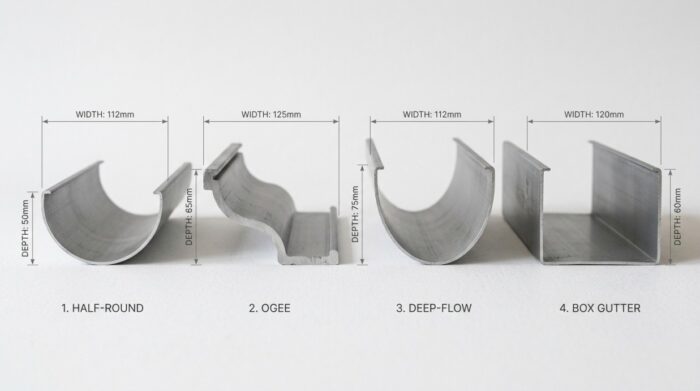
The key practical difference between a box gutter and a traditional half-round or ogee profile is flow capacity. A rectangular cross-section is hydraulically more efficient than a semicircular one of the same nominal width because the flat base and vertical sides use the full volume of the channel rather than tapering to a point at the bottom. This means a 125mm x 100mm box gutter can carry significantly more water than a 125mm half-round gutter of the same front width.
In this aluminium box gutter UK guide, different types and sizes are used depending on the building structure and drainage requirements.
Visually, box gutters project a flat, angular face from the roofline rather than the curved projection of a half-round. That suits buildings with flat or low-pitch roofs, steel frame construction, and contemporary architectural styles. On a Victorian terrace or a traditional cottage, a box gutter often looks out of place. On a new-build commercial unit, a flat roof extension, or a modern housing development, it looks exactly right.
| Feature | Box gutter | Half-round | Ogee / moulded | Deep-flow |
| Cross-section shape | Rectangle | Semicircle | Decorative S-curve | Deep ellipse |
| Flow capacity | High | Standard | Standard-high | High |
| Visual style | Modern / angular | Traditional | Period | Modern |
| Best suited to | Commercial, flat roof, new-build | Residential, heritage | Victorian, period | Larger roofs, residential |
| Fits concealed system | Yes (with fascia) | Partially | Partially | No |
| Standard bracket spacing | 750mm centres | 750mm centres | 750mm centres | 750mm centres |
| UK Standard | BS 9101:2017 | BS 9101:2017 | BS 9101:2017 | BS 9101:2017 |
Aluminium Box Gutter Sizes: What Is Available and What Each Size Suits
Box gutters are available in a range of standard sizes defined by their width and depth dimensions. The width is typically the external measurement across the front face (or top opening), and the depth is the internal measurement from the base of the channel to the top lip. Knowing both dimensions matters because the internal cross-sectional area is what determines the flow capacity, not just the width.
Standard aluminium box gutter sizes
| Size (W x D) | Internal area (approx.) | Max. eff. roof area | Typical use | Downpipe size |
| 100mm x 75mm | ~65cm2 | Up to 30m2 | Small garage, outbuilding, extension | 63mm round |
| 125mm x 100mm | ~105cm2 | Up to 60m2 | Standard domestic, terrace, small commercial | 75mm round or 65mm sq |
| 150mm x 100mm | ~130cm2 | Up to 80m2 | Larger domestic, semi-detached, bungalow | 75mm or 100mm round |
| 150mm x 150mm | ~190cm2 | Up to 120m2 | Commercial, industrial, large flat roof | 100mm round or square |
| 200mm x 150mm | ~260cm2 | Up to 180m2 | Large commercial, warehouse, sports hall | 100mm+ round or square |
| 200mm x 200mm | ~340cm2 | Up to 240m2 | Industrial, large flat roof, specialist | 150mm+, or multiple pipes |
Effective roof area figures above are approximate and based on a single end outlet with standard UK rainfall intensity of 0.022 litres per second per square metre for the South East. Centre outlets effectively double the drainage capacity for a given run. For accurate sizing, always carry out a proper BS EN 12056-3 calculation using your site-specific roof area, pitch, and local rainfall intensity data.
| If you are not sure which size to specify, our team can help you work through the BS EN 12056-3 calculation for your project. Contact us via the request an estimate page and provide your roof plan dimensions, pitch, and location. We can advise the correct gutter and downpipe sizes for your project. |
Request an estimate from Metal Profiles Ltd
Section lengths
Standard aluminium box gutter sections are typically supplied in 1m, 2m, 2.5m, and 3m lengths. The 3m length is the most commonly used on residential and commercial projects because it minimises the number of joints per run while keeping sections manageable to handle at height. Shorter lengths are useful for tight spaces, for cutting to fit at returns, and for projects where access restricts what can be manoeuvred on site.
Where long uninterrupted runs are needed, it is worth planning the joint positions carefully before ordering, since each joint needs a minimum of one bracket either side within 375mm. Joints should also never be positioned directly over or within 375mm of a running outlet. Plan the bracket layout and joint positions on paper before cutting or fixing anything.
Types of Aluminium Box Gutter Profile
Not all aluminium box gutters are the same shape. As well as the standard square or rectangular box section, there are several profile variations that suit different applications and aesthetic preferences.
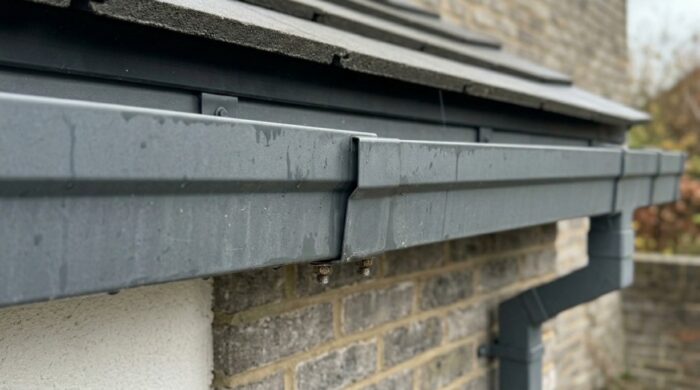
The pressed box gutter with integral joggle joint union is the most widely used type in the UK. The gutter section is pressed from flat aluminium sheet and has an integral spigot (joggle joint) formed at one end, which overlaps the plain end of the adjacent section. The joint is sealed with low-modulus silicone sealant applied in two beads before the sections are brought together, then secured with M6 aluminium bolts, neoprene washers, and nuts.
This jointing method has been used on aluminium box gutters for over 40 years and is well-proven when done correctly. The key to a reliable joint is surface preparation: both joint faces need to be clean, dry, and free from grease before sealant is applied. Acetone applied with a clean cloth and allowed to dry is the standard degreasing method.
Our aluminium half-round gutter sections use similar jointing principles. Our colour-matched sealant and colour-coded stainless steel fixings are suitable for aluminium box gutter installations.
Aluminium Box Gutter Types UK Guide
A shaped box gutter has a sloped front face rather than a fully vertical front, which gives a slightly softer visual appearance while retaining the high-capacity rectangular internal channel. The sloped front face also sheds water and debris more readily than a fully vertical face, which can be an advantage in locations with overhanging trees or heavy leaf fall. Shaped box gutters are particularly popular on housing developments where a more refined appearance than a standard box section is wanted without the cost of a bespoke fabricated profile.
DF profile (clipped corner box gutter)
The DF (or clipped corner) profile is a box gutter with the external top corners chamfered at 45 degrees, giving a slightly softer visual profile while retaining the rectangular channel internally. It reads as a box gutter from any distance but is less severe at close quarters. Commonly used on housing developments and refurbishment projects where a degree of softening is desired.
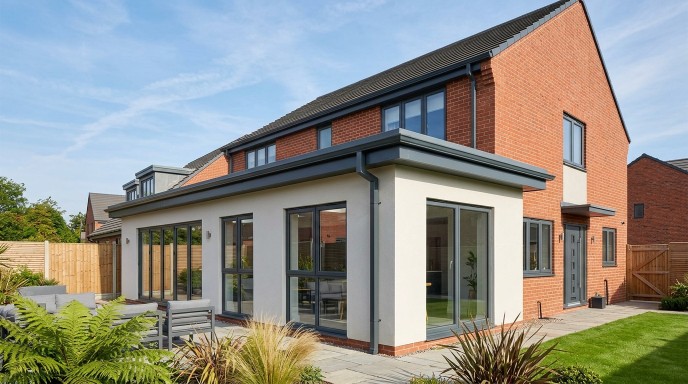
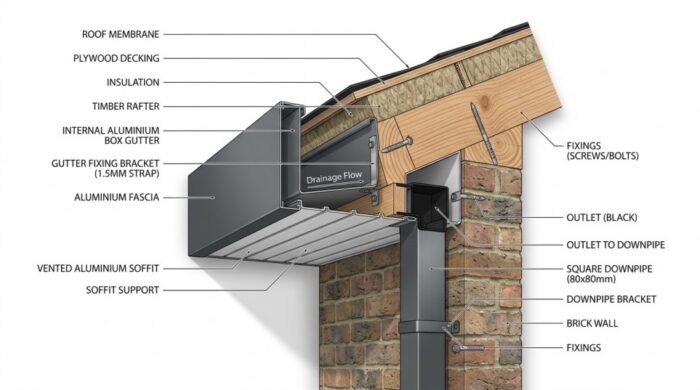
On higher-specification commercial and residential buildings, architects sometimes specify a fully concealed gutter where the box section sits behind the fascia line and is invisible from the exterior. This is achieved by integrating the box gutter within a combined aluminium fascia and soffit system, so the eaves presents a clean, uninterrupted plane to the outside with the water collection channel hidden behind it.
This approach requires careful coordination between the gutter supplier, the fascia system supplier, and the roofline installer to ensure the outlet positions align with the drainage positions and the thermal movement of the gutter is accommodated by the fascia system around it. It is more complex than a standard face-fixed installation but the result on a well-designed building is genuinely impressive. See our full guide to aluminium fascia and copings for how the fascia system integrates with the roofline.
How to Size an Aluminium Box Gutter Correctly: BS EN 12056-3
Sizing a gutter correctly is not difficult, but it does require working through the calculation properly rather than guessing. The standard method in the UK is BS EN 12056-3:2000 (Gravity drainage systems inside buildings, Part 3: Roof drainage, layout and calculation). This sets out exactly how to calculate the design flow rate for your roof and select the appropriate gutter and outlet sizes to handle it.
Here is a step-by-step walkthrough of the process for a standard eaves gutter application.
Step 1: Establish the effective roof area
The effective roof area is not simply the plan area of the roof. The pitch of the roof increases the amount of rainfall it intercepts compared to a flat surface, so you need to apply a pitch correction factor. The formula is:
Effective roof area (m2) = Roof plan width (m) x Roof length (m) x Pitch factor
The pitch factors from BS EN 12056-3 are approximately:
- Flat roof (0 to 5 degrees): pitch factor 1.0
- 30-degree pitch: pitch factor 1.29
- 45-degree pitch: pitch factor 1.50
- 60-degree pitch: pitch factor 1.87
For a roof that is 5m wide by 10m long at a 30-degree pitch: 5 x 10 x 1.29 = 64.5m2 effective roof area.
Step 2: Apply the rainfall intensity for your UK region
Rainfall intensity varies across the UK. The figures from BS EN 12056-3 for standard design calculations are approximately:
- South East England (including Essex): 0.022 litres per second per square metre (l/s/m2)
- Midlands and East Anglia: 0.021 l/s/m2
- South West and Wales: 0.023 l/s/m2
- Northern England and Scotland: 0.024 to 0.026 l/s/m2
These are the design storm intensities for standard return period events. For public buildings or critical applications where overflow would cause serious consequences, a higher intensity figure or a safety factor of 1.2 to 1.5 on the gutter capacity is applied. The Met Office rainfall data can provide site-specific historical rainfall records if needed for a specific location.
Design flow rate = Effective roof area x Rainfall intensity = 64.5 x 0.022 = 1.42 litres per second for our example.
Step 3: Account for outlet position
Where you place the outlet(s) has a significant effect on the required gutter capacity. The rule from BS EN 12056-3 is:
- End outlet: the full gutter run must handle the complete design flow rate
- Centre outlet: the effective flow rate per half-run is halved, so a smaller gutter or smaller outlet can be used for the same roof area
- Multiple outlets: the flow is divided between outlets, so each section between outlets needs to handle only its share of the total design flow
This is worth thinking about at design stage because positioning outlets centrally on a run, rather than at one end, can allow you to use a smaller gutter profile for the same roof area. On a 20m run, two centre outlets at 5m and 15m means each 10m section only needs to carry half the total flow.
Step 4: Apply the gutter length reduction factor
For gutter runs where the length exceeds 50 times the depth of the gutter, BS EN 12056-3 requires a reduction factor to be applied to the gutter’s published flow capacity. For a 100mm deep box gutter (depth = 0.1m), this length limit is 5 metres before the reduction kicks in. For a 150mm deep gutter it is 7.5 metres. For runs longer than these thresholds, multiply the gutter’s published flow capacity by the appropriate reduction factor (typically 0.86 to 0.92 depending on exact run length).
Ignoring this reduction factor is one of the most common reasons why a correctly specified gutter overflows in practice. The calculation assumes short hydraulic runs; longer runs have more friction resistance and therefore carry less water than the theoretical maximum suggests.
Step 5: Select the gutter and outlet sizes
With your adjusted design flow rate calculated, compare it against the published flow capacity data for the gutter profiles you are considering. The gutter’s published capacity needs to equal or exceed your design flow rate. The outlet (running outlet or stop-end outlet) needs to be sized to match the downpipe and have sufficient capacity not to become the bottleneck in the system.
As a cross-check: the distance between a stop end and the nearest outlet should not exceed 50 times the gutter depth. The distance between two outlets should not exceed 100 times the gutter depth. These limits from BS EN 12056-3 prevent gutter runs that are so long that water backs up before it can drain.
| For complex roofs with multiple pitches, dormers, valley gutters, or large roof areas, it is genuinely worth getting a formal drainage calculation done by a specialist before specifying. The Metal Gutter Manufacturers Association (MGMA) publishes a free guidance document on BS EN 12056-3 calculations at mgma.co.uk, which is a useful starting point. |
How to Install an Aluminium Box Gutter: Step-by-Step Guide
A well-installed aluminium box gutter system will last 40 to 50 years with almost no maintenance. A poorly installed one will leak within the first winter. The difference between the two is almost entirely in the preparation and the attention to detail on joints and bracket spacing. Here is how to do it properly.
What you need before you start
- Aluminium box gutter sections (correct size, sufficient lengths for your run plus waste allowance)
- Running outlets and/or stop-end outlets positioned at your pre-planned drainage points
- Stop ends for the exposed ends of gutter runs
- Gutter angles (90-degree or 135-degree internal or external) for changes of direction
- Fascia brackets at 750mm centres, plus one additional bracket within 375mm of each joint and each fitting
- M6 aluminium bolts, neoprene washers, and nuts (usually supplied with the gutter sections)
- Low-modulus silicone sealant conforming to BS EN ISO 11600 (such as Arbosil 1096 or similar)
- Acetone and clean lint-free cloths for joint surface preparation
- Stainless steel fixing screws (5mm x 25mm minimum for fixing brackets to fascia)
- Touch-up spray can for treating cut ends
- Spirit level and chalk line for setting the fall
- Drill, metal saw or angle grinder with aluminium blade, and suitable access equipment (scaffold tower or erected scaffold)
| Always use stainless steel fixings when working with aluminium. Ordinary steel fixings will corrode rapidly in contact with aluminium in wet conditions, leaving rust staining on the face of the gutter and fascia, and eventually failing. Galvanised steel is not good enough. Use stainless steel throughout. |
Installation Step 1: Check and prepare the fascia
Before any gutter goes up, check the condition of the fascia boards the system will be fixed to. Timber fascias that are soft, wet, or crumbling will not hold stainless steel fixings reliably, and fitting a new gutter to a rotten fascia is a waste of time and money. If the timber is in poor condition, replace it first. This is the ideal time to upgrade to aluminium fascia at the same time, which will eliminate the rot issue permanently.
Our 2mm aluminium fascia in 3m lengths with matching internal corners, external corners, and stop ends forms a complete roofline system that coordinates with aluminium box gutter installations.
Installation Step 2: Mark out bracket positions and set the fall
Start by establishing the bracket positions along the full gutter run. Brackets go at 750mm maximum centres, plus one additional bracket either side of every joint and every fitting (outlet, angle, stop end) placed no more than 375mm from the fitting. Mark all bracket positions on the fascia with a pencil before fixing anything.
Then set the fall. Aluminium box gutters can be installed level or with a predetermined fall towards the outlet. A fall of approximately 1 in 60 (about 16mm per metre) is common on longer runs where you want to ensure positive drainage, but a level installation is perfectly acceptable for shorter runs or where the position of the outlet is fixed. Use a spirit level or chalk line to mark the top bracket position at the high end, then use the fall calculation to mark the bracket position at the outlet end. String a line between the two marks and use this as your guide for all intermediate brackets.
Installation Step 3: Fix all brackets to the fascia
Fix the brackets to the fascia at all marked positions using stainless steel screws. Fix the highest bracket first, then work to the lowest. Check each bracket with a level both front-to-back and side-to-side as you go. The top of each bracket should follow your chalk line or string line precisely. Any bracket that is out of line will cause the gutter section above it to rock slightly, which puts stress on the joints either side.
Where brackets fall near a joint position, confirm the bracket is within 375mm of the joint. Add an extra bracket if any joint lands at a point where the nearest bracket is more than 375mm away after your initial spacing has been set out.
Installation Step 4: Work from corners outward
If your run has one or more corners, start at the corners and work outward towards the outlets and stop ends. Corners are the fixed points in the layout, and fitting them first means the straight runs can be cut to fit between corners and fittings without introducing awkward short sections or cuts that land on a joint
Fit all outlet fittings and angles to their fixed positions before fitting any straight sections. This way you can measure the exact lengths of straight sections needed between fixed points and cut them accurately, rather than discovering mid-installation that a run is 30mm too long or short.
Installation Step 5: Joint preparation and sealing
This is the most critical part of the installation. A poorly sealed joint is where every box gutter failure begins. The process for a joggle joint system is:
- Clean both joint faces (the plain end face of one section and the internal face of the joggle union on the next) with acetone applied on a clean lint-free cloth. Allow to dry fully.
- Apply two 6mm diameter beads of low-modulus silicone sealant to the plain end face of the gutter, running the full length of the joint on the internal base and up both sides.
- Offer the joggle union end of the next section over the prepared joint, pressing it firmly and evenly so sealant emerges slightly along the full joint length. A 3mm expansion gap should be left between the butt ends of the two sections within the joint.
- Insert M6 aluminium bolts through the pre-drilled fixing holes on the union, applying a small amount of sealant to the thread of each bolt before insertion. Fit neoprene washers and nuts and tighten gently until sealant just squeezes out around the bolt holes. Do not over-tighten.
- Wipe off any excess sealant from the exterior face of the gutter immediately. Once cured, sealant is extremely difficult to remove cleanly.
Leave joints to cure fully before allowing water to run through the system. Most low-modulus silicone sealants require 24 hours at room temperature to achieve a full cure, and performance in cold or wet weather is reduced. Do not seal joints in temperatures below 5 degrees Celsius if it can be avoided.
Installation Step 6: Treat all cut ends
Every time you cut an aluminium box gutter section with a saw or angle grinder, the raw aluminium at the cut face is exposed without its powder coat protection. Left untreated, this is less of a problem than it would be with steel (aluminium naturally forms its own protective oxide layer), but treating cut ends with a matching touch-up spray paint protects the colour consistency and gives a more professional finish. Apply touch-up spray immediately after cutting, before any sealant work or installation, so overspray does not contaminate joint faces.
Installation Step 7: Final check and test
Once the full system is installed and sealant has cured, check the following before signing off:
- Every joint shows a consistent bead of cured sealant visible from the front and base. Any joint that shows a dry gap needs to be resealed from the inside immediately.
- All brackets are secure and the gutter run follows the intended fall without any low spots where water could pool.
- Outlets are correctly connected to downpipes with the offset swan neck positioned to bring the downpipe into the wall face at the correct standoff distance.
- Stop ends are fitted and sealed at all exposed ends of runs.
- All cut ends have been treated with touch-up paint.
- Test with a slow trickle of water from a hosepipe at the far end of each run. Walk the run and look for any drips or seepage. Check that water reaches the outlet and drains freely.
Where Aluminium Box Gutters Are Used: Applications by Building Type
Aluminium box gutters are versatile enough to appear on a very wide range of building types, from domestic extensions to large industrial units. Here is how they are typically used across different sectors.

The biggest single driver of aluminium box gutter growth in the UK residential market over the past decade has been the rise of flat or low-pitched roof extensions. Kitchen extensions, orangeries, garden rooms, and rear single-storey additions are now extremely common on UK housing stock, and the standard half-round gutter simply does not look right on a clean, angular flat roof detail.
A 125mm x 100mm aluminium box gutter in anthracite grey is now probably the most commonly specified gutter for UK residential extensions, and it is not hard to understand why. It handles the drainage perfectly well for a standard extension roof area, the rectangular profile suits the flat roof geometry, and the anthracite grey powder coat coordinates naturally with grey window frames, grey composite doors, and the other RAL 7016 elements that have become standard in contemporary UK residential design.
Coordinating the gutter colour with the fascia, soffit, and downpipes creates a coherent roofline package. Our aluminium fascia and soffit range in matching RAL colours provides exactly this coordination, and our existing posts on installing aluminium coping and why aluminium fascias and copings are essential show how the full roofline system goes together.
Commercial and industrial buildings
Steel-framed commercial and industrial buildings are the original home of the aluminium box gutter. Most light industrial units, logistics sheds, retail parks, and commercial offices built in the UK since the 1980s have some form of aluminium box gutter on the eaves, and the profile has become so standard in this sector that it is often just called the commercial gutter regardless of its exact dimensions.
For commercial and industrial applications, the key specification decisions are capacity and finish. Capacity is determined by the roof area and the local rainfall data. A large industrial warehouse with 5,000m2 of roof area and a number of large internal drainage valleys is a very different calculation from a 200m2 flat roof extension, and the gutters need to be sized accordingly. Finish matters because aluminium box gutters on commercial buildings are often visible from the street, and a well-chosen powder coat colour that matches the rest of the cladding system gives the building a more considered appearance.
Flat roofs, parapet walls, and internal gutter valleys
On flat roof buildings with parapet walls, the drainage often happens at the base of the parapet rather than at the eaves. Water collects in a channel or valley at the roof level and drains to internal outlets or through the parapet to external downpipes. This is a somewhat different application from a conventional eaves gutter, and the box gutter section is often used as the lining channel in this kind of internal valley gutter detail.
For internal valley gutters, the waterproofing membrane typically overlaps into the gutter channel and the gutter acts as a secondary drainage line rather than the primary waterproofing layer. The key specification requirement for this application is that the gutter has enough capacity to handle rapid drainage from the whole roof without backing up, since any overflow in an internal valley gutter will end up inside the building rather than outside it.
Our guide to box gutter design for roofs goes into more detail on internal valley gutter applications and the specific considerations for flat roof drainage design.
Schools, healthcare, and public buildings
Public sector buildings have specific requirements around fire safety, maintenance access, and longevity that make aluminium box gutters the natural choice. The A2-s1,d0 fire classification of powder-coated aluminium meets the non-combustible requirements for buildings over 11m under the current Building Regulations (as amended following the Building Safety Act 2022), which rules out many plastic gutter systems for these applications. The 40 to 50 year service life with minimal maintenance reduces lifecycle costs, which is important in a public sector procurement context where whole-life costs are often evaluated alongside upfront price.
Agricultural and rural buildings
On agricultural buildings, particularly those in coastal locations or areas with high rainfall, aluminium box gutters offer a significant advantage over galvanised steel in terms of corrosion resistance. Aluminium does not rust even if the powder coat is scratched or mechanically damaged, because the underlying aluminium naturally forms its own protective oxide layer. In a farm environment where the gutters may be hit by farm vehicles or equipment and surface damage is inevitable, this self-healing corrosion resistance is genuinely valuable.
Specifying Aluminium Box Gutter Colours and Finishes
One of the genuine advantages of aluminium over other gutter materials is the colour flexibility. Because the surface finish is polyester powder coat applied to BS EN 12206-1, it is available in any RAL or BS colour with a consistent, durable result. Here are the most commonly specified colours for UK projects in 2026:
| RAL colour | Name | Best suited to | Common combination |
| RAL 9010 | Pure white | Traditional and period buildings | White fascia, white soffit, white downpipe |
| RAL 7016 | Anthracite grey | Modern residential and commercial | Grey window frames, grey composite doors, grey cladding |
| RAL 9005 | Jet black | Contemporary and high-spec residential | Black window frames, steel, brick or render facade |
| RAL 1013 | Oyster white | Cream render, traditional stone buildings | Cream or stone-coloured fascia and soffit |
| RAL 7015 | Slate grey | Slate roof buildings, coastal properties | Grey render, natural slate, zinc cladding |
| RAL 7021 | Black grey | Industrial and commercial | Anthracite cladding, dark masonry, dark timber |
| Mill finish | Natural aluminium | Industrial, agricultural | Bare aluminium structural elements |
For any project where colour consistency across the roofline matters, always order all aluminium products (gutter, downpipes, fascia, soffit) from the same supplier in the same RAL colour at the same time. Powder coat batch variation is small but visible when adjacent sections are compared at close range. Ordering in a single batch eliminates this risk.
Maintaining an Aluminium Box Gutter System
One of the things people often overlook when specifying aluminium guttering is just how low the ongoing maintenance requirement is compared to other materials. Powder-coated aluminium does not rust, does not rot, does not need painting, and does not become brittle with UV exposure. A properly installed aluminium box gutter system needs very little attention over its service life.
What maintenance is actually needed
- Clear debris from the gutter channel once or twice a year, in autumn after leaf fall and in spring. Box gutters tend to collect debris more than half-round profiles because the flat base provides a ledge where leaves can settle rather than being washed through. A simple brush and scoop is sufficient for most runs.
- Check all joints visually after the first winter following installation, particularly if the system was installed in cold or wet conditions. Any joint that has started to weep should be sealed from the inside with a fresh bead of low-modulus silicone sealant while the gutter is empty and dry.
- Check outlet strainers or leaf guards if fitted and clear any blockages. A blocked outlet is the most common cause of box gutter overflow in practice, and it is a five-minute job to clear once a year at most.
- Inspect bracket fixings every few years on older systems, particularly if the brackets were originally fixed into timber fascia boards that may have moved or deteriorated.
Signs that something needs attention
- Water running down the outside face of the gutter rather than the inside: sealant has failed at a joint or a stop end. Reseal immediately.
- Water overflowing the front lip of the gutter in normal rain: outlet is blocked, or the gutter has a low spot where water is pooling before the outlet. Check and clear the outlet first, then check the fall along the run.
- Rust-coloured staining on the face of the gutter: steel fixings have been used somewhere in the installation and are corroding. Find and replace all non-stainless fixings.
- Gutter visibly bowing or sagging: bracket has failed or pulled from the fascia. Check and re-fix or add additional brackets.
- White or grey deposits along the joint lines: this is mineral deposition from water seeping slowly through a failing joint, not sealant failure per se, but it indicates the joint needs resealing.
Overall, this aluminium box gutter UK guide helps you understand the best options for long-term performance and durability.
Common Mistakes When Installing Aluminium Box Gutters (and How to Avoid Them)
Having seen quite a lot of box gutter installations over the years, these are the mistakes that come up again and again.
Using steel fixings
This one causes a lot of headaches. Steel bolts, screws, and brackets corrode rapidly in contact with aluminium and moisture, leaving rust staining on the gutter face and eventually failing structurally. Always use stainless steel fixings throughout. It costs a little more but saves significant remediation work down the line.
Skimping on sealant at joints
Some installers apply a thin single bead of sealant at joints rather than the two 6mm beads specified. This leaves an under-sealed joint that starts weeping after one or two freeze-thaw cycles. Apply sealant generously, use the correct low-modulus product (not ordinary silicone or flexible mastic), and degrease the joint faces properly before applying.
Missing brackets near joints and fittings
The rule of one additional bracket within 375mm of every joint and every fitting is there for a reason. A joint that is not supported close to its fixing points experiences much more movement and bending stress than a supported one. Over time, this opens joints and eventually causes cracking. Count your brackets against your joints and fittings before fixing, not after.
Not leaving expansion gaps
Aluminium expands at 0.023mm per mm per degree Celsius. A 3m section will grow by about 4mm across a 60-degree temperature range. If sections are pushed hard together without the specified 3 to 4mm expansion gap at each joint, that movement has nowhere to go and the gutter will buckle. Leave the gap, fill it with sealant rather than a rigid filler, and the system will handle thermal movement without stress.
Undersizing the system
This is the most costly mistake because it is not obvious until the first serious rainfall, by which point everything is installed and remediation means doing large sections over again. Do the BS EN 12056-3 calculation before specifying. Use the correct rainfall intensity for your region. Apply the run length reduction factor if your runs exceed 50 times the gutter depth. Size for centre outlets rather than end outlets wherever the roof geometry allows.
Frequently Asked Questions: Aluminium Box Gutters
-
What is an aluminium box gutter?
An aluminium box gutter is a rectangular cross-section gutter channel manufactured from pressed or extruded aluminium, powder-coated in any RAL colour. The flat-sided rectangular profile gives it higher flow capacity than a half-round gutter of the same nominal width, and its clean angular appearance suits modern and commercial architecture. Standard sizes range from 100x75mm for small domestic applications up to 200x200mm and beyond for large commercial projects.
-
What sizes do aluminium box gutters come in?
Standard sizes in the UK range from 100mm wide x 75mm deep up to 200mm wide x 200mm deep, in various width and depth combinations. The most commonly used domestic size is 125x100mm for standard housing and extensions, and 150x100mm or 150x150mm for larger domestic and light commercial projects. For industrial and large commercial buildings, 200x150mm and 200x200mm sections are common. All sizes can be supplied in bespoke dimensions if standard sizes do not suit a specific project.
-
How do I calculate what size aluminium box gutter I need?
The correct method is to follow BS EN 12056-3:2000. Calculate the effective roof area (plan area multiplied by a pitch factor), multiply by the rainfall intensity for your UK region (typically 0.021 to 0.026 litres per second per square metre), adjust for outlet position (end or centre) and run length, and compare the resulting design flow rate against published gutter flow capacities to select the correct size. For straightforward residential projects, our team can help you work through this calculation.
-
How long does aluminium box gutter last?
A properly installed aluminium box gutter system should last 40 to 50 years in typical UK suburban or rural environments. In coastal or industrial environments with higher salt or chemical exposure, the powder coat life may be somewhat shorter, but the underlying aluminium substrate will not corrode. Aluminium forms its own protective oxide layer that prevents rusting even if the surface coating is scratched or damaged. This is a significant advantage over galvanised steel, which will rust once the galvanise is compromised.
-
Can aluminium box gutter be used on domestic houses or just commercial buildings?
It is widely used on both. For domestic properties, the 125x100mm size is standard for most extensions, flat roof additions, and new-build houses. The angular profile suits contemporary architecture particularly well. On more traditional house styles, a half-round profile often looks more appropriate, but on any building with flat or low-pitch roof elements, a box gutter is usually the better choice both aesthetically and in terms of performance.
-
What is the correct bracket spacing for aluminium box gutters?
Brackets should be fitted at a maximum of 750mm centres along the full gutter run. An additional bracket must be placed within 375mm of every joint and within 375mm of every fitting (outlet, angle, stop end). This means a joint that falls between two brackets at 750mm spacing must have an extra bracket added to bring a fixing within 375mm of the joint. Always plan bracket positions before fixing any brackets to the fascia.
-
How do I join aluminium box gutter sections?
The standard method for pressed aluminium box gutters is the joggle joint system. One end of each gutter section has an integral spigot (the joggle union) that overlaps the plain end of the adjacent section. Two 6mm beads of low-modulus silicone sealant are applied to the plain end face, then the joggle union is pressed over it and secured with M6 aluminium bolts, neoprene washers, and nuts. A 3 to 4mm expansion gap must be left between the butt ends of the two sections within the joint to allow for thermal movement.
-
What sealant should I use for aluminium box gutters?
Use a low-modulus silicone sealant conforming to BS EN ISO 11600. Arbosil 1096 is the most commonly referenced product, but other brands meeting the same standard are equally suitable. Do not use ordinary bathroom silicone, flexible mastic, or polyurethane adhesive sealant. These either do not bond correctly to aluminium or are too rigid to accommodate the thermal movement that occurs in a long gutter run. Our colour-matched sealant is available from the Metal Profiles Ltd product range.
-
Does aluminium box gutter comply with Building Regulations?
Yes. Powder-coated aluminium achieves an A2-s1,d0 fire classification, which meets the non-combustible requirements under the Building Regulations Approved Document B for buildings at any height, including those over 11m where restrictions on combustible external materials apply. Box gutters designed and sized in accordance with BS EN 12056-3 and manufactured to BS 9101:2017 comply with the drainage and performance requirements of Approved Document H.
-
Can I paint aluminium box gutter a different colour after installation?
Technically yes, but it is not recommended. Powder coat is baked on at high temperature and provides a far more durable finish than any liquid paint applied on site. If you need a specific colour, specify it with your order rather than trying to paint over an existing powder coat after installation. If you do need to repaint a section after installation, use a high-quality metal primer followed by a two-part polyurethane topcoat. Thoroughly prepare the surface first by abrading the existing powder coat to give the primer a mechanical key.
-
What is the difference between a pressed box gutter and an extruded box gutter?
A pressed box gutter is formed by pressing flat aluminium sheet through a die to create the rectangular channel section. An extruded box gutter is produced by forcing a heated aluminium billet through a shaped die, which allows more complex cross-section geometries and tighter dimensional tolerances. Extruded sections are typically used for high-specification architectural applications where profile precision is important. Pressed sections are more commonly used in standard domestic and commercial gutter applications and are generally more cost-effective.
Discover more from Metal Profiles Ltd
Subscribe to get the latest posts sent to your email.