



How to install aluminium fascia is a common question when upgrading rooflines. Understanding the steps to install aluminium fascia correctly can save time and effort. This guide will walk you through the aluminium fascia installation process.
Let’s be honest. If you are staring up at a roofline with timber fascia boards that are peeling, splitting, or turning that grim shade of grey, you already know it’s time to sort it out. The question is whether to go with uPVC again and have the same conversation in ten years’ time, or to make the switch to aluminium and be done with it for good.
Aluminium fascia has been a staple in commercial and architectural construction for decades. It is only in recent years that it has really taken off in the residential market too, mainly because people have started to notice how durable, low-maintenance, and sharp-looking it is once it’s properly fitted.
Fascia installation guide walks you through every stage of the installation, from pulling off the old boards through to fitting the final corner trim. Whether you are a homeowner tackling it yourself, a builder quoting a job, or a roofer who mostly works with uPVC and wants to understand the differences, there is something useful in here for you.
We are based in Chelmsford and supply aluminium architectural products across Essex and the wider UK, so a lot of what follows is drawn from real installation experience rather than theory. Read on.
What Is Aluminium Fascia and How to Install It Correctly?
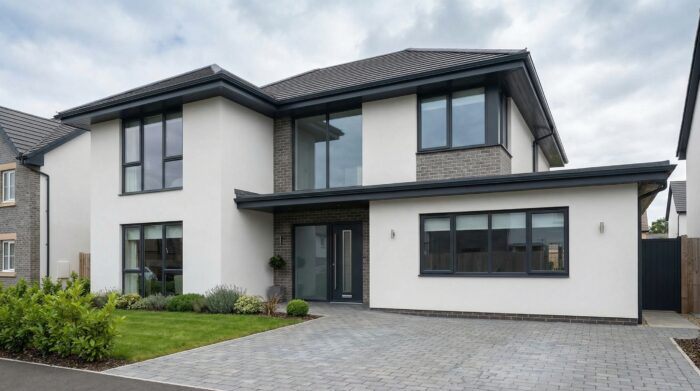
The fascia is the vertical board that runs along the lower edge of your roof. It sits right at the point where the roof rafters end, and it carries the guttering. From the street, it is one of the most visible parts of the roofline.
The soffit is the horizontal board tucked underneath the fascia, closing off the gap between the fascia and the wall. Together, they seal the roof edge, stop pests getting in, and manage ventilation in the roof space.
For a detailed comparison of the two, have a read of our post on soffit or fascia: what is the difference?.
Aluminium fascia does exactly the same structural job as timber, but without the rot, the cracking, the painting, or the annual maintenance. The boards are typically 2mm thick, powder-coated in a range of colours, and can be cut to any length on site.
Why Choose Aluminium Fascia Over Timber or uPVC for Installation?
This question comes up a lot, especially when people see the upfront cost is slightly higher. Here is the honest answer.
Timber fascia
Wood looks good when it’s freshly painted, but it requires repainting every few years, it rots if water gets behind it, and it warps in freeze-thaw cycles. In a British climate, timber fascia rarely lasts more than 15 to 20 years without needing significant work. Many older properties have timber that’s been patched and repainted so many times it’s more filler than wood.
uPVC fascia
uPVC is cheap, widely available, and genuinely low-maintenance. The problem is that it can become brittle in UV exposure over time, it discolours, and it cannot be painted if you change your mind on colour. uPVC also has a lower fire resistance rating than aluminium, which matters more on commercial projects but is worth knowing on residential too.
Aluminium fascia
Aluminium does not rot, does not crack, does not discolour, and does not need painting. The powder coat is baked on and far more durable than any applied paint finish. You can get it in any RAL colour, which means it can match window frames, guttering, or cladding precisely.
The key trade-off is that aluminium expands and contracts more noticeably with temperature changes than uPVC does. This is not a problem if the boards are fitted correctly (which we cover in full below), but it is the reason you cannot just treat it exactly like timber during installation.
For more on why aluminium is worth the investment, see our post on why aluminium fascia and copings are essential.
Tools and Materials You Will Need,
Before you go up a ladder, make sure you have everything to hand. Stopping halfway through to nip to a merchant is annoying and potentially dangerous when you are working at height.
Tools
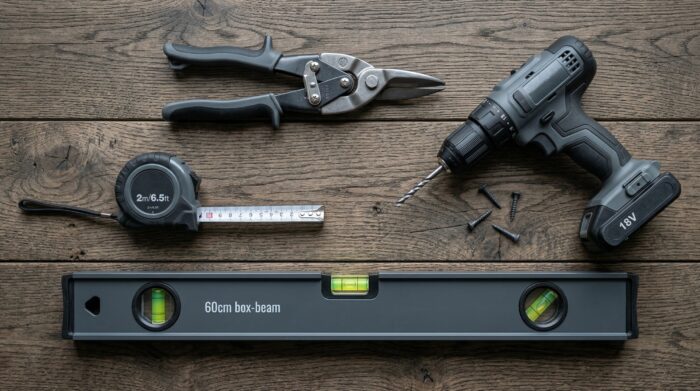
- Fine-toothed hacksaw or metal-cutting blade fitted to a mitre saw
- Aviation snips (tin snips) for smaller cuts and trimming
- Power drill with metal and masonry bits
- Spirit level
- Tape measure and chalk line
- Soft-faced mallet
- Pencil or marker
- Ladder or scaffold tower (a tower is strongly preferable for a full roofline)
- Safety glasses and work gloves
Materials
- Aluminium fascia boards (2mm thickness is standard for residential use) available from our shop
- Aluminium soffit panels to match
- Corner trims (internal and external)
- Joint trims / union pieces
- Fascia end caps
- Stainless steel or aluminium screws (never use steel, more on that below)
- Coloured sealant to match your fascia
- Colour-coded fasteners
- Marine-grade plywood (18mm) for backing in flat roof sections
How to Prepare for Aluminium Fascia Installation: Working at Height Safely
Working at height safely
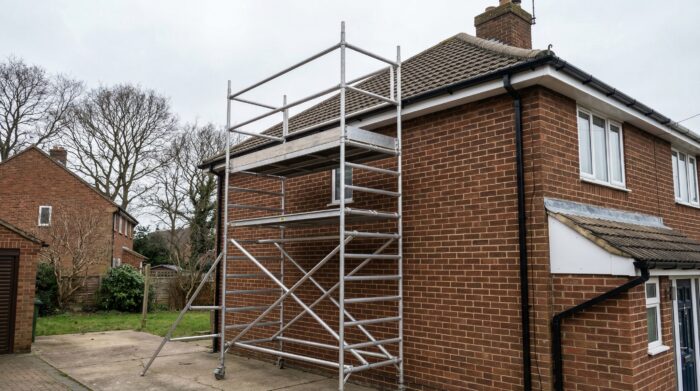
Working at height is the biggest risk in any roofline job. The Health and Safety Executive (HSE) recommends using a scaffold tower wherever possible rather than a ladder, especially when you need both hands free to position boards.
- Set up on level, firm ground only
- Never lean out to one side or overreach
- Work with someone else present whenever possible, especially when carrying long boards
- Do not work in high winds or wet conditions
- Wear gloves: freshly cut aluminium edges are sharp
Checking the existing roofline
Before ordering a single board, inspect what you are working with. If the timber rafters, bargeboard supports, or sub-fascia backing is rotten or compromised, new fascia boards are not going to fix the underlying problem. They will just hide it for a while before you end up dealing with a bigger job.
- Probe the rafter ends with a screwdriver. If it sinks in easily, you have rot.
- Check for evidence of damp or mould behind the existing boards
- Look at the tile overhang. The fascia needs to sit at the correct height so tiles drain properly into the gutters
- Check whether the existing fixings are compatible with aluminium (important: see notes on galvanic corrosion below)
How to Remove Old Aluminium Fascia Boards
- Remove the guttering first. Unclip or unscrew the guttering brackets and set the sections aside carefully if you plan to reuse them. If you are fitting new
Remove the guttering first. Unclip or unscrew the guttering brackets and set the sections aside if you plan to reuse them. If you are fitting new aluminium guttering at the same time, this is a good opportunity to start fresh. See our guide to durable aluminium guttering for options.
Work from a safe position on a scaffold tower or ladder, and remove the fascia boards carefully. On timber, they are usually nailed or screwed directly to the rafter ends.
Once the boards are down, take a moment to assess the rafter ends properly. Any signs of rot should be treated with a timber preservative or, in severe cases, the rafter ends may need replacing before you proceed. Do not skip this step.
Remove any remaining nails, clean up the surface, and you are ready to start measuring.
How to Measure the Roofline for Aluminium Fascia Installation
Step 1: Measure the roofline
Measure each run of your roofline individually. Do not assume the whole house is one continuous length or that the heights are uniform. On older properties especially, the height from the tile underside to the soffit can vary significantly from one end to the other.
Mark out your measurements on each board before cutting. The key measurement is from the underside of the tile (not the surface of the tile) down to the soffit position. Note that most standard aluminium fascia boards include a small return lip at the top of around 9mm, so your overall cut dimension needs to account for this.
Step 2: Cutting Aluminium Fascia Boards to the Right Length
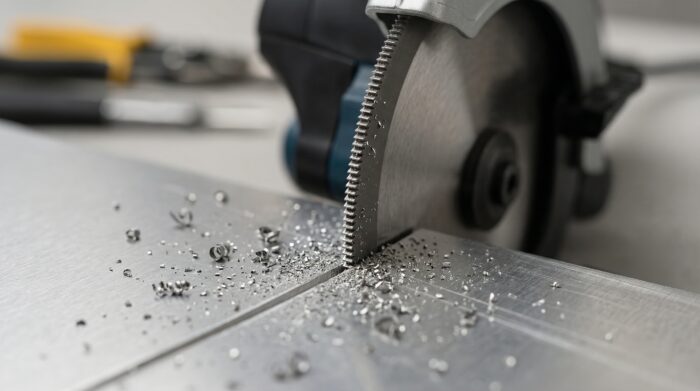
Cut aluminium with a fine-toothed blade. A standard wood-cutting blade will work in a pinch but leaves a rough edge. For a cleaner finish, use a blade rated for non-ferrous metals or a good pair of aviation snips for shorter pieces.
- Keep the blade speed moderate. Too fast generates excessive heat and can distort the cut edge
- Cut with the decorative face down when using a circular saw, to reduce surface scratching
- Stick felt pads to the saw’s support arms if you are cutting long sections, to protect the powder-coat finish
- Deburr any cut edges before installation. Run a file or fine sandpaper along the cut to remove sharp burrs
For the expansion gap: aluminium expands and contracts with temperature. A 3-metre board can move by around 6mm across a full temperature range. When fixing boards end to end, always leave a 4mm gap between panels, which is what the joint trim covers. Do not pull boards tight together.
Step 3: Fix the backing structure if required
On some properties, particularly flat-roof sections or where the existing rafter ends are irregular, you will need to fix a backing board before the fascia goes on. Marine-grade 18mm plywood is the standard choice. Fix it to the rafter ends using appropriate treated timber screws and check it is level before you move on.
On most pitched-roof sections with sound timber rafters, you can fix the aluminium fascia directly to the rafter ends. Use a chalk line snapped along the intended fascia top edge to give you a consistent fixing height across the whole run.
Step 4: Fix the fascia boards
Start at the furthest corner from the main entrance or most visible elevation. Any seam or join is more noticeable at the start of a run than at the end, so start the less visible sections and work towards the front of the property.
Fixing method:
- Pre-drill fixing holes slightly larger than your screw diameter to allow for thermal movement
- Fix into the top of the fascia, ideally hidden behind the drip edge where possible
- Space fixings at no more than 600mm centres. More frequent fixing is better in exposed locations
- Do not over-tighten fixings. The board needs to be able to move slightly with temperature changes
- Check with a level regularly as you work along the run
Where fascia sections meet end to end, slide a joint trim over the end of the first board, apply a thin bead of coloured sealant to the exposed edge, then slide the next board into the joint trim leaving the 4mm expansion gap. The joint trim hides the gap and gives a neat finish.
Step 5: Handle corners and angles
Corners are where a lot of DIY installations go wrong, and they are also the most visible point of any roofline. There are two options: use purpose-made corner trim pieces (the faster and tidier approach), or mite the boards and bend a return flap around the corner (the more traditional approach that takes more skill).
Using corner trims (recommended): Clean both faces of the fascia with a solvent cleaner. Apply a bead of sealant to the rear faces of the corner trim. Press the trim into position and hold it temporarily with low-tack masking tape while the sealant sets.
Mitred corners: Set the mitre saw to 45 degrees. The cut on the return flap needs to be made before the board is fixed. Bend the return using a hand brake or metal-folding tool. This takes practice and is worth testing on offcuts first.
| On pitched roofs where the gable meets the eaves, the junction between the rake fascia (on the gable) and the eaves fascia (horizontal) needs careful measuring. Cut the rake fascia slightly long and trim flush once the eaves board is in position. |
Step 6: Fit the soffit
The soffit fits between the fascia and the wall, closing off the eave. Measure the gap carefully as it can vary across a run, especially on older properties.
- Cut soffit panels to approximately 3mm shorter than the measured width to allow for slight variations
- Start from the middle of each run and work outwards, not from one end to the other
- Fix soffit panels using aluminium nails or screws at 400mm centres
- Where ventilation is required in the roof space, use perforated soffit panels or install discrete vent inserts
For a complete guide to aluminium soffit options and profiles, visit our aluminium products section.
Step 7: Seal and finish
Once all boards, soffits, and trims are in position, go back along the full roofline and apply coloured sealant to all joints and junctions. Use a sealant that matches the fascia colour (we supply coloured sealant to match our fascia range).
- Do not fill the 4mm expansion gaps between boards: these need to remain open
- Seal where the fascia meets any masonry or cladding to prevent water ingress
- Wipe off any excess sealant before it cures
- Check all fixings are secure and none are overtightened
Refit the guttering at this stage. Aluminium square-line or half-round guttering works particularly well alongside aluminium fascia and gives a consistent finished look. See our guide on aluminium box gutters if you are working on a commercial or flat-roof property.
Common Mistakes to Avoid When Installing Aluminium Fascia
1. Not allowing for thermal expansion
This is the most common one. If you butt boards tightly together without a gap and fix them too rigidly, the aluminium will buckle on a hot day. It looks terrible and once it has buckled, it will not spring back. Always leave a 4mm expansion gap between boards.
2. Using the wrong fixings
Steel nails or screws in contact with aluminium will corrode over time through a process called galvanic action. The fixing weakens and leaves rust stains on the face of the board. Use stainless steel or aluminium fixings only.
3. Face-nailing through the visible surface
Every nail hole you put through the face of the board is both a potential entry point for water and an eyesore. Fix from the top edge wherever possible. Where you do need to face-nail, pre-drill a hole slightly larger than the nail shank so the board can still move.
4. Skipping the inspection of the backing structure,How to Install Aluminium Fascia
Aluminium fascia cannot compensate for rotten rafter ends. If the backing is not sound, the new boards will not stay secure. Always inspect and repair before you fix anything new.
5. Incorrect height measurement
Remember that the internal measurement (tile underside to soffit) is not the same as the overall board height. The return lip adds to the total dimension. Measure from the correct reference points and mark out each board individually.
How Much Does It Cost to Install Aluminium Fascia in the UK?
Costs vary depending on the size of the property, the complexity of the roofline, and whether you are doing the work yourself or hiring a tradesperson. Here is a rough guide for 2026.
| Item | DIY (materials only) | Professional install |
| Standard 3-bed semi (approx 30m run) | £300 to £600 | £900 to £1,600 |
| Detached house (approx 50m run) | £480 to £900 | £1,400 to £2,600 |
| Fascia board per metre (supply only) | £8 to £14/m | N/A |
| Professional installation per metre | N/A | £18 to £35/m incl. materials |
| Soffit board per metre (supply only) | £6 to £12/m | N/A |
For full pricing on our aluminium roofline products, take a look at our guttering cost guide.
Maintaining Your Aluminium Fascia After Installation
Genuinely, this is the short section of this guide. Aluminium fascia requires almost no maintenance. That is part of the point.
- Give it a wipe down with warm soapy water once a year, or after long winters where there has been a lot of salt in the air
- Check the sealant at joints annually and reapply if it has cracked or pulled away
- If the guttering is creating water overflow that constantly runs over the fascia face, that is a gutter issue to fix, not a fascia problem
- Any minor scratches on the powder coat can be touched up using matching
Any minor surface scratches to the powder coat can be addressed with matching touch-up paint or a colour-matched spray can. These are available from Metal Profiles in all standard colours.
Other than that, it really does look after itself.
Frequently Asked Questions
-
Can I install aluminium fascia over existing timber without removing it?
In theory yes, if the timber is sound and rot-free. This is called capping. The new aluminium board fits over the existing timber and is fixed through it. However, if there is any dampness or softness in the timber, you should remove it first. Trapping moisture behind a sealed aluminium board will accelerate decay and eventually cause bigger problems.
-
How long does aluminium fascia last?
A properly installed aluminium fascia should last 40 to 50 years with very minimal maintenance. The powder coat finish carries a typical guarantee of 25 years from most manufacturers, but the aluminium substrate itself will outlast most other roofline materials by a considerable margin.
-
Do I need planning permission to replace my fascia boards?
In most cases, no. Replacing like-for-like roofline materials is classified as maintenance and does not require planning permission in England and Wales. However, if your property is listed or in a conservation area, you should check with your local planning authority first. The Planning Portal at planningportal.co.uk has up-to-date guidance.
-
What colour should I choose for my aluminium fascia?
White is the most popular choice for residential properties as it matches the majority of uPVC window frames and guttering. Anthracite grey (RAL 7016) has become very popular over the last five years, particularly on contemporary homes and extensions. If you have aluminium windows or coping stones, matching the fascia colour to these gives a very coherent finish.
-
Can aluminium fascia be painted after installation?
Technically yes, though it is rarely necessary. The powder coat finish is far more durable than any applied paint and does not need repainting. If you do want to change the colour, the surface needs to be thoroughly cleaned, lightly abraded, primed with an etch primer, and then painted with a paint system designed for metal. It is a significant job. Far easier to order in the right colour from the start.
-
What is the difference between aluminium fascia and aluminium coping?
Fascia runs along the roof edge (eaves) and supports the guttering. Coping sits on top of walls (parapets, gable ends, and boundary walls) and protects the masonry from water penetration. Both are aluminium architectural products but they serve different roles. For more detail, read our guide to installing aluminium coping.
-
Is aluminium fascia suitable for flat roofs?
Yes, and it is a particularly popular choice on flat-roof extensions because it can be sized and profiled to suit. The lip on the standard fascia profile is usually removed on flat-roof applications to keep the board flush with the wall face. A bead of silicone behind the fascia and at the junction with the waterproof membrane provides the seal.
This guide explains exactly how to install aluminium fascia correctly in the UK climate for long-term performance.
Discover more from Metal Profiles Ltd
Subscribe to get the latest posts sent to your email.