


Aluminium Planters: Benefits, Types and Buying Guide 2026

Aluminium planters are one of the fastest-growing choices for UK gardeners, landscapers, and commercial specifiers. Rust-free, lightweight, available in any RAL colour, and fabricated to any size, they outperform terracotta, plastic, and wood planters on almost every practical measure. This guide covers everything you need to know: why aluminium is the right material, which type of planter suits your application, how to size correctly, how to care for your planters, and where to buy in the UK with nationwide delivery.
Metal Profiles Ltd manufactures metal planters at our Chelmsford, Essex facility. Bespoke sizes, any RAL powder coat colour, trough and square profiles, fully welded construction, drainage holes as standard, delivered nationwide within 5 to 10 working days.
50+ Year lifespan
100% Recyclable material
70% Lighter than terracotta
Any RAL / BS colour
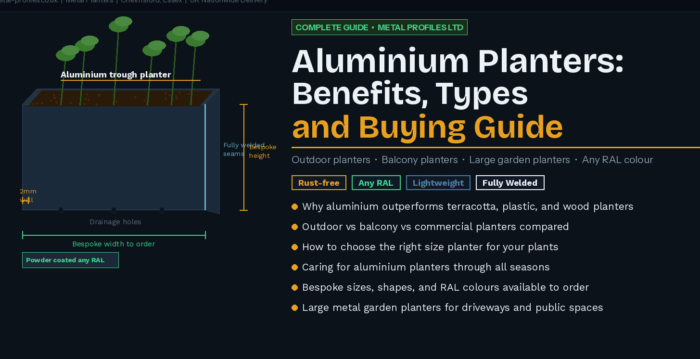
What Are Aluminium Planters?
Aluminium planters are garden containers fabricated from pressed or welded aluminium sheet. Unlike moulded plastic pots or kiln-fired terracotta, they are precision-manufactured to specific dimensions, making bespoke sizing straightforward. The aluminium sheet is typically 2mm thick for standard domestic planters and up to 4mm or 6mm for large commercial or public realm installations where structural robustness is required.
Aluminium naturally forms a thin, stable oxide layer on its surface that prevents further corrosion. This means an aluminium planter that has its powder coat surface scratched or chipped will not rust at the exposed point the way a steel planter would. The base metal itself is corrosion-resistant regardless of the surface coating condition.
Metal Profiles Ltd manufactures metal planters in trough, square, and rectangular profiles. All planters are fabricated with fully welded seams, drainage holes as standard, and a high-quality polyester powder coat in any RAL or BS colour. Bespoke dimensions are available for any garden, terrace, commercial, or public realm application.
Types of Aluminium Planters
Choosing the right planter type depends on the plants you intend to grow, the space available, and the visual effect you want to achieve.
Trough planters
Trough planters are long, rectangular containers with a low-to-moderate depth. They are ideal for growing a row of plants along a boundary, dividing a terrace, lining a driveway, or creating a window box effect on a balcony rail. Their elongated form works particularly well with grasses, lavender, box hedging, and low-growing perennials.
Square and cube planters
Square and cube planters make strong architectural statements at entrances, on patios, and at the corners of terraces. Their symmetrical form works well with topiary, standard bay trees, box balls, and specimen shrubs. Pairs of matching square planters flanking a doorway or gate are a classic high-end landscaping detail.
Large and extra-large planters
Large aluminium planters of 800mm or more are used for substantial plantings including small trees, multi-stem specimens, and large ornamental grasses. They are commonly specified for hotel entrances, restaurant terraces, retail frontages, and public realm planting schemes. Metal Profiles Ltd manufactures large aluminium planters to any dimension on request.
Bespoke aluminium planters
For gardens and commercial projects with specific dimensional or design requirements, bespoke metal planters can be fabricated to exact specifications. This includes non-standard widths, L-shaped planters for corner positions, bottomless planters for in-ground planting, and planters with integrated drainage systems. Contact Metal Profiles Ltd with your dimensions and requirements for a quote.
| Type | Best For | Typical Sizes | Applications |
| Trough | Row planting, boundaries, balconies | 600mm to 1200mm+ length | Grasses, herbs, lavender, box hedging |
| Square / cube | Entrances, patios, symmetrical displays | 400mm to 800mm square | Topiary, bay trees, specimen shrubs |
| Large | Specimen trees, commercial use | 800mm to 1500mm+ | Multi-stem trees, large ornamental grasses |
| Bespoke | Any specific requirement | Any dimension to order | Public realm, commercial, unusual spaces |
Aluminium planters for UK weather: what makes them practical
When people choose Aluminium Planters, they are usually thinking about long term performance in real UK conditions. Rain, frost, strong sunlight and wind can all affect outdoor containers, especially those placed near paths and entrances.
Aluminium is naturally resistant to corrosion, so it is a good option for exposed sites. With a powder coated finish, it can also keep its appearance for longer than many alternative materials, even when it is used year after year.
Another practical point is that aluminium planters are typically fully welded and made to be rigid. That makes them suitable for planting displays that need to stay neat and stable, including boundary troughs and frontage arrangements.
The Benefits of Aluminium Planters in Gardening
Aluminium is not the cheapest planter material at the point of purchase, but it offers substantial advantages over every alternative that compound in value over the life of the planter.
Rust-free and corrosion-resistant
The single most important practical benefit of aluminium planters is that they do not rust. This sets them apart from steel and iron planters, which require painting and maintenance to prevent corrosion, and from wooden planters, which rot regardless of treatment. An aluminium planter placed outdoors in a UK garden, exposed to rain, frost, and salt air in coastal areas, will show no structural corrosion after decades of use.
Lightweight: ideal for balconies and rooftop gardens
Terracotta planters can weigh 15 to 25 kg empty. Stone and concrete planters weigh even more. A comparable aluminium planter weighs 2 to 5 kg. This weight difference is critical for balconies and rooftop gardens where the structural load capacity of the slab is a design constraint. Aluminium planters allow gardeners to create full, lush planting schemes on elevated surfaces that could not support the weight of traditional materials.
Any RAL colour
Aluminium planters can be powder coated in any RAL or BS colour. This is a significant advantage over terracotta (which comes only in natural clay tones), plastic (limited and often fading colours), and even most ceramic planters. Whether you want RAL 9005 Jet Black for a contemporary urban garden, RAL 6009 Fir Green for a naturalistic country garden, or a bespoke corporate colour for a hotel terrace, powder coated aluminium delivers a precise, long-lasting finish.
Long service life
Properly manufactured aluminium planters last 20 to 50 years outdoors. This compares favourably with wooden planters (5 to 15 years before rot becomes a structural issue), plastic planters (5 to 20 years before UV degradation causes brittleness and fading), and even terracotta (which can crack in frost if water trapped in the porous material freezes). The long lifespan of aluminium planters makes their higher initial cost-effective over the life of the garden.
Safe for edible plants
Aluminium does not leach harmful chemicals into the growing medium at concentrations that affect plant health or food safety. This makes aluminium planters a safe choice for growing vegetables, herbs, and fruit. Avoid using untreated galvanised or zinc-coated metal containers for edibles, as zinc can leach into the soil at potentially harmful concentrations. Powder coated aluminium has no such concern.
Low maintenance
An aluminium planter in good condition requires nothing beyond an occasional wipe down with a damp cloth. There is no annual painting, no rust treatment, no sealing, and no rot inspection. Drainage holes should be checked once a year to ensure they are clear. This low maintenance requirement is a significant practical advantage for gardeners who want beautiful containers without ongoing upkeep.
Environmentally sustainable
Aluminium is 100 percent recyclable and retains its full material properties through repeated recycling cycles. Producing secondary aluminium from recycled material uses only 5 percent of the energy required to produce primary aluminium from bauxite ore. When an aluminium planter eventually reaches the end of its service life, the material has full scrap value and can be entirely recycled. No landfill contribution, no toxic degradation products.
Aluminium Planters vs Other Materials
Understanding how aluminium compares to alternative planter materials will help you make the right purchasing decision for your garden or project.
| Material | Lifespan | Rust Risk | Weight | Maintenance | Colour Choice | Edible-safe |
| Aluminium | 20 to 50+ yrs | None | Very light | Minimal | Any RAL/BS | Yes |
| Terracotta | 10 to 30 yrs | None | Very heavy | Moderate (sealing) | Natural only | Yes |
| Wood | 5 to 15 yrs | None | Medium | High (painting, sealing) | Paintable | Treat dependent |
| Plastic / GRP | 5 to 20 yrs | None | Light | Minimal | Limited, fades | Usually yes |
| Steel | 10 to 30 yrs | High risk | Heavy | High (painting) | Paintable | Coat dependent |
Why aluminium wins for most UK gardens.
The combination of rust-free performance, low weight, any RAL colour, long lifespan, and minimal maintenance makes aluminium the dominant choice for gardeners who want planters that look good and last. The higher initial cost over plastic or treated pine is recovered within 5 to 10 years through avoided replacement costs.
Choosing the Right Size Aluminium Planter
Selecting the correct planter size is essential for plant health. A planter that is too small restricts root growth and causes the plant to become pot-bound quickly. A planter that is too large holds excess moisture around the roots, increasing the risk of root rot in poorly draining conditions.
Sizing guide by plant type
| Plant Type | Min Planter Depth | Min Planter Width / Length | Notes |
| Herbs (basil, parsley, thyme) | 150mm | 200mm minimum | Group multiple herbs in a 600mm trough |
| Annuals and bedding plants | 200mm | 250mm minimum | Shallow roots — compact planters fine |
| Perennials and grasses | 300mm | 400mm minimum | Allow room for root spread over seasons |
| Lavender, box, small shrubs | 400mm | 400mm minimum | Needs room for multi-season root development |
| Standard bay or topiary | 500mm | 500mm minimum | Use John Innes No.3 for stability |
| Small trees and multi-stems | 600mm+ | 600mm+ minimum | Consider bottomless planter for in-ground option |
Not sure which size to order?
Contact Metal Profiles Ltd on 07566 862501 or email info@metal-profiles.co.uk with your plant type and available space. We can advise the correct planter dimensions and profile for your project and supply to any bespoke size required.
How to choose the right size of aluminium planter
Choosing the right size is one of the biggest factors in whether your planting looks healthy after a few months, not just after a fresh fill. With Aluminium Planters, the container size affects how quickly soil dries out, how much room roots have and how stable the planting looks during the seasons.
As a simple rule of thumb:
- Smaller planters dry out faster, so they suit shallow rooted plants and regular watering routines.
- Larger planters hold moisture for longer and are often easier to maintain for perennials and ornamental grasses.
- Very large planters are best for specimen planting, but they also need the right drainage and soil depth.
If you are planting a mix, it is usually better to choose a size that supports the most demanding roots in the arrangement. When in doubt, moving up slightly in size can reduce the risk of the plants drying out too quickly.
Aluminium Planters for Balconies and Rooftop Garden
Balconies and rooftop gardens present unique challenges for gardeners. Weight is the primary concern: most residential balcony slabs are designed for a distributed live load of 1.5 to 2.5 kN/m2, equivalent to approximately 150 to 250 kg per square metre. A large terracotta planter filled with compost can easily exceed 80 to 100 kg on its own, rapidly consuming this weight budget.
Aluminium planters address this problem directly. An equivalent aluminium trough planter of 1200mm x 400mm x 400mm weighs approximately 4 to 6 kg empty, compared to 40 to 60 kg for a comparable terracotta or glazed ceramic planter. This means significantly more planting can be accommodated within the same structural weight budget.
- Aluminium planters are up to 70 percent lighter than terracotta equivalents of the same size
- Filled weight can be further reduced by using lightweight growing media such as perlite-enriched compost or hydro-clay aggregates instead of standard loam
- Raised feet on aluminium planters allow drainage and air circulation beneath the planter, protecting the balcony surface and improving drainage
- Metal Profiles Ltd can manufacture aluminium planters with integrated drip trays to prevent water staining on balcony tiles and decking
- Bespoke dimensions allow planters to fit precisely along balcony railings or in corner positions without wasted space
How to Plant and Care for Aluminium Planters
Setting up and maintaining aluminium planters correctly makes the difference between a thriving container garden and one that struggles. Follow these six steps for the best results.
Choose the right size planter
Select a planter that is at least 200mm deeper and wider than the root ball of your plant. Allow 100mm extra depth at the base for drainage material. See the sizing guide in Section 5 above for specific recommendations by plant type
Add a drainage layer
Place a 50 to 100mm layer of gravel, perlite, or broken crock at the base of the planter over the drainage holes. This prevents the growing medium from blocking the drainage holes and allows excess water to escape freely, preventing waterlogging and root rot.
Fill with the right growing medium
Use peat-free loam-based compost for most perennials and shrubs. For herbs and Mediterranean plants, mix in 20 to 30 percent horticultural grit to improve drainage. For trees, use John Innes No.3 for stability and long-term nutrient retention. Avoid using garden soil, which compacts in containers and drains poorly.
Plant and water in thoroughly
Plant at the same depth as the plant was in its original container. Firm the compost gently around the roots and water thoroughly until water runs freely from the drainage holes. This settles the compost and removes air pockets around the roots.
Position correctly before filling
Place the planter in its intended position before filling if it will become heavy once planted. Ensure it stands level. If on a hard surface, raise it on the supplied planter feet to allow free drainage and prevent staining of the surface below.
Maintain through the seasons
Water regularly during the growing season and check that drainage holes are clear. In winter, protect tender plants by moving the planter to a sheltered spot or wrapping it in horticultural fleece. In spring, top-dress with slow-release fertiliser and refresh the top layer of compost to support the new growing season. Wipe the planter exterior with a damp cloth once a year to keep it looking sharp.
Large Aluminium Planters for Commercial and Public Realm Use
Aluminium planters are widely specified for commercial landscaping because they combine the professional appearance required in public-facing environments with the practical durability needed in high-traffic locations. Hotel entrances, restaurant terraces, retail frontages, office courtyards, and public squares all benefit from large aluminium planters that make a strong visual impact while requiring minimal ongoing maintenance from facilities teams.
For commercial applications, Metal Profiles Ltd can manufacture aluminium planters in:
- Extra-large sizes of 1500mm or more for statement planting of specimen trees and multi-stem birches
- Bottomless profiles for in-ground installation where a raised container look is desired over a planting bed
- 4mm or 6mm wall thickness for high-traffic locations where impact resistance is required
- Custom RAL colours to match a corporate brand palette or an architect’s specification
- Integrated drainage systems with outlet connections for permanent irrigation or drainage infrastructure
- Matching sets of multiple planters in consistent sizes and colours for a coordinated installation
Commercial landscaping enquiries welcome.
Metal Profiles Ltd works directly with landscapers, architects, hotel operators, and facilities managers on commercial planting scheme specifications. Contact us with your project details, dimensions, and colour requirements for a trade quote and lead time.
Aluminium planters: planting and care tips that save problems
Once your Aluminium Planters are in place, a few simple steps can make a noticeable difference to how your plants perform.
Start with drainage
Good drainage is essential. Most aluminium planters come with drainage holes, but it still helps to check they are clear before filling. If water cannot drain freely, roots can struggle and the soil can stay too wet for too long.
Use the right compost and layer
For many outdoor plants, a quality compost mix with suitable drainage properties works well. If you are planting in a planter that will hold larger specimens, consider adding a suitable drainage layer rather than filling entirely with compost.
Check after heavy rain and windy weather
After a period of heavy rain, take a quick look at how the planter drains. After windy spells, check that tall plants are stable and the arrangement still looks balanced.
Cleaning and maintenance
Aluminium planters are generally low maintenance. Routine rinsing is usually enough to keep them looking fresh. If you notice soil staining, a gentle clean is typically preferable to harsh chemicals.
Frequently Asked Questions About Aluminium Planters
-
What are aluminium planters?
Aluminium planters are garden containers fabricated from pressed or welded aluminium sheet. They are rust-free, lightweight, available in any RAL colour, and suitable for outdoor, balcony, and commercial use. Metal Profiles Ltd manufactures aluminium planters at our Chelmsford, Essex facility to bespoke dimensions.
-
What are the benefits of aluminium planters compared to other materials?
Aluminium planters are rust-free for decades, up to 70 percent lighter than terracotta alternatives, available in any RAL powder coat colour, safe for edible plants, 100 percent recyclable, and require minimal maintenance. Unlike wooden planters, they do not rot. Unlike plastic planters, they do not fade or become brittle in UV light.
-
Are aluminium planters suitable for outdoor use in the UK?
Yes. Aluminium planters are highly suitable for the UK climate. The material naturally resists corrosion in rain, frost, and damp conditions. Powder coated aluminium planters resist UV fading and are suitable for coastal, urban, and rural settings without any additional treatment.
-
Can aluminium planters be used on balconies and rooftop gardens?
Yes. Aluminium planters are one of the best choices specifically for balconies and rooftop gardens because of their low weight. A large aluminium trough weighs a fraction of an equivalent terracotta or concrete planter, reducing the structural load on the balcony slab or roof deck significantly.
-
Can I grow vegetables and edible plants in aluminium planters?
Yes. Aluminium planters are safe for growing vegetables, herbs, and fruit. Aluminium does not leach harmful chemicals into the soil at concentrations that affect plant health or food safety. For extra peace of mind, you can line the planter with a food-safe butyl rubber liner before filling with growing medium.
-
What sizes do aluminium planters come in?
Aluminium planters are available from small window box troughs of 400mm x 200mm up to large statement planters of 1500mm or more. Metal Profiles Ltd manufactures to bespoke dimensions to suit any space, from compact balcony troughs to extra-large commercial planters for hotel entrances and public realm schemes.
-
What colours are available for aluminium planters?
Any RAL or BS colour. Popular choices include RAL 9005 Jet Black, RAL 7016 Anthracite Grey, RAL 9010 Pure White, RAL 6009 Fir Green, and RAL 8014 Sepia Brown. Metallic and stone-effect finishes are also available on request.
-
How do I care for aluminium planters?
Wipe down with a damp cloth and mild detergent once or twice a year. Check drainage holes annually to ensure they are clear. No painting, rust treatment, or sealing is ever required. Avoid abrasive cleaners that could scratch the powder coat.
-
Are large aluminium planters available for commercial projects?
Yes. Metal Profiles Ltd manufactures large aluminium planters for commercial landscaping, hotel entrances, retail spaces, public realm planting, and event venues. Bespoke dimensions, custom RAL colours, integrated drainage, and bottomless profiles are all available. Contact us for a project quote.
Related products and guides from Metal Profiles Ltd
- Metal Planters
- Aluminium Copings
- Fascia and Soffits
- Rainwater Goods
- Door Canopies
- Window Surrounds
- Accessories
- Gutter Supplies Guide
- Aluminium Copings Guide
- Request a Free Quote
Order Aluminium Planters from Metal Profiles Ltd
Manufactured in Chelmsford, Essex. Trough, square, and bespoke profiles. Any RAL or BS colour. Fully welded construction. Drainage holes as standard. UK nationwide delivery in 5 to 10 working days. Commercial and trade enquiries welcome.
Discover more from Metal Profiles Ltd
Subscribe to get the latest posts sent to your email.