



A bare patio edge, an empty corner beside a rear extension, or a long boundary that feels unfinished can all change how a garden is read from the house. Metal garden planters can bring structure to these spaces. However, the right choice depends on more than a tidy finish or a strong shape.
Dimensions, planting depth, material, drainage, site conditions, garden style, and colour coordination all affect whether the final result feels resolved or out of scale. In a domestic setting, those decisions matter just as much as the planting itself.
Metal garden planters can significantly enhance the visual appeal of your garden by adding a structural element.
This guide is written to help homeowners, garden designers, landscapers, and project planners make better decisions before ordering metal garden planters. The goal is for the planter to support the wider garden rather than sit apart from it.
Why Metal Garden Planters Can Change the Shape of a Garden
Exploring the Benefits of Metal Garden Planters
Metal garden planters are popular for their durability and aesthetic appeal. They come in various styles, making them versatile for different garden designs. Incorporating metal garden planters into your garden can enhance the overall look while providing practical benefits.
When selecting metal garden planters, consider how they align with your garden’s layout and existing elements. The right metal garden planters can blend seamlessly with your outdoor design, adding both functionality and style.
Metal garden planters are often used to define edges, guide movement and give order to areas that otherwise feel open-ended. In a rear garden, they can help draw attention to a seating area, create a clearer boundary line or introduce planting where soil conditions are poor or access is limited. They are also useful where a clean architectural line is needed against brickwork, cladding or paving.
Using metal garden planters in different areas can help create visual interest and distinct zones within your garden. For example, tall metal garden planters can create a focal point, while shorter ones can frame pathways.
Additionally, metal garden planters can be used to complement other materials in your garden, such as wood or stone. This versatility allows for creative combinations that enhance the beauty of your outdoor spaces.
When considering metal garden planters, it’s essential to think about the maintenance required. Corten steel, for instance, may need different care compared to PPC aluminium, making it important to choose the right style for your lifestyle.
In summary, metal garden planters are a fantastic choice for enhancing any garden. They offer structure, style, and practicality, and with careful selection, they can significantly improve your outdoor environment.
Remember to explore different options and find the metal garden planters that best fit your vision. With the right planters, your garden can transform into a stunning outdoor retreat.
Choosing high-quality metal garden planters ensures longevity and continued beauty. Always consider factors such as size, shape, and material when making your selection.
In conclusion, metal garden planters are more than just functional elements; they are design features that can shape your outdoor space. Invest in the right metal garden planters to elevate your garden aesthetic.
Explore our collection of metal garden planters and discover how they can transform your outdoor living areas.
A garden planter can be selected as part of the overall landscape rather than as a separate decorative object. Reviewing the Metal Profiles Ltd metal planter range can help compare material directions and planter formats before a final garden layout is decided. The selected planter should still suit the available space, planting intention and surrounding exterior finishes.
With a wide range of styles and sizes, our metal garden planters are designed to suit any garden aesthetic.
Whether you prefer contemporary or traditional, our metal garden planters can enhance your garden’s appeal. A well-placed metal garden planter can become a stunning focal point, drawing attention to your favourite plants.
Don’t hesitate to explore different finishes for your metal garden planters to achieve your desired look. With their timeless aesthetic, metal garden planters can complement any outdoor setting.
Consider investing in custom metal garden planters for a unique touch to your landscape. Metal garden planters are an ideal solution for creating defined planting areas without damaging the existing landscape.
Explore the versatility of metal garden planters, perfect for both residential and commercial projects. Metal garden planters can be easily integrated into various landscaping styles for an elegant finish.
Creating clear planting lines around patios, paths and boundaries
Our selection of metal garden planters offers both functionality and striking designs for your outdoor space.
On patios and along paths, garden metal planters can help define where circulation ends and planting begins. This is especially useful in courtyards or narrow rear gardens, where every line affects how spacious the area feels.
A long, low planter can soften a hard edge without blocking views, while a taller planter can introduce privacy or frame a door opening.
The strongest layouts usually feel deliberate rather than added later. This means considering how the planter relates to paving joints, fence lines, steps, and low walls.
If the planter interrupts those lines awkwardly, the garden can feel fragmented. However, if it aligns with them carefully, the whole space usually reads as more considered.
When planters work better than planting directly into the ground
There are times when outdoor metal planters are a practical response to the site itself. Shallow soil, compacted ground, existing hard landscaping, or a paved terrace may make direct planting difficult.
In those cases, planters can introduce planting without major ground disturbance and help control the overall composition of the space.
They can also be useful where a planting area needs definition, such as beside a brick extension or at the edge of a driveway.
The planter does not replace thoughtful planting design, but it can give that planting a more legible frame. This is often the difference between a space that feels finished and one that still appears provisional.
Choosing the Right Material for a Garden Planter
Material choice influences far more than appearance. It affects how a planter sits against stone, brick, and timber, how it weathers over time, and how suitable it feels in a particular garden setting.
For UK projects, the choice is usually best made alongside the wider external materials already in place. Make a statement with your choice of metal garden planters to define your garden’s character.
Consider using metal garden planters in clusters for a dramatic visual impact in your garden. Investing in high-quality metal garden planters ensures a long-lasting addition to your outdoor environment.
For more tips on choosing the right metal garden planters, visit our website for expert guidance. Explore the possibilities with metal garden planters to enhance your garden’s functionality and beauty.
Metal garden planters can help create a welcoming atmosphere, enhancing your outdoor experience. The three main directions in the Metal Profiles Ltd range offer different visual and practical outcomes. Corten steel develops a changing rusted patina outdoors. PPC mild steel has a polyester powder-coated finish. PPC aluminium also has a polyester powder-coated finish. Each can support a different kind of garden layout.
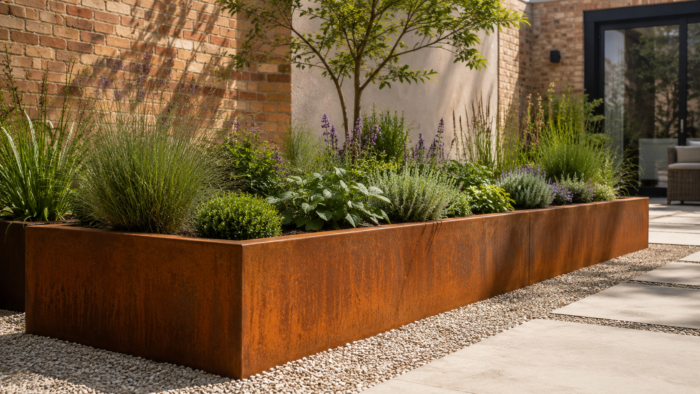
Corten steel for a changing weathered finish
Corten steel may be considered where a naturally changing, weathered finish suits the surrounding garden materials and planting style. The 3mm Corten Steel Planters page provides a useful reference for this material direction and its rusted patina. Early weathering run-off and the surrounding surface should still be considered before final placement.
In practice, Corten often suits gardens that already include brick, gravel, oak, darker cladding or other strong natural tones. Its appearance can feel grounded and calm in a rear boundary or along a courtyard edge. It may be less suited where a sharply controlled colour scheme is the priority, or where surrounding pale paving would be affected by weathering marks.
PPC mild steel for colour-led garden schemes
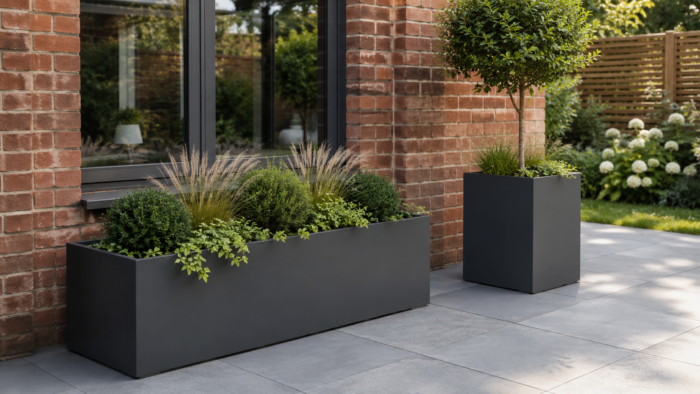
PPC mild steel may be relevant where a controlled powder-coated finish is part of the garden design direction. The 3mm PPC Mild Steel Planters page provides a useful reference for this material option when colour coordination with paving, glazing, fencing or exterior metalwork is important. Suitability should still be assessed against the final setting and project requirement.
This option can work well in contemporary gardens where the planter needs to sit quietly within the landscape rather than drawing attention to itself.
A dark finish can strengthen the edge of a patio, while a lighter tone may soften a boundary or complement painted joinery.
PPC aluminium for selected garden requirements
Aluminium may be considered where a powder-coated planter direction and lighter handling are relevant to the wider project requirement. The 4mm PPC Aluminium Planters page provides a useful reference for aluminium planter options and finish direction. The selected planter should still be reviewed against dimensions, planting load and the proposed garden location.
Aluminium can suit upper terraces, roof-adjacent gardens or locations where the wider project team is balancing appearance with practical handling considerations. It is not the same as mild steel or Corten in how it behaves outdoors, so it should be reviewed in the context of the specific garden, not assumed to perform identically. The finish and proportions should work with the rest of the scheme.
Choosing Planter Shape, Size and Placement
Shape and size affect how a planter reads from inside the house as well as from the garden itself. A planter that seems attractive in isolation can still feel too small beside a broad terrace, or too large against a compact paving run. That is why proportion matters before ornament does.
Planter placement should be planned with sightlines, access and garden use in mind. A planter near a rear door may need to leave enough circulation space, while one along a boundary may be better used to anchor a seating zone or soften a long fence line. The goal is to support the garden layout rather than compete with it.
Trough planters, tall planters and raised planting features
Trough planters, tall planters and raised planting features each create a different effect. Trough planters tend to extend a line horizontally, which can suit long patios, boundary runs or narrow courtyards. Tall planters add vertical emphasis and can help break up blank walls or fence panels. Raised features can create more pronounced planting zones where the garden needs structure.
Matching planter proportions to the garden rather than forcing a statement piece
A planter that is too dominant can make a small garden feel crowded, while one that is too modest can disappear against hard landscaping. Proportion should be tested against the length of the wall, the depth of the patio and the height of nearby elements such as fencing or glazed doors. The same planter may feel balanced in one setting and awkward in another.
It also helps to think about how the planter sits with nearby planting. If shrubs or perennials will soften the edges, the structure may be more visible at first. If the planter is intended to stand as a feature on its own, the scale and silhouette need to hold their own against the surrounding architecture.
Planning planter positions around patios, doors and garden seating areas
A planter beside a seating area can create enclosure and make the space feel more defined, but it should not interrupt movement or block key views. Near doors, the position often needs to feel welcoming rather than crowded, especially where the garden is viewed from a kitchen or family room. In these areas, a planter should support circulation, not fight it.
Careful placement of metal garden planters can enhance both aesthetics and functionality in your outdoor space.
Loaded weight, access, substrate and structural requirements should be reviewed with the relevant project professional where required. That is especially important on terraces, roof gardens or raised decks, where the supporting surface may have specific limitations. Placement and drainage planning should be reviewed before the planter is filled.
Drainage, Planting and Day-to-Day Garden Considerations
Drainage is not a minor detail. It affects how the planter performs through wet periods, colder months and the repeated cycles of watering and drying that happen in domestic gardens. The planter choice should be matched with the intended planting, the exposure of the site and the level of maintenance the garden can realistically support.
Planting depth is equally important. Some plants need more rooting space than others, and some schemes rely on layered planting that depends on enough internal depth to look balanced from the outside. A planter may suit a low seasonal display, while another may be better for shrubs or repeated structural planting.
Planting depth, growing medium and weather exposure
The depth available inside the planter should be considered alongside the mature size of the planting idea, not just the first season’s appearance. Shallow planters can look neat but still limit what can be planted comfortably, while deeper planters may be better suited to more substantial planting zones. Exposure matters too, particularly in open gardens where wind and rain affect container conditions.
Drainage planning is important because container plants can be affected by waterlogging, rainfall, plant type and seasonal changes. The Royal Horticultural Society’s guidance on growing plants in containers provides useful wider context on drainage and container care. The final planting arrangement should still reflect the chosen plants, growing medium, planter position and local conditions.
Why drainage and final position should be reviewed before planting begins
Once a planter is in place and filled, changing the position can be difficult. That is why the final location should be assessed before planting begins, especially where the planter sits on paving, close to a wall or near a threshold. Exposure to wind, rainfall splash and reflected heat from hard surfaces can all affect how the planting performs.
This is also where garden planning becomes more than a material decision. A planter in a sheltered courtyard may behave differently from one at a garden boundary or beside a sun-facing extension. Drainage and position should therefore be considered together, rather than as separate afterthoughts.
Bringing Metal Garden Planters into Different Garden Styles
A planter should respect the style of the garden rather than override it. This does not mean it has to disappear, but it should feel as though it belongs to the materials and planting already present.
The most successful schemes usually echo one or two existing features in tone, form, or rhythm.
This is where colour and finish coordination become particularly useful. In some gardens, the planter should blend with paving or joinery. In others, it may provide a quiet contrast that sharpens the whole composition. Either approach can work if it is consistent with the wider setting.
Contemporary gardens with paving, brickwork and dark exterior details
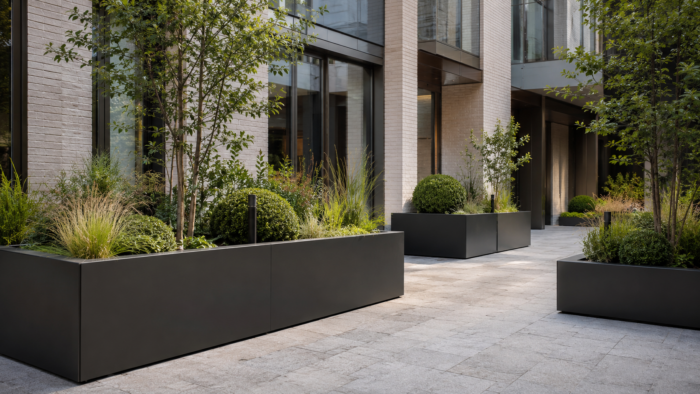
Contemporary gardens often rely on clear edges, strong geometry and a limited materials palette. In those settings, powder-coated metal garden planters can support the design by echoing the lines of paving, glazing and dark window frames. A restrained finish can help the planting feel integrated rather than isolated.
Brick extensions, large-format paving and slim boundary fencing often create a strong backdrop for angular planters. The key is to keep the relationship between planter and architecture calm. If the planter material, colour and size are all competing for attention, the garden can lose the clarity that makes contemporary design work.
Softer garden settings with timber, gravel and natural planting
In softer schemes, garden metal planters can still feel at home if the finishes are chosen carefully. Timber, gravel and looser planting often benefit from a planter that adds structure without becoming severe. A warmer material direction or a less reflective finish may sit more comfortably within that kind of setting.
These gardens often rely on the contrast between built elements and planting, so the planter should help hold that balance. A well-placed planter can define a seating area, mark a transition or support a boundary planting scheme without breaking the softer mood. The result should feel settled rather than overly engineered.
What to Check Before Ordering Metal Garden Planters
Before ordering, it helps to slow down and review the project as a whole. The planter dimensions should suit the intended location, the planting purpose and the available circulation space. A planter that works on paper may still be awkward if access is tight or if it clashes with nearby doors, steps or fence lines.
It is also worth checking the selected material, finish and likely colour direction against the rest of the exterior. That includes paving, walls, cladding, fencing, glazing and any nearby architectural metalwork. For some projects, bespoke planter dimensions may be available, subject to the selected product and project requirement.
Measurements, materials, finishes and access planning
Measurements should be taken with the final layout in mind, not simply the planter footprint. Consider the space around the planter, the visual weight of the surrounding area and how the planter will relate to other garden features. In narrower spaces, a carefully sized planter can look far more resolved than a larger one forced into the same location.
Access planning matters too, particularly for enclosed courtyards or gardens with restricted side access. The route into the garden should be checked before a planter is specified, because placement can be affected by practical handling as much as by design intent. Materials, finishes and available dimensions should all be reviewed together.
FAQ
-
What are metal garden planters used for?
They are used to create structure, define boundaries, support planting on patios or courtyards and bring clearer shape to garden layouts. They can also help connect planting with paving, brickwork, fencing and other external finishes.
-
Which material is suitable for metal garden planters?
Suitability depends on the garden style, colour scheme and project requirement. Corten steel, PPC mild steel and PPC aluminium each offer different visual and practical qualities, so the best choice is the one that matches the setting.
-
Can metal garden planters be made to bespoke dimensions?
Bespoke planter dimensions may be available for suitable project requirements. This can be helpful where a planter needs to fit a specific patio edge, boundary run, entrance area or raised planting zone.
-
Do metal garden planters need drainage planning?
Yes. Drainage should be considered alongside plant type, growing medium and site conditions. Rainfall, exposure, seasonal temperatures and watering routines all influence how container planting performs over time.
-
Can metal garden planters be supplied in different colours?
Yes, a wide range of RAL or BS colour options may be available, subject to the selected finish and project requirement. Colour choice is often important where the planter needs to align with paving, glazing, fencing or exterior metalwork.
Metal Profiles Ltd supplies and fabricates metal planters and architectural metalwork for UK projects. Metal garden planters may be considered for garden, patio, courtyard and landscaped outdoor requirements. If you are planning a project, share your preferred material, dimensions, planting intention, photographs, finish preferences and wider garden context. A wide range of RAL or BS colour options may be available, subject to the selected finish and project requirement. For product or project support, Contact Metal Profiles Ltd today.
Discover more from Metal Profiles Ltd
Subscribe to get the latest posts sent to your email.