


Metal Profiles in Construction UK: what are metal profiles, common types, uses and FAQs

If you’re searching for Metal Profiles in Construction and “metal profiles UK”, you’re usually looking for one of two things:
- a clear explanation of what are metal profiles in construction, and what they’re used for, or
- practical guidance on choosing the right architectural metal profiles and aluminium profiles for a real roofline, façade or weatherproofing detail.
This guide explains what metal profiles are, where they are used, and what to consider when specifying bespoke metal profiles or powder coated metal profiles for UK buildings.
If you need help choosing the right system for your project, Metal Profiles Ltd can advise on options and next steps via:
What are metal profiles in construction?
Metal profiles are shaped pieces of metal used to form building components such as roofline trim, weather protection, façade cladding details, drainage channels, and bespoke architectural features.
In the UK, many projects specify aluminium because it’s well-suited to outdoor exposure. That’s why you’ll see a lot of aluminium metal profiles across roof edges and perimeter details, including:
- aluminium coping profiles and aluminium capping profiles for parapets and wall tops
- aluminium fascia profiles and aluminium soffit profiles for roofline protection
- aluminium gutter profiles including aluminium box gutter systems
- metal flashing profiles and aluminium flashing profiles to manage water at roof transitions
- aluminium window profiles and aluminium door profiles in façade detailing
- metal cladding profiles where architectural cladding needs durable edging and weatherproofing
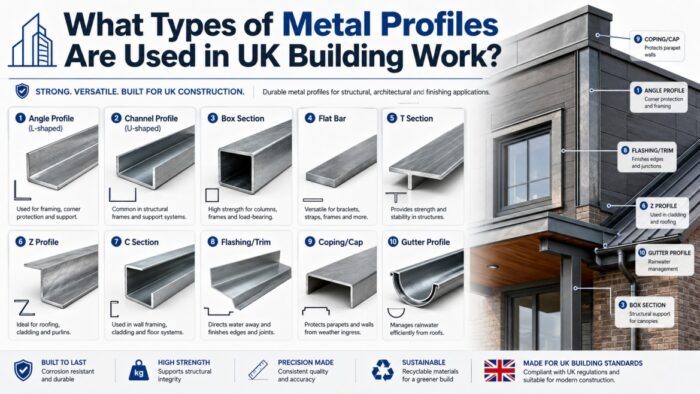
What types of metal profiles are used in UK building work?
Sheet metal profiles and fabrication formats
Many components begin as sheet stock and are then cut, formed and finished. Depending on the project, you might hear terms like:
- sheet metal profiles in construction (formed from sheet stock and shaped as required)
- pressed metal profiles in construction (profiles formed using pressing/forming processes)
- folded metal profiles in construction (profiles created by folding sheet to achieve the correct sections and edges)
In practical terms, these fabrication types support different design needs such as clean corners, consistent edges, and weatherproof interfaces.
Architectural metal profiles and roofline metal profiles
In roofing and façade work, you’ll often see architectural metal profiles that are designed to:
- protect exposed edges from wind-driven rain
- reduce water tracking onto walls
- create crisp lines around parapets, roof edges and openings
This is where roofline metal profiles come in, including fascia/soffit trim, verge trim, coping systems and drainage components.
Bespoke metal profiles in construction (when standard isn’t enough)
Some projects require a shape that doesn’t match standard catalogue items. That’s when bespoke metal profiles are specified, for example:
- parapet details with unusual offsets
- corners and junctions that need custom mitres
- façade details around windows, canopies or roof transitions
If you want to discuss bespoke aluminium or custom dimensions, Metal Profiles Ltd can help.
Aluminium profiles in practice: what they protect
Because aluminium is used extensively in roofline and façade weatherproofing, it helps to understand what the profiles are protecting.
Common applications include:
Aluminium coping profiles and parapet protection
Aluminium copings protect parapet walls and wall tops where rainwater repeatedly hits the exposed edge. They also help create an architectural finish that looks consistent season after season.
Related guide:
Aluminium capping and wall heads
Where a top edge needs protection and improved appearance, aluminium capping can form part of the weatherproofing detail.
Aluminium fascia profiles and aluminium soffit profiles
Fascia and soffit components protect the roof edge and underside of the roof overhang. They also support a tidy, finished look for the roofline.
Aluminium gutter profiles and aluminium box gutter systems
Rainwater control is one of the biggest drivers of roof durability. Aluminium guttering helps move water away from the building in a controlled way, including advanced drainage routes where appropriate.
If you want to learn more about drainage design:
- What is a box gutter and how does it work?
- Box gutter guide for roofing professionals
- Rainwater Goods
Powder coated metal profiles and RAL colour specification
Many clients choose powder coated metal profiles in construction work because the finish can be specified to match the wider building palette.
When specifying colour, ask for:
- the intended RAL colour (and confirm whether it’s a match to existing roofline/fascia/soffit/coping colours)
- whether the finish is intended to coordinate with other external metalwork such as flashings, window surrounds or canopies
- a consistent finish across the whole run, especially where visible junctions matter
This is where good communication between the specifier, installer and supplier prevents mismatched tones after installation.
Metal profile suppliers UK: what to look for before you order
Searching for “metal profile suppliers” and “metal profile manufacturers” is only the start. The better question is what you need from the supplier.
When choosing metal profile suppliers UK, consider:
- Do they offer made-to-measure or bespoke metal profiles for your roofline or façade details?
- Can they supply compatible systems (for example coping plus fixing approach, or drainage plus outlets/downpipes)?
- Are they able to advise on the right profile type (flat/sloped sections, joint approach, end details)?
- Do they support specification and ordering with clear information (dimensions, quantities, junction requirements)?
- Can they coordinate powder coating and colour consistency?
If you’re specifying for a UK project with local relevance for Chelmsford, Essex, London, or elsewhere, Metal Profiles Ltd can help with advice and supply.
For next steps:
How to specify metal profiles for your project (quick guide)
Whether you’re a homeowner, builder, architect or facilities manager, a simple approach helps:
- Describe the building element
Roof edge, parapet, fascia/soffit line, gutter run, window surround, canopy, or flashing transition. - Provide key dimensions
Length of runs, corner counts, offsets, and any constraints around access. - Select the profile type
For example aluminium coping profiles as flat or sloped, or the correct roofline profile system. - Confirm the finish
Powder coating and RAL colour coordination where needed. - Agree the installation approach
Fixing method, sealing approach, and how junctions will be detailed.
Conclusion: choosing the right metal profiles makes a difference
Good metal profiles are not just a finish detail. They help protect roof edges, manage water, support clean façade lines and reduce long-term maintenance headaches.
If you’re planning a project in Chelmsford, Essex, London or elsewhere in the UK, Metal Profiles Ltd can help you select and specify the right aluminium metal profiles in construction and related systems.
Start here:
Frequently Asked Questions
-
What are metal profiles used for in construction?
Metal profiles are shaped metal components used across roofing, façades and weatherproofing details. They can form roofline systems like fascia and soffits, protect wall edges with copings and cappings, manage rainwater with gutters and downpipes, and create architectural finishing elements like flashings and bespoke cladding trims.
-
Why do projects use aluminium profiles?
Aluminium profiles are commonly selected for outdoor use because they suit external weather exposure and can be finished to an architectural standard. Aluminium-based systems are widely used in UK roofline detailing where durable performance and clean visual lines are important.
-
What is the difference between metal cladding profiles and roofline metal profiles?
Metal cladding profiles are usually designed to support external cladding or architectural façade finishes. Roofline metal profiles are specifically designed for the roof edge environment, helping with weather protection, water management, and coordination with fascia/soffit and drainage systems.
-
Can metal profiles be powder coated in RAL colours?
Yes, many aluminium profile systems are supplied with powder coated finishes and can be specified to match RAL colour palettes. When ordering, confirm the exact colour reference and agree finish consistency across components that will be seen together.
-
What are bespoke metal profiles in construction?
Bespoke metal profiles in construction are made to required sizes and shapes for a specific building detail. They are typically used where standard components do not suit corners, offsets, roof geometry or architectural design intent.
-
Do I need a metal profile supplier UK-wide or local?
Both can work. For local projects, choosing a supplier with regional relevance is helpful. For larger developments, UK-wide supply can be better. What matters is whether the supplier can meet your specification requirements and coordinate lead times and ordering details.
-
How do I choose aluminium coping profiles for a parapet?
Start by deciding whether you need a flat or sloped coping profile based on how you want the water to shed. Then confirm dimensions, corners, end details and joint approach. A system-based specification helps reduce leak-risk at interfaces.
-
What fixing and sealing should be considered when installing metal profiles?
Correct fixing and sealing depend on the building element, substrate and interface. In general, installers must select fixing methods suited to the wall/roof build-up and complete sealing at joints and transitions so water does not track behind the weatherproofing.
-
Are aluminium window profiles and aluminium door profiles supplied as part of architectural systems?
They can be. Aluminium window surrounds and door detailing are often coordinated with other external metalwork such as roofline trims and weatherproof flashing. This helps deliver a consistent look and weather-tight interfaces.
-
Where can I find NBS wording for metal profile specification?
Metal Profiles Ltd provides NBS specification information, which can support specifiers and contractors during procurement and coordination. See nbs specification.
Discover more from Metal Profiles Ltd
Subscribe to get the latest posts sent to your email.