


Aluminium Window Surrounds: The Complete UK Guide to Types, Design and Installation in 2026

Walk down any street in a new-build development in Chelmsford, or most of Essex come to that, and you will start to notice something. A lot of the houses that look genuinely smart from the outside, the ones that do not just look like every other render box on the plot, have something framing their windows. A bold rectangular projection around each opening. Clean lines. A consistent colour. And it makes a real difference to how the building reads from the road.
Those are window surrounds. And while the idea of framing a window is not new (stone and brick architraves have been doing it for centuries on Georgian and Victorian buildings), the modern aluminium version is a genuinely clever product that does things the traditional materials cannot. It is lightweight, corrosion-proof, available in any RAL colour, non-combustible, and it can be fitted on a new build or retrofitted onto an existing property without any significant structural work. That is a pretty compelling combination.
This guide covers everything about aluminium window surrounds: what they are, how they differ from other surround materials, the types and profiles available, how to design and specify them correctly, how to install them, and how they interact with Building Regulations. It is written for homeowners, self-builders, architects, contractors, and anyone who wants to understand the product properly before they buy or specify.
View Metal Profiles Ltd aluminium window surrounds to see our standard range and request an estimate for your project.
What Are Window Surrounds?
A window surround is a decorative and functional architectural element that frames a window opening on the exterior of a building. It sits proud of the wall surface and projects outward, creating a three-dimensional frame around the window that adds visual depth and definition to the facade.
At its most basic, a window surround is just four sides forming a rectangle around a window. But the projection depth, the face width, the material, and the colour all determine whether the surround reads as a subtle detail or a bold architectural statement. Get it right and it transforms the appearance of even the most ordinary building. Get it wrong and it can look incongruous and cheap.
Window surrounds serve several purposes at once. The most obvious is visual: they add definition and character to window openings that would otherwise be just holes in a wall. But they also perform practical functions: they help weather-seal the junction between the window frame and the wall substrate, they protect the reveal edges from weathering and impact, and on contemporary buildings with render or cladding facades, they provide a clean finish at the interface between the facade material and the window frame.
Window surrounds versus window cills: what is the difference?
A window cill (sometimes spelled sill) sits at the base of the window opening only, providing a weathered ledge that throws water clear of the wall below the window. A window surround encompasses all four sides of the opening: the cill at the bottom, the two side jambs, and the head piece above. The surround is a complete frame, while the cill is just one component of it.
On traditional buildings you often see cills without full surrounds: a stone or brick sill at the base but no formal framing on the sides and head. On contemporary buildings, particularly those with render or panel facades, a complete surround on all four sides gives a much more finished appearance and provides better weatherproofing at all the window junctions, not just the base.
Read our complete guide to aluminium wall copings for more on how aluminium profile sections handle weathering at key building junctions.
Window Surround Materials: A Comparison
Window surrounds have been made from many different materials over the centuries, and the right choice still depends on the building’s architecture, the design intent, and the practical requirements of the installation. Here is how the main options compare.
Natural stone window surrounds
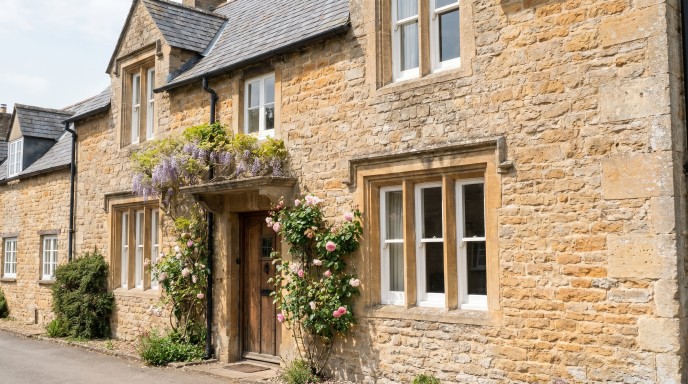
Stone window surrounds are the original. On Georgian, Victorian, and Edwardian buildings, carved limestone or sandstone architraves were the standard way of framing windows, and the quality of the stone carving often signalled the status of the building. Bath stone surrounds on a Regency terrace, red sandstone on a Victorian terrace: the material was intrinsic to the architectural language.
Natural stone surrounds are still used today, primarily on high-specification traditional or neoclassical buildings, heritage conservation projects, and listed building works where natural stone is required by the planning authority. They are expensive (carved stone is labour-intensive), heavy (requiring structural consideration for the wall and lintel), and slow to install. But the result is genuinely beautiful and will last centuries with minimal maintenance.
For most modern new-build and refurbishment projects, natural stone is impractical on cost and programme grounds. Where the traditional aesthetic is required, reconstituted stone (glass fibre reinforced concrete cast in stone moulds) provides a similar visual result at significantly lower cost and weight.
Brick and masonry window surrounds
Brick window surrounds, where the brickwork around the window is laid in a contrasting bond or brick type to create a visual frame, are a traditional detail on Victorian and Edwardian housing stock across the UK. Rubbed and gauged brickwork, corbelled arched heads, and soldier course lintels all create window surround effects using the masonry itself rather than an added architectural element.
For new-build brick construction, subtle brickwork detailing around windows can add character without additional material cost, but it requires skilled bricklayers and good design to look intentional rather than accidental. On render facades, brickwork surrounds are not possible, which is one reason why aluminium and composite surrounds have become standard on rendered new-build and self-build properties.
GRP and composite window surrounds
Glass fibre reinforced polymer (GRP) and composite window surrounds replicate the appearance of stone or painted timber mouldings at lower cost and weight. They are commonly used on new-build traditional-style houses (those developments that look Georgian or Victorian but are not), where the planning authority or developer specifies traditional-looking window surrounds but the budget does not stretch to real stone or cast stone.
GRP surrounds are lightweight and paintable, but they are not particularly robust, they do not cope well with impact damage, and the cheaper products have a surface texture that does not convincingly replicate stone at close quarters. They are also typically available only in a limited range of profiles designed for traditional architectural styles, which makes them unsuitable for contemporary design.
uPVC window surrounds
uPVC trim sections are used on some residential buildings as window surround or architrave elements, typically on older properties with uPVC window frames where a matching trim material makes sense. uPVC is cheap, easy to cut and fix, and does not rot, but it has significant limitations. It becomes brittle with UV exposure over time, it cannot be powder coated (only available in a limited colour range), and it has a distinctly plastic appearance that does not work well on rendered facades or contemporary buildings. The material is also classified as combustible, which creates compliance issues on buildings over 11 metres.
Aluminium window surrounds
Aluminium is now the standard material for window surrounds on contemporary UK buildings, and for very good reasons. Here is the combination of properties that makes it the right choice for most new-build and refurbishment applications in 2026:
- Non-combustible: solid aluminium sheet achieves an A1 non-combustible fire classification. Powder-coated aluminium meets the criteria for Class 0 under BS 476 Parts 6 and 7, which is compliant with Building Regulations Approved Document B for buildings at any height. This is critical following the Building Safety Act 2022 and the restrictions on combustible materials on buildings over 11 metres.
- Corrosion-proof: aluminium does not rust. It forms a self-healing protective oxide layer when exposed to air, which means even if the powder coat surface is scratched, the underlying metal will not corrode. This is a significant advantage over steel or cast iron alternatives in UK coastal and urban environments.
- Lightweight: aluminium is roughly one third the weight of steel. Aluminium window surround sections can typically be handled, cut, and fixed by one or two people without lifting equipment.
- Full RAL colour range: powder-coated aluminium can be specified in any RAL or BS colour using an external-grade polyester powder system to BS EN 12206-1. This means the window surrounds can be matched precisely to any other aluminium element on the building, whether fascias, soffits, copings, gutters, or cladding panels.
- Bespoke profiles and sizes: aluminium surrounds can be fabricated to custom face widths, projection depths, and corner details to suit specific architectural requirements. Standard kit systems cover most common window and door opening sizes, and bespoke fabrication handles anything outside those parameters.
- Minimal maintenance: a properly installed aluminium window surround system requires no painting, no sealing, and no treatment over a service life of 40 to 50 years. An occasional wash down with water is all that is needed to keep them looking good.
| Material | Weight | Fire class | Corrosion | Colour range | Best for |
| Natural stone | Very heavy | Non-combustible | Excellent | Natural only | Heritage, listed, luxury traditional |
| Cast/recon stone | Heavy | Class A | Excellent | Limited | Traditional new-build, period style |
| GRP composite | Light | Combustible | Good | Paintable | Budget traditional new-build |
| uPVC | Light | Combustible | Good | Limited | Budget residential (uPVC frames only) |
| Aluminium | Very light | Class 0 / A2 | Excellent | Full RAL range | Modern residential, commercial, all heights |
Types of Aluminium Window Surround: Profiles and Projections
Not all aluminium window surrounds are the same. The two main variables that define how a surround looks and performs are the projection depth (how far it stands out from the wall face) and the face width (how wide the visible face of the surround is). Getting these two dimensions right is the key design decision.
Projection depth: Deepline vs Slimline
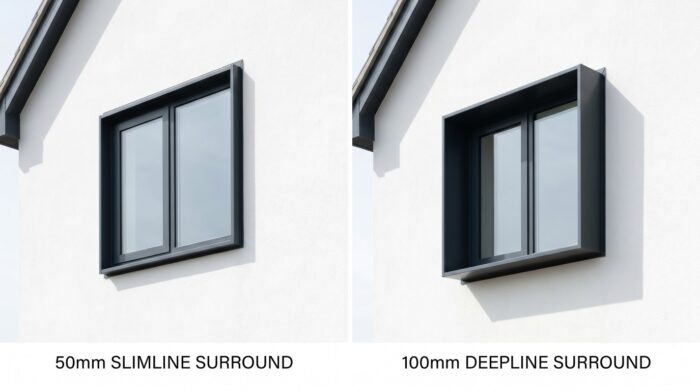
The projection depth is measured from the face of the wall or cladding to the front face of the window surround. This is probably the single most important dimension in terms of visual impact, because projection depth determines the shadow line around the window, which is what creates the three-dimensional character of the surround.
A 50mm projection (what is commonly called a Slimline profile) gives a noticeable raised frame that adds definition to the window without dominating the facade. This works well on buildings where a contemporary but understated effect is wanted, or where the overall facade treatment is busy enough that you do not want the surrounds to compete for attention.
A 100mm projection (the Deepline profile) creates a very bold, architectural frame around the window with a pronounced shadow line that reads strongly from the street. This is the right choice for buildings designed to make a statement, for developments where the surrounds are part of a deliberate design feature, and for facades with large wall panels between windows where the surrounds need to provide the main visual interest.
Our standard aluminium window surrounds at Metal Profiles Ltd are supplied with a 150mm face measurement in 2mm gauge aluminium. For specific projection depths and face widths outside our standard range, we can produce bespoke profiles to your specification. Contact us or request an estimate with your project dimensions and we will advise the right profile for your application.
Face width: 100mm, 150mm, and 200mm profiles
The face width is the visible front dimension of the surround, measured from the wall face to the front edge of the section. Common standard face widths are 100mm, 150mm, and 200mm.
A 100mm face width is quite narrow and reads as a fine architectural frame. It is appropriate for smaller windows, windows with narrow reveals, or buildings where a more restrained surround is required. It works particularly well on buildings where multiple surround elements are used together, because narrower faces create a lighter visual rhythm without making the facade feel heavy.
150mm is the most commonly specified face width for standard residential windows in the UK. It is wide enough to be clearly visible and to create a confident architectural statement without being overwhelming. Most standard window surround kit systems are designed around 150mm as the standard face dimension, and it is the face width of our standard Metal Profiles Ltd window surround product.
200mm face widths are used on larger windows, commercial and mixed-use buildings, and projects where a more emphatic frame is desired. A 200mm surround on a large commercial window creates a very strong architectural presence and can be an effective tool in creating visual hierarchy across a complex facade.
Corner details: mitre joints and return legs
At the corners of a window surround, where the head meets the side jambs, there are two main ways of making the join. A mitre joint cuts both sections at 45 degrees and brings them together at the corner, giving a clean, elegant appearance with a continuous profile running around the full perimeter. A return leg (sometimes called a butt joint or a capped corner) has the horizontal head section running the full width of the window and the vertical side sections butting up to the underside and top of the head, with visible end caps at the return corners.
Mitre joints look cleaner and are preferred on higher-specification projects and on surrounds where the shadow line profile has a strong three-dimensional character. They require more precision to cut and fit than butt joints. For standard aluminium window surround kits, pre-formed corner sections ensure a clean and consistent corner without the need for on-site mitre cutting.
Bespoke and custom window surrounds
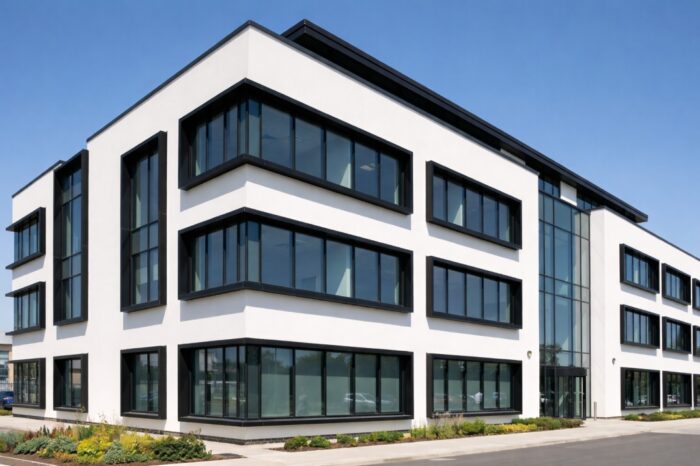
Standard kit systems cover the most common residential window and door opening sizes, but a significant number of projects require something different. Commercial buildings with non-standard opening sizes, architectural projects with specific profile requirements, buildings where the surrounds need to integrate with other facade elements (cladding panels, copings, door canopies), and refurbishment projects where the surround needs to work around existing features all typically need bespoke fabrication.
Aluminium is a material that lends itself very well to bespoke fabrication. It can be brake-pressed, roll-formed, welded, and extruded into virtually any cross-section geometry, and it can be powder coated to any RAL colour. This means a genuinely bespoke aluminium window surround that is designed specifically for a project is achievable without the time or cost penalty that bespoke stone or cast iron work would incur.
For bespoke window surround requirements, contact our team at Metal Profiles Ltd with your opening dimensions, required face width and projection depth, corner detail preference, and colour specification. We can produce fabricated surrounds to your exact requirements. See also our aluminium door canopies range and NBS specification page for how our products integrate with technical specifications.
Designing Window Surrounds for Different Building Types
Window surrounds are used across a very wide range of building types, and the right design approach varies significantly depending on the context. Here is how to think about it for the most common UK project types.
Modern residential new-build
This is where the growth in aluminium window surrounds has been most dramatic over the past ten years. Contemporary new-build housing in the UK has largely moved toward render facades, and a rendered facade without window surrounds looks flat and featureless. Aluminium surrounds in RAL 7016 anthracite grey or RAL 9005 jet black against a light grey or white render have become the characteristic visual language of premium new-build housing across the country.
For residential new-build, the typical specification is a 150mm face surround in either 50mm or 100mm projection, in the same RAL colour as the fascia, soffit, and guttering. This creates a completely coherent roofline and facade package where all the aluminium elements sing the same colour note. Coordinating the window surround colour with the fascia and soffit means ordering all products from the same supplier in the same RAL at the same time, to avoid batch variation between powder coat runs.
Our aluminium fascia in 3m lengths with matching fascia external corners, internal corners, and stop ends provide the roofline coordination to go with window surrounds. Our guide to why aluminium fascia and copings are essential explains the full roofline system in detail.
Self-build and home extension
Self-builders are typically among the more design-aware buyers of window surrounds, precisely because they are making their own design decisions rather than following a developer’s specification. A well-designed window surround package on a self-build is one of the most cost-effective ways to lift the building from looking like a generic new-build to looking like something that has had genuine design thought applied to it.
For self-build projects, the decision about projection depth and face width should be made in the context of the overall facade composition. If the render or cladding panels between windows are large and relatively plain, deeper and wider surrounds help to break up the facade and add visual interest. If the facade has other texture or material variation, lighter surrounds may be more appropriate to avoid a busy appearance.
Our aluminium flat coping sections and aluminium sloped coping brackets are frequently used on self-build projects alongside window surrounds to create a comprehensive aluminium detailing package across the building envelope.
Retrofit and property renovation
Adding aluminium window surrounds to an existing property is one of the most impactful aesthetic upgrades you can make to a rendered facade. Properties built in the 1970s, 1980s, and 1990s often have plain render facades with plain window openings and no architectural detail at all. Retrofitting powder-coated aluminium surrounds transforms the external appearance without requiring any significant structural work or planning consent in most cases.
For retrofit installations, the key practical consideration is the condition of the wall substrate around the window openings. The surround fixing brackets need to engage with solid substrate: masonry, timber, or a structural cladding support system. If the existing render is hollow, cracked, or poorly bonded, it needs to be repaired before the surrounds are fixed.
It is also worth considering the thermal detail at the junction between the aluminium surround and the window frame. On a retrofit installation where the window frame stays in place, a correctly detailed and sealed joint between the surround back leg and the window frame prevents cold bridging and water ingress at this junction. Our colour-matched sealant is specifically suited for this application.
Commercial buildings and mixed-use developments
On commercial buildings, window surrounds perform a more pronounced architectural function than on residential properties. They are part of the building’s visual branding, they help to define the scale and rhythm of the facade, and they often need to coordinate with other architectural aluminium elements: cladding systems, column casings, canopies, and balustrade details.
Commercial window surrounds are typically specified at larger face widths (200mm is common) and with deeper projections (100mm or more) because commercial buildings are viewed from greater distances, where finer details are lost and the bolder shadow lines of deeper surrounds read more clearly. The fire classification of the material is also a critical specification requirement on commercial buildings, particularly those over 11 metres in height under the post-Grenfell regulatory framework.
Aluminium window surrounds achieve an A2-s1,d0 classification under BS EN 13501-1 (powder-coated) or A1 (bare aluminium), which satisfies the non-combustible material requirements of Building Regulations Approved Document B for buildings of any height. This is a straightforward compliance route that uPVC, GRP, and timber surrounds cannot match.
Installing Aluminium Window Surrounds: Step-by-Step Guide
A well-installed aluminium window surround should be perfectly plumb, level, and square, with clean sealed joints at all corners and at the junction with the window frame. Here is how to approach the installation correctly.
Tools and materials required
- Aluminium window surround sections (head, two side jambs, cill/sill section), cut to the required lengths
- Pre-formed corner pieces or mitre-cut corners, depending on the system
- Concealed fixing brackets (typically fabricated from 3mm aluminium, cantilever design for direct fixing to facade)
- Stainless steel fixing screws appropriate for the substrate (masonry anchors for concrete/brick, structural screws for timber frame)
- Colour-matched sealant conforming to BS EN ISO 11600, in the matching RAL colour
- Colour-coded stainless steel fasteners for any exposed fixing points
- Touch-up paint or colour-matched spray can for treating cut edges
- Spirit level, tape measure, chalk line or laser level
- Power drill with masonry and metal bits as required
- Metal cutting saw or angle grinder with aluminium cutting blade
- Acetone and clean cloths for joint degreasing before sealing
- According to UK Building Regulations, non-combustible materials are essential for safe building design.
Installation Step 1: Measure and set out the surround positions
Before anything else, mark out the exact surround positions on the wall surface. For each window, establish a level datum line across the top of the head section position, and use a spirit level or laser level to ensure the two side jamb lines are truly vertical. Plumb lines that are even 2mm out of vertical will be visible on the finished installation, particularly on a smooth render facade where there are no texture lines to distract the eye.
Mark the bracket positions on the wall at this stage. The number of brackets per side depends on the surround length and the structural requirements, but as a minimum, one bracket at the top and bottom of each vertical section and one at each end of the horizontal head section, plus one at the centre of any section over about 1.5 metres, is the usual rule.
Installation Step 2: Check the wall substrate condition
Before fixing any brackets, tap the wall surface around the marked bracket positions to check for hollow render. A hollow sound indicates debonded render that will not support the bracket fixing. If hollow areas are found, they need to be cut out and made good before proceeding. This is particularly common on older rendered facades where the render has partially debonded from the masonry below.
For timber frame construction, identify the stud or sheeting positions behind the cladding before drilling, to ensure brackets are fixed into structural material rather than just cladding panels. A stud finder is useful here, or check the construction drawings if available.
Installation Step 3: Fix the brackets to the wall
Fix all brackets at the marked positions before fitting any surround sections. Use stainless steel fixings appropriate for the substrate: resin anchors or frame fixings for masonry, stainless screws for timber. Check each bracket with a spirit level as it is fixed: the bracket face needs to be perfectly plumb (vertical) and all brackets on the same section need to be in the same plane.
On rendered facades, take care not to crack or dislodge the render around the fixing holes. If the render is fresh, allow it to cure fully before fixing brackets. On existing render, use a masonry bit to drill cleanly through the render into the substrate, and use a fixings designed to bridge the render thickness without bearing on the render face.
Installation Step 4: Cut surround sections to length
Measure each surround section against the actual wall position rather than relying solely on the nominal opening dimensions. Buildings are rarely perfectly square, and dimensions taken from drawings may not match what is actually on site. Measure twice, cut once.
Cut aluminium surround sections with a metal cutting saw or a fine-toothed circular saw blade designed for aluminium. A sharp blade in an aluminium-capable saw gives a clean, accurate cut that requires minimal finishing. Treat all cut ends immediately with touch-up spray paint matched to the powder coat colour before fitting, to protect the raw aluminium at the cut face.
Allow for thermal movement when cutting sections to length. Aluminium expands at approximately 0.023mm per mm per degree Celsius. A 2m surround section over a 70-degree temperature range will move by about 3.2mm. This movement needs to be accommodated at the corner joints rather than fought against: leave a 2 to 3mm gap at the corner joints (filled with flexible sealant) rather than cutting sections dead tight.
Installation Step 5: Clip or slide sections onto brackets
With all brackets fixed and surround sections cut to length, the sections clip or slide onto the brackets depending on the system design. Concealed bracket systems have a proprietary clip that engages with the back of the surround section, allowing the section to be fitted and removed without exposing fixings on the face of the surround. This gives the clean, hardware-free appearance that makes modern aluminium window surrounds look so much more refined than older systems with visible screw heads on the face.
Ensure each section sits firmly on all its brackets with no rocking or movement. A section that rocks on its brackets will make noise in the wind and will eventually wear the bracket contact point, leading to loosening over time.
Installation Step 6: Form the corner joints
At the corners of the surround where the head meets the side jambs, fit the pre-formed corner pieces according to the system instructions, or form mitred corners where a mitre joint detail is specified. Pre-formed corners are quicker to fit and give a consistent result; mitred corners give a cleaner appearance but require more care to execute correctly.
For mitred corners, cut both sections at exactly 45 degrees using a mitre saw. Both cut faces need to be clean, flat, and at exactly 45 degrees for the joint to close tightly. Even a degree of deviation in the mitre angle leaves a visible gap at the outside edge of the joint when the sections are brought together.
Installation Step 7: Seal all joints and edges
Sealing is the last step but arguably the most important for long-term performance. All corner joints, all expansion joints, and the full perimeter junction between the back of the surround and the wall surface need to be sealed with a colour-matched low-modulus silicone sealant. A silicone joint that is properly applied will flex with the thermal movement of the surround without cracking or debonding. A rigid filler will not, and will fail within one or two thermal cycles.
The method for applying silicone to surround joints is straightforward but needs to be done carefully:
- Clean and degrease both joint faces with acetone applied on a clean lint-free cloth. Allow to dry fully.
- Apply masking tape to both sides of the joint line to give a clean sealant edge.
- Apply a continuous bead of colour-matched sealant to the joint, working it fully into the gap.
- Tool the sealant bead smooth with a wetted finger or a purpose-made sealant tool, pressing the sealant into the joint.
- Remove the masking tape immediately before the sealant skins.
- Allow to cure for 24 hours before exposing to rain or washing.
| Never use clear or white silicone on coloured aluminium surrounds. The colour mismatch is visible immediately and gets worse over time as the sealant yellows. Always use a sealant matched to the RAL colour of the surround. Our colour-matched sealant range is available from our product page and covers all the most common RAL colours we supply. |
Installation Step 8: Final check
- Stand back at street level and check all surrounds are level and plumb. Errors that are invisible at arm’s length can be obvious from 10 metres away.
- Check all corner joints are fully sealed with no gaps.
- Check the perimeter junction between the back of the surround and the wall is fully sealed with no open gaps where water could enter.
- Check that no fixing brackets or screws are visible on the face of the surrounds.
- Check that all cut ends have been treated with touch-up spray.
- Run your hand along all the sections to check for any sharp burrs or edges at cut positions that might catch on clothing or cause cuts.
Colour and Finish Specification for Aluminium Window Surrounds
Getting the colour right matters a lot for window surrounds because they are a prominent and permanent visual element on the building’s facade. Here are the most commonly specified colours for UK projects in 2026 and the context where each works well.
| RAL | Name | Works with | Design context |
| RAL 7016 | Anthracite grey | Light grey or white render, grey cladding | Most popular choice on contemporary UK new-build. Strong architectural presence without being severe. |
| RAL 9005 | Jet black | White render, light brick, zinc or aluminium cladding | Bold and contemporary. Very strong shadow lines. Works particularly well on minimalist architecture. |
| RAL 9010 | Pure white | White render or painted facades | Traditional and contemporary. Clean and bright. Suits heritage and modern styles equally. |
| RAL 7021 | Black grey | Dark grey render, dark timber, anthracite cladding | Sophisticated and subtle. Less contrast than pure black. |
| RAL 1013 | Oyster white | Cream or warm-toned render, stone facades | Warmer than pure white. Suits traditional and rural settings. |
| RAL 7015 | Slate grey | Slate-effect cladding, natural stone | Natural and understated. Suits rural and coastal properties. |
| Bespoke RAL | Any | As specified | For projects requiring an exact colour match to other facade elements. |
Always order window surrounds in the same RAL colour and from the same supplier as all other aluminium elements on the building. Powder coat colour varies slightly between batches and between applicators, and a mismatch between the surround colour and the fascia or gutter colour, even in the same nominal RAL, will be visible. Order everything together in one batch to eliminate batch variation risk.
The surface finish should be specified as external-grade polyester powder coat to BS EN 12206-1. This is the standard for aluminium architectural products intended for external use in the UK and provides the UV and weather resistance required for a 40 to 50 year service life. Cheaper internal-grade powder coats will fade and chalk much more quickly in external conditions. Always confirm the specification with your supplier before ordering.
Window Surrounds and Building Regulations
Following the Grenfell Tower fire in 2017 and the subsequent Building Safety Act 2022, fire safety of external cladding and facade materials has become a central compliance issue for anyone specifying or installing external architectural products on UK buildings. Window surrounds are considered part of the external facade, and their fire classification is a material specification requirement, not a nice-to-have.
Fire classification of aluminium window surrounds
Solid aluminium sheet (the base material for aluminium window surrounds) achieves an A1 non-combustible classification under BS EN 13501-1. This is the highest fire classification available and means the material does not contribute to fire at all.
Powder-coated aluminium achieves an A2-s1,d0 classification, which is the minimum non-combustible classification required under Approved Document B for buildings over 11 metres. It has also been tested to BS 476 Parts 6 and 7 and meets the criteria for Class 0 building regulation approval. This means powder-coated aluminium window surrounds are compliant for use on buildings of any height, including high-rise residential buildings that are subject to the most stringent fire safety requirements.
By contrast, uPVC surrounds (typically Class E or worse), GRP/composite surrounds (typically Class C or D), and timber surrounds (typically Class C or D without fire treatment) do not meet the non-combustible requirements for buildings over 11 metres and cannot be used on these buildings without a specific fire engineering justification.
Planning permission for window surrounds
Adding window surrounds to an existing property is typically permitted development for residential properties and does not require planning consent in most circumstances, provided the surrounds do not project more than 100mm from the wall face (most standard surround systems are within this limit) and the building is not in a conservation area or listed.
In conservation areas, additional restrictions may apply. The planning authority may require the surrounds to be in a material and colour consistent with the area’s character, and may need to approve a sample of the proposed surround before installation. If your property is in a conservation area or is listed, check with your local planning authority before ordering.
For new build projects, window surrounds are typically included in the planning drawings and the planning consent. Any significant departure from the approved drawings (including changes to surround profiles or colours) may require a minor material amendment to the planning consent before proceeding.
| For any building over 11 metres in height, the specification of window surrounds must be checked against the requirements of Building Regulations Approved Document B and the Building Safety Act 2022. If you are unsure whether your project is within scope, consult your building control body before specifying. Always obtain a fire classification data sheet from your surround supplier to demonstrate compliance. |
Window Surrounds vs Window Reveals: Understanding the Difference
These two terms get confused fairly often, and it is worth being clear about the difference because they are quite different architectural elements that do different jobs.
A window reveal is the internal side face of the window opening in the wall: the face you see when you look at the window from inside the room, between the window frame and the internal wall surface. Reveals are typically plastered, rendered, or lined internally. On buildings with thick masonry walls, the reveals can be quite deep, and the reveal depth affects how much light enters the room and how the window reads from inside.
A window surround is an external element that frames the window opening on the outside face of the building. It is not the reveal itself, but it may cover or define the external edge of the reveal. On a rendered facade, the surround typically sits on the render face and projects forward, with its back leg overlapping onto the window frame to seal the junction.
Some aluminium window surround systems include an integrated external reveal lining: a return section that wraps around the external reveal face as well as projecting forward to form the surround frame. This gives a particularly clean and complete detail, especially on buildings with lightweight cladding systems where the reveal face would otherwise be exposed substrate.
Frequently Asked Questions: Aluminium Window Surrounds
-
What are window surrounds?
Window surrounds are architectural elements that frame window openings on the exterior of a building, projecting outward from the wall face to create a three-dimensional rectangular frame around each window. They add visual definition and depth to facade openings, protect the reveal edges from weathering, and help seal the junction between the window frame and the wall substrate. Modern window surrounds are most commonly made from powder-coated aluminium, though traditional buildings use stone, brick, or GRP.
-
Why choose aluminium window surrounds over stone or GRP?
Aluminium window surrounds offer a combination of properties that stone and GRP cannot match: they are non-combustible (Class 0 fire rating, suitable for buildings of any height), completely corrosion-proof, available in any RAL colour, lightweight enough for one or two people to handle, and require no maintenance over a 40 to 50 year service life. GRP is combustible, which restricts its use on buildings over 11 metres. Stone is extremely heavy, expensive, and slow to install. For most modern UK residential and commercial projects, aluminium is the clear first choice.
-
What size window surrounds do I need?
The key dimensions to specify are the face width (typically 100mm, 150mm, or 200mm) and the projection depth (typically 50mm slimline or 100mm deepline). For standard residential windows, a 150mm face width with either 50mm or 100mm projection is the most commonly used specification. For larger commercial windows or where a bolder architectural statement is wanted, 200mm face width and 100mm projection are typical. The surround should be specified in the RAL colour of your choice to coordinate with the rest of the building’s aluminium elements.
-
Can aluminium window surrounds be used on buildings over 11 metres?
Yes. Powder-coated aluminium achieves an A2-s1,d0 fire classification under BS EN 13501-1 and meets the Class 0 criteria under BS 476 Parts 6 and 7, making it compliant with Building Regulations Approved Document B for external facades on buildings of any height. This is one of the significant advantages of aluminium over uPVC and GRP surrounds, which are classified as combustible and cannot be used on buildings over 11 metres without specific fire engineering justification.
-
How are aluminium window surrounds fixed to the wall?
Aluminium window surrounds are typically fixed using concealed cantilever brackets that attach to the wall substrate and engage with the back of the surround section. The brackets are fixed with stainless steel screws or masonry anchors appropriate to the substrate. The surround sections then clip or slide onto the brackets, leaving no visible fixings on the face of the surround. All joints and the perimeter junction with the wall are sealed with colour-matched low-modulus silicone sealant.
-
Do window surrounds need planning permission?
Adding aluminium window surrounds to an existing residential property is typically permitted development and does not require planning consent, provided the surrounds do not project more than 100mm from the wall and the property is not in a conservation area or listed. In conservation areas, additional restrictions may apply and you should check with the local planning authority before proceeding. For new build projects, window surrounds are typically included in the planning drawings and are covered by the original planning consent.
-
How do I maintain aluminium window surrounds?
Powder-coated aluminium window surrounds require very little maintenance. An occasional wash down with clean water and a soft cloth to remove dirt and traffic grime is all that is needed in most locations. Do not use abrasive cleaners or solvents on the powder coat surface as these can damage the finish. If any sealant joints show signs of cracking or debonding after several years, they can be resealed with matching low-modulus silicone sealant after cleaning and degreasing the joint faces.
-
Can window surrounds be retrofitted to an existing house?
Yes. Aluminium window surrounds can be retrofitted to most existing properties without significant structural work. The main requirement is that the wall substrate around the window openings is sound enough to support the fixing brackets. On rendered facades, hollow or debonded render should be repaired before fixing brackets. The project does not usually require building control notification for a like-for-like replacement or addition of decorative elements, but do check the permitted development rules for your property type and location.
-
What is the difference between a slimline and deepline window surround?
These terms refer to the projection depth of the surround: how far it stands out from the wall face. A slimline surround typically has a 50mm projection, creating a subtle raised frame that adds definition without a strong shadow line. A deepline surround has a 100mm projection, creating a pronounced three-dimensional frame with a strong shadow line that reads clearly from the street. Deepline surrounds make a bolder architectural statement and are better suited to larger buildings, contemporary architecture, and projects where the surrounds are intended to be a dominant design feature.
-
What colour should I choose for my window surrounds?
The most popular colour for aluminium window surrounds on UK new-build and renovation projects in 2026 is RAL 7016 anthracite grey, typically used against light grey or white render. Jet black (RAL 9005) is increasingly popular for bolder contemporary schemes. Pure white (RAL 9010) suits both traditional and modern buildings. The best approach is to specify the surrounds in the same RAL colour as any other aluminium elements on the building (fascia, soffit, gutters, copings) so all the aluminium reads as a single coordinated colour note, rather than mixing different shades of grey or having the surrounds as a noticeably different tone from the fascia.
-
How long do aluminium window surrounds last?
A properly installed powder-coated aluminium window surround system should last 40 to 50 years with minimal maintenance in typical UK residential or commercial environments. The aluminium substrate will not rust or corrode, and a good external-grade polyester powder coat to BS EN 12206-1 will retain its colour and gloss without significant fading for 20 to 30 years before any recoating might be considered. In harsh coastal or industrial environments, the powder coat life may be somewhat shorter, but the underlying aluminium will not degrade.
Discover more from Metal Profiles Ltd
Subscribe to get the latest posts sent to your email.