


Parapet Wall Coping: The Complete UK Guide to Materials, Types, Installation and Specification

If you have got a flat roof extension, a rendered parapet wall, or a commercial building with any kind of upstand at the roofline, there is one thing that will make or break the long-term performance of that wall more than almost anything else. It is the coping. The cap that sits on top of the parapet. The thing most people do not think much about until water starts coming in through the ceiling.
Parapet wall coping has been doing a seriously important job on buildings in the UK for centuries. From carved Bath stone on Georgian terraces to pressed lead on Victorian commercial buildings to the powder-coated aluminium systems used on pretty much every new flat-roof extension in Essex, Chelmsford, and across the country today, the core purpose has never changed: stop rain getting into the top of the wall. Do that properly and the wall stays sound for decades. Do it badly and you are looking at damp, mould, spalling masonry, and eventually some pretty serious structural repair bills.
This guide covers everything about parapet wall coping: what it is, why it matters, the different materials available, the types of aluminium coping profiles used on modern UK buildings, how to size and specify it correctly, how to install it properly, and what the regulations say. Whether you are a homeowner planning a flat roof extension, a self-builder, an architect specifying a commercial project, or a contractor fitting coping on site, this guide should answer every question you have.
Metal Profiles Ltd aluminium coping range for our full range of flat coping, sloped coping, brackets, and accessories.
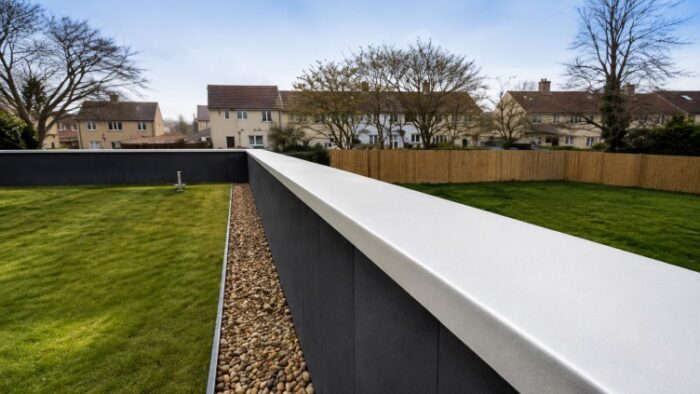
What Is Parapet Wall Coping?
A parapet wall is a low wall that extends above the roofline of a building. You see them on flat-roof extensions, on commercial and industrial buildings, on blocks of flats, on school buildings, on terraced houses where the party wall rises above the roof plane, and on countless other building types across the UK. The parapet serves several purposes: it hides the roof edge and any roofing details behind it, it provides a degree of wind protection to the roof membrane, it can carry fascias and other architectural elements, and on taller buildings it forms part of the edge protection for anyone working on the roof.
Parapet wall coping is the protective cap or cover that sits on the top surface of the parapet wall. Its job is to intercept rainwater before it can soak into the top of the wall and work its way down through the masonry, mortar joints, cavity, or blockwork. Without a properly designed and installed coping, even a well-built parapet wall will eventually suffer from water penetration, freeze-thaw damage to mortar joints, and in brick construction, spalling of the face brickwork as trapped moisture expands on freezing.
The coping is sometimes called a capping, a wall cap, a wall cover, or a coping stone depending on the material and context. Technically, a coping overhangs the wall face on both sides with a drip edge, while a capping sits flush or with a minimal overhang. The distinction matters in practice because a properly overhanging coping throws water clear of the wall face, while a flush capping just directs it down the front of the wall and causes staining and weathering damage over time.
Why does a parapet wall need coping?
Brick is porous. Mortar joints in brick and blockwork are porous. The top surface of an unprotected parapet wall is essentially a horizontal platform that catches every drop of rain, every overnight condensation event, every heavy dew, and every frost. In the UK climate, that is a lot of water events every single year.
Water that enters the top of a parapet wall does not stay there. It migrates downward under gravity and by capillary action, travelling through mortar joints, through the masonry units themselves, and into the cavity if there is one. Once inside the wall structure, water causes a range of serious problems over time: freeze-thaw spalling of brickwork faces, deterioration of cavity insulation, corrosion of wall ties, saturation of internal finishes, mould growth, and in the worst cases, structural undermining of the masonry itself.
The BRE (Building Research Establishment) has consistently identified unprotected or poorly detailed parapet walls as one of the most common causes of water ingress in UK buildings. The labcwarranty.co.uk technical guide to weatherproof parapet walls, which is well worth reading for anyone involved in parapet specification, identifies the coping as the first of three lines of defence against water penetration in a parapet wall construction. Get the first line of defence right and the other two rarely need to be tested in anger.
Read our guide on why aluminium copings are the best choice for an in-depth look at material selection for coping applications.
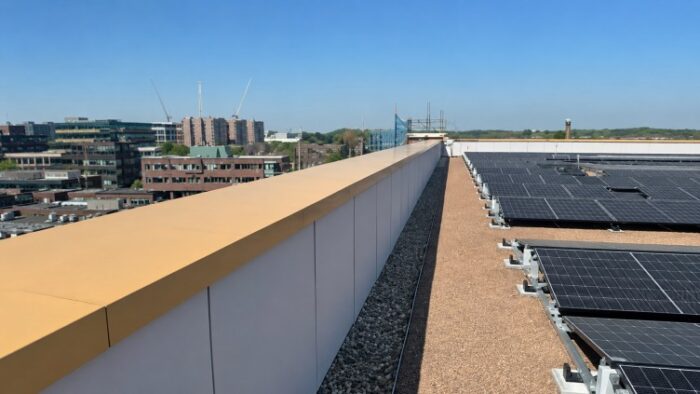
What makes a good parapet wall coping?
There are a few things a coping needs to do well to earn its place on a parapet wall. It is not complicated, but the details matter.
- It needs to overhang the wall face on both sides with a drip edge. The drip edge is a downward kick at the bottom edge of the coping that breaks the surface tension of water running along the underside of the coping, causing it to drip clear of the wall rather than tracking back to the wall face. Without a drip edge, water runs straight down the front of the wall.
- It needs to shed water rather than hold it. A flat-topped coping with no fall will collect standing water. Standing water on a horizontal joint is the most likely place for long-term water ingress. Either the coping profile itself has a pitch (a sloped top surface that drains to one or both sides), or the coping is laid with a nominal fall built into the installation.
- It needs to be mechanically fixed. The UK guidance document on safety of masonry parapets (BD2452) states clearly that cappings and copings should be capable of being mechanically fixed to the parapet wall. A coping that relies on mortar bedding alone or on mastic adhesive alone is a coping that will eventually come off in a UK winter storm.
- Joints need to accommodate thermal movement. Aluminium expands at around 0.023mm per mm per degree Celsius. A 3m aluminium coping section over a 70-degree seasonal temperature range in the UK will move by about 5mm end to end. Joints sealed with rigid filler will crack. Joints need to be designed and sealed to accommodate this movement.
- It needs to be non-combustible on buildings over 11 metres. Following the Building Safety Act 2022 and amendments to Approved Document B, combustible cladding materials (including combustible coping materials) are restricted on buildings over 11 metres in height. Aluminium achieves an A1 or A2-s1,d0 fire classification and complies at any height.
Parapet Wall Coping Materials: Which Is Right for Your Project?
Coping materials have ranged from hand-dressed stone to lead-sheet to concrete to modern pressed aluminium over the centuries. Here is how the main options stack up for UK projects in 2026.
Natural stone coping
Natural stone coping (typically limestone, sandstone, or granite in the UK) is the traditional choice for boundary walls, garden walls, and historic buildings. A well-cut natural stone coping with a saddle-back or splayed profile is a genuinely beautiful thing and will last for centuries with minimal maintenance. The stone is inherently non-combustible, it is UV-stable, and the better stones have very low water absorption.
The practical drawbacks for modern projects are weight (natural stone coping is very heavy, requiring careful structural consideration for the wall below and proper setting-out and bedding with the right mortar), cost (dressed stone is labour-intensive to produce and install), and jointing (mortar joints between stone coping sections are the weak point of the system, requiring regular inspection and repointing over the building’s life). On a rendered parapet wall with a flat roof, natural stone coping also looks incongruous with contemporary architectural language, which is why it is rarely specified on modern new-build or commercial projects.
Precast concrete and cast stone coping
Precast concrete coping sections are widely used on industrial and commercial buildings as a lower-cost alternative to natural stone. They come in standard saddle-back, half-round, and flat profiles, in standard widths from 150mm to 450mm, and in standard lengths of typically 600mm or 900mm. Cast stone (architectural concrete with a refined mix that mimics natural stone) is used where a more refined appearance is required.
Precast concrete coping is relatively cheap and widely available, but it shares the weight and jointing drawbacks of natural stone. The short section lengths mean a lot of mortar joints, each of which is a potential water ingress point if not maintained. Precast concrete also has a higher water absorption than aluminium, meaning the coping itself can become waterlogged and contribute to freeze-thaw cycling damage at the wall head in exposed locations. For flat roof extensions and modern construction, aluminium is a more suitable choice.
Lead coping
Lead has been used as a coping material on high-quality traditional and historic buildings for centuries, and on a well-detailed project it is genuinely excellent: soft, malleable, completely weathertight when properly dressed, and with a very long service life. Lead coping is still specified on conservation projects, listed buildings, and high-end traditional new-build work where the material’s softness allows it to be dressed and formed around complex parapet geometries that would challenge other materials.
Lead is expensive, heavy, and requires skilled sheet lead workers to install correctly. It also has a significant theft risk on buildings, as anyone who has seen a church roof knows. For the vast majority of residential, commercial, and industrial projects, lead is not a practical or cost-effective coping material, and aluminium is the standard modern alternative.
GRP and polymer coping
GRP (glass fibre reinforced polymer) and similar composite copings are lightweight, can be moulded into a range of profiles, and are used on some budget residential and light commercial applications. The main limitations are fire classification (GRP is combustible and cannot be used on buildings over 11 metres), UV degradation over time (the gel coat surface can chalk and fade), and lower structural integrity than aluminium under point loading or impact. For most applications where a long service life and fire compliance matter, aluminium is the preferred choice over GRP.
Aluminium coping
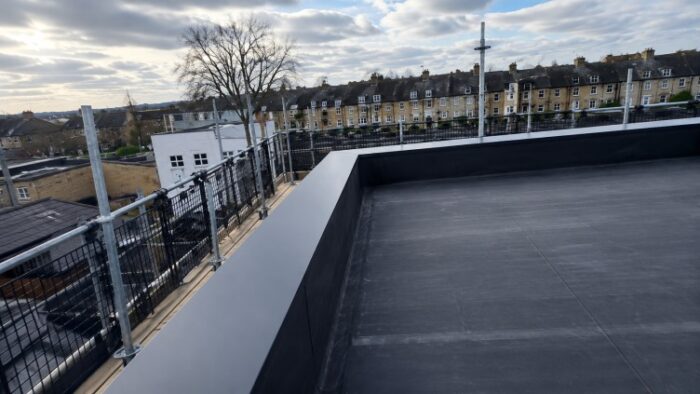
Aluminium is the standard material for parapet wall coping on flat-roof residential, commercial, and industrial buildings in the UK, and for very good reasons. Here is the combination of properties that makes it the right choice for most modern applications:
- Non-combustible: aluminium achieves an A1 (bare) or A2-s1,d0 (powder-coated) fire classification under BS EN 13501-1. This makes it compliant with Building Regulations Approved Document B for use on buildings of any height, including high-rise residential and commercial buildings subject to the tightest post-Grenfell restrictions.
- Corrosion-proof: aluminium forms a self-healing aluminium oxide layer on its surface when exposed to air, which means it does not rust even if the powder coat surface is scratched. This is a significant advantage over galvanised steel (which will eventually rust when the zinc coating fails) and over lead (which is relatively soft and vulnerable to damage).
- Lightweight: aluminium is approximately one third the weight of steel and much lighter than stone or concrete. This makes it easy to handle and install, and reduces the dead load on the parapet wall structure below.
- Full RAL colour range: powder-coated aluminium can be specified in any RAL or BS colour to coordinate with fascias, soffits, gutters, window frames, or any other element of the building. The powder coat is applied to BS EN 12206-1 for external-grade durability.
- Sloped and flat profiles: aluminium coping is available in both flat and sloped (typically 5 degrees) profiles to suit different design and drainage requirements. Sloped coping actively directs water to one side of the parapet, which is important on parapets where the internal drainage is on the roof side and you want water directed onto the roof membrane rather than down the external face.
- Secret-fix systems available: concealed bracket fixing systems mean no visible fixings on the coping face, giving a much cleaner architectural appearance than copings with visible screw heads or straps.
- 40 to 50 year service life: a properly installed aluminium coping system requires no painting, no repointing, no sealing, and no treatment over a very long service life. An occasional wash down is all that is needed.
| Material | Weight | Fire class | Corrosion | Joint type | Best for |
| Natural stone | Very heavy | Non-combustible | Excellent | Mortar + repoint | Heritage walls, garden walls, conservation |
| Precast concrete | Heavy | Non-combustible | Good | Mortar + repoint | Industrial, budget commercial, boundary |
| Lead | Heavy | Non-combustible | Excellent | Welded/dressed | Heritage, conservation, complex geometry |
| GRP composite | Light | Combustible | Good | Sealant | Budget residential (low-rise only) |
| Aluminium | Very light | A2-s1,d0 / A1 | Excellent | Sealant + movement | Modern residential, commercial, any height |
Types of Aluminium Parapet Wall Coping
Not all aluminium copings are the same profile, and the right choice depends on the wall thickness, the drainage requirement, and the visual effect wanted. Here are the main types used on UK buildings.
Flat aluminium coping
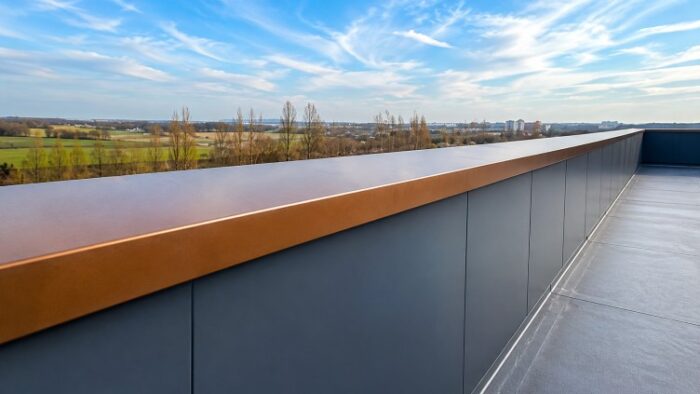
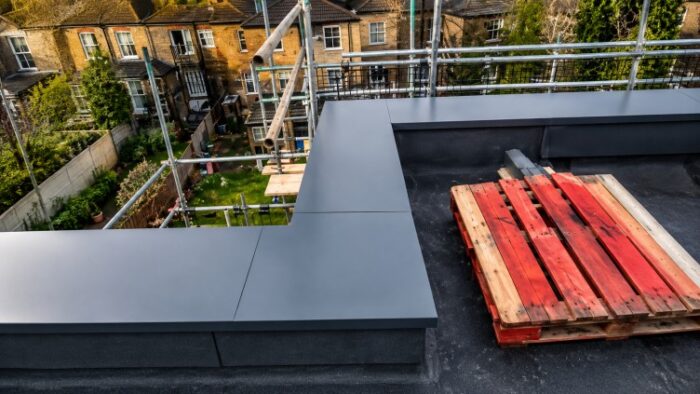
Flat aluminium coping has a horizontal top surface with two equal or unequal legs dropping down each side of the parapet wall. It is the most commonly used profile on UK residential flat-roof extensions and low-rise commercial buildings. Flat coping is visually clean and architectural: it gives the parapet wall a crisp, defined top edge that suits contemporary building design very well.
The flat profile means water can collect on the top surface if the installation has any low spots or is on a building where the parapet itself is perfectly level. This is worth thinking about at the design stage: on a well-executed installation with good workmanship, this is rarely a problem, but on a longer run where the parapet wall has minor undulations, a small fall built into the coping installation (or a sloped profile) is preferable.
Our aluminium flat coping in 3m lengths is available with matching 90-degree external corners, 135-degree corners, flat coping brackets, and 1m and 2m sections for filling shorter runs or making up non-standard lengths. See also our aluminium flat coping 1m length and 2m length pages.
Sloped aluminium coping
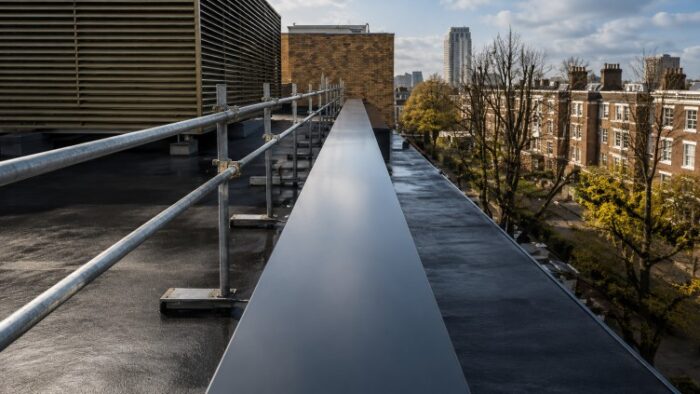
Sloped aluminium coping has a pitched top surface, typically at 5 degrees, that actively directs rainwater to one side. The standard UK detail for most flat-roof buildings is a coping that slopes inward toward the roof, so that rainwater is directed onto the flat roof membrane and into the internal roof drainage system rather than being allowed to run down the external face of the building.
Sloping the water inward is generally the preferred design for most commercial flat-roof buildings because it keeps the external facade cleaner (no water runs down the front face), protects any external cladding or render from constant water exposure at the wall head, and allows the drainage to be controlled through the internal roof drainage system rather than relying on the facade to handle it.
Our aluminium sloped coping brackets support sloped coping profiles and maintain the correct drainage fall along the full run. They are compatible with our standard flat coping sections and with custom fabricated sloped profiles.
Saddle-back and dual-pitch coping
A saddle-back (or dual-pitch) coping has a central ridge that pitches the top surface to both sides, so water sheds equally to the external face and the internal roof side. This profile is traditional on stone and precast concrete copings and is also available in aluminium fabrication. It is a good choice on boundary walls and parapets where drainage to both sides is acceptable, or where the wall appearance from both sides matters equally. The central ridge gives a distinctive roofline character that suits traditional architectural styles better than the flat profile.
Secret-fix aluminium coping systems
Secret-fix (also called concealed-fix) coping systems use a hidden bracket mechanism to secure the coping to the wall without any visible fixings on the top or face of the coping. The bracket is fixed to the wall first, and the coping section then clicks, clips, or slides onto the bracket. From outside, the coping appears to have no fixings at all, which gives a very clean and architectural appearance.
The most common concealed fixing method uses either a fixing strap that is screwed or anchored into the top of the wall and then bent up to engage with a slot or lip on the underside of the coping section, or a proprietary bracket with an EPDM (ethylene propylene diene monomer) rubber seal that both secures the coping and provides a weatherseal at the fixing point. The EPDM seal is important because it prevents the fixing from becoming a water ingress point at the wall head.
Secret-fix systems also accommodate thermal movement more effectively than simple face-fixed systems, because the coping can move relative to the fixing bracket within the slot or engagement mechanism rather than trying to drag the fixing screws with it. This reduces the risk of joint cracking and sealant failure at the movement joints as the temperature cycles through the seasons.
| For any project where the coping will be viewed from above (for example, from adjacent taller buildings, from a terrace, or from any part of the roof surface), secret-fix systems are strongly recommended. The absence of visible fixings on the top surface gives a professional finish that is immediately noticeable compared to systems with visible screw heads or straps. |
How to Size Aluminium Parapet Wall Coping Correctly
Getting the coping size right is not complicated but it is easy to get wrong if you measure from the wrong points. Here is the correct way to approach it.
Measuring the parapet wall width
The width of the coping must be measured from the back (internal, roof side) face of the parapet wall to the front (external, facade side) face of the parapet wall, plus the required overhang on each side. The standard minimum overhang is 40mm to 50mm on each side, measured from the face of the wall to the outer edge of the coping leg. This overhang positions the drip edge clear of the wall face so that water running off the edge of the coping drips clear rather than tracking back to the wall.
So for a 215mm single-leaf brick parapet wall with 50mm overhangs on both sides, the coping should be 215 + 50 + 50 = 315mm wide. For a 300mm cavity parapet wall with 50mm overhangs, the coping should be 400mm wide. Always measure the actual wall width on site rather than relying on nominal drawing dimensions, because built walls often differ slightly from nominal.
On cavity parapet walls, also consider whether the coping needs to span over the top of any cavity closer or cavity tray at the wall head. If there is a projecting cavity tray upstand at the wall head, the coping needs to clear it, and the actual wall head width at coping level may be wider than the nominal wall thickness.
Standard aluminium coping widths available
Most aluminium coping systems are manufactured in a range of standard widths to cover the most common UK parapet wall thicknesses. Typical standard widths available are:
| Coping width | Typical wall width | Typical overhang | Typical application |
| 200mm to 250mm | 100mm to 150mm | 50mm each side | Lightweight blockwork, slim parapets |
| 250mm to 300mm | 150mm to 200mm | 50mm each side | Single-leaf brick parapet, 100mm block |
| 300mm to 350mm | 200mm to 250mm | 50mm each side | Single-leaf brick with render |
| 350mm to 450mm | 250mm to 350mm | 50mm each side | Cavity wall parapet, standard cavity |
| 450mm to 600mm | 350mm to 500mm | 50mm each side | Wide cavity wall, insulated parapet |
| Custom width | Any | As specified | Bespoke fabrication for non-standard walls |
For exact width requirements outside the standard range, aluminium coping can be fabricated to custom widths without difficulty. Aluminium sheet can be brake-pressed to virtually any width, and the cost premium for non-standard sizes is typically minimal for runs over about 10 metres.
Section lengths and planning joints
Standard aluminium flat coping sections are available in 1m, 2m, and 3m lengths. The 3m length is the most cost-effective for longer runs as it minimises the number of joints. Plan the joint positions along each wall run before ordering, aiming to position joints at regular intervals that avoid coinciding with structural movement joints in the wall below or with external corners where two runs of coping meet.
Each joint needs a 3mm to 4mm expansion gap between the butted ends of the coping sections, filled with colour-matched flexible sealant. This gap accommodates the thermal movement of the aluminium across the seasonal temperature range without putting the sealant or the fixings under stress. The gap looks tiny in practice and is not visible from normal viewing distances when filled with matching sealant.
| Never butt aluminium coping sections hard together end to end with no expansion gap. Even if the sections look tight and neat in summer, the thermal contraction in winter will pull joints apart, crack the sealant, and create water ingress points at the wall head. Always leave the 3 to 4mm gap specified by the manufacturer. |
How to Install Aluminium Parapet Wall Coping: Step-by-Step Guide
A well-installed aluminium parapet coping system is clean, watertight, and neat. Here is how to do it properly, from start to finish.
Tools and materials for installation
- Aluminium flat coping sections (3m lengths), cut to required lengths plus a small cutting waste allowance
- Aluminium flat coping brackets or sloped coping brackets as required
- 90-degree external corners and 135-degree corners for wall returns and angles
- Colour-matched sealant (300ml) conforming to BS EN ISO 11600, matching the coping RAL colour
- Colour-coded stainless steel fasteners for bracket fixing to masonry, or timber fasteners for timber substrate
- Touch-up spray paint or touch-up paint pen for cut ends
- Spirit level, chalk line or laser level, tape measure
- Metal cutting saw or angle grinder with aluminium cutting blade
- Power drill with masonry bits and suitable fixing anchors for the substrate
- Acetone and clean lint-free cloths for degreasing joint faces
- Masking tape for clean sealant lines
Installation Step 1: Prepare the wall head
Before fitting any coping, the top of the parapet wall needs to be properly prepared. The wall head should be sound, with no loose mortar, no crumbling masonry, and no hollow areas in any render or screed on the wall head surface. If there is existing old coping or mortar bedding on the wall head, this should be removed and the wall head cleaned back to a sound substrate.
The horizontal DPC (damp proof course) beneath the coping is a critical element of the parapet wall construction. LABC’s guidance on weatherproof parapet walls specifies that the horizontal DPC at the wall head should be a single continuous length as far as practicable, with a minimum 150mm lap at any joints (300mm preferred), formed as a continuous protective layer that acts as a secondary line of defence if water penetrates below the coping. If the DPC is absent, damaged, or inadequately lapped, it should be reinstated before fitting the new coping. Do not simply fit new coping over a failed DPC and hope for the best.
On cavity parapet walls, check that the cavity tray and cavity closers are in place at the wall head. Cavity trays above wall openings and at the base of parapets are specified by BS 5628 and are the third line of defence against water getting into the building structure.
Installation Step 2: Mark out bracket positions
Mark the bracket positions along the full length of each coping run before fixing anything. Brackets should be placed at maximum 600mm centres as a general rule (check the specific manufacturer’s guidance for your coping system, as some systems specify tighter spacings on wider copings or in exposed locations). On exposed coastal or upland sites, or on buildings where wind uplift loads are a concern, tighter bracket spacings or heavier-duty brackets may be required.
Also mark the positions of any joints in the coping run, and check that a bracket falls within 150mm of each planned joint position. A joint that is unsupported by a nearby bracket experiences more movement and bending stress than a supported joint, and will cause cracking over time.
Finally, mark the positions of all corners (both 90-degree and 135-degree) and any stop ends at the ends of runs. Corners and stop ends are fixed points in the layout and should be positioned first, with the straight runs cut to fit between them.
Installation Step 3: Fix the brackets
Fix all brackets at the marked positions on the top of the wall before fitting any coping sections. Use fixings appropriate for the substrate: masonry anchors or resin anchors for brick or blockwork, stainless steel screws for timber plate or timber blocking. All fixings used with aluminium coping should be stainless steel to avoid galvanic corrosion at the fixing point. Galvanised steel fixings are not good enough: the zinc coating will fail over time in the wet conditions at the wall head, allowing rust to stain the aluminium and eventually allowing the fixing to fail.
Check each bracket for level after fixing. On longer runs, set up a string line or use a laser level to ensure all brackets are in the same plane. A bracket that is high or low will cause the coping section above it to rock slightly, which puts stress on the sealant joints either side of the bracket and can cause noise in the wind.
Installation Step 4: Fit the corners and stop ends first
Always fit the corner pieces and stop ends before fitting any straight coping sections. Corners are fixed-point elements in the layout. Fitting them first means you can measure the exact straight-run lengths needed between corners and cut the sections accurately to fit, rather than finding at the end of the job that a run is 30mm too long and you need to recut a section.
External corners (90 degrees) are where two runs of parapet wall meet at an outward-facing corner, for example at the corner of a building. Internal corners are rarer on flat-roof parapets but are used where a parapet wall has a re-entrant corner. Our 135-degree corners suit walls that do not turn at a perfect 90 degrees, which is common on buildings with bay projections or angled plan forms.
Installation Step 5: Cut coping sections to length
Measure each straight run between its fixed endpoints (corners, stop ends, or existing fixed sections) and cut the coping sections to the required lengths. Always measure the actual run length on site, not from drawings. Allow a 3mm to 4mm expansion gap at each joint position in the cutting calculation: if a run measures 5,960mm between two corners and you are using 3,000mm sections, you need to cut the second section to 5,960 – 3,000 – 4 (gap) = 2,956mm, not 2,960mm.
Cut aluminium coping sections with a metal saw or a fine-toothed circular saw blade designed for aluminium. A clean cut is important for a tight and tidy joint. Treat all cut ends immediately with colour-matched touch-up spray before fitting, to protect the raw aluminium at the cut face from any superficial oxidation or staining.
Installation Step 6: Fit the coping sections onto the brackets
With all brackets fixed and sections cut, fit the coping sections onto the brackets starting from one end of each run. On bracket-and-clip systems, the coping section engages with the bracket by pressing down: the bracket has a return lip or slot that the leg of the coping hooks over. On fixing-strap systems, the strap is bent up through a slot in the coping section and folded over to secure it. Follow the specific system instructions for your coping product.
On flat coping, both legs (the external face leg and the internal roof-side leg) should hang equally and vertically. Check both legs with a spirit level as you work along the run. If one leg hangs longer than the other, the coping section has slipped sideways on the bracket: adjust before the section is fully engaged.
Installation Step 7: Seal all joints
This is the most important step for long-term waterproofing performance. Every joint between coping sections, every corner junction, and every stop-end junction needs to be properly sealed. The sealant used should be a low-modulus (flexible) silicone or polyurethane sealant conforming to BS EN ISO 11600, in a colour matched to the RAL colour of the coping. A colour-matched sealant joint that is properly tooled is virtually invisible from normal viewing distances.
Method for sealing expansion joints between straight coping sections:
- Degrease both joint faces with acetone on a clean lint-free cloth. Allow to dry fully.
- Apply masking tape to both faces of the coping either side of the joint to give a clean, straight sealant line.
- Apply a continuous bead of colour-matched sealant into the 3 to 4mm expansion gap, working it fully into the joint from front to back.
- Tool the sealant bead smooth with a wetted finger or a plastic sealant tool, pressing the sealant into the joint and forming a slightly concave surface.
- Remove the masking tape immediately before the sealant begins to skin. If the tape is removed after the sealant has started to cure, it will tear the sealant and the edge will be ragged.
- Allow the sealant to cure for 24 hours at room temperature before the joint is exposed to rain or water. Most silicone sealants require a temperature above 5 degrees Celsius and a humidity above 40 percent to cure properly.
| Never use clear or white sealant on a coloured aluminium coping. The mismatch is immediately visible and the sealant will yellow with UV exposure over time, making it worse. Always use a sealant matched to the specific RAL colour of the coping. We supply colour-matched sealant to all the standard RAL colours in our coping range. |
Installation Step 8: Final inspection
Walk the full run of coping after installation and check the following:
- All joints are sealed with a continuous, properly tooled bead of matching sealant with no gaps or dry areas
- All corners and stop ends are sealed on all faces
- No coping section rocks on its brackets when pressed
- Both legs hang vertically with equal overhang on each side, checked visually from below
- All cut ends have been treated with touch-up spray
- No visible fixings on the top or face surface of the coping
- Water can flow freely off the coping: check by pouring a small amount of water on the top surface and watching that it runs to the drip edge rather than pooling
Read our detailed aluminium coping installation guide for additional technical guidance and photographs of each installation step.
Parapet Wall Coping and Building Regulations
There are a few bits of regulation and guidance that are relevant to parapet wall coping in the UK, and it is worth being clear on what applies and when.
Approved Document B and fire classification
Following the Grenfell Tower fire in 2017 and the Building Safety Act 2022, the fire classification of external cladding and facade materials is a major specification concern on any building over 11 metres. Coping sits at the top of the building envelope and is classified as an external wall element for the purposes of fire safety assessment. The restriction on combustible materials under Approved Document B applies.
Aluminium (both bare and powder-coated) achieves the A2-s1,d0 fire classification under BS EN 13501-1 that satisfies the non-combustible requirements of Approved Document B for buildings of any height. This is an important compliance advantage over GRP, uPVC, and timber copings, which are classified as combustible and cannot be used on buildings over 11 metres without specific fire engineering justification. For any building project above 11 metres, specify aluminium coping and obtain the fire classification data sheet from the supplier to demonstrate compliance.
BD2452 guidance on safety of masonry parapets
BD2452 is the UK government’s guidance document on the safety of masonry parapets, covering structural design, detailing, and specification requirements for parapet walls and their copings. The key messages from BD2452 for coping specification are:
- Cappings and copings should be capable of being mechanically fixed to the parapet wall. Reliance on mortar bedding or mastic adhesive alone is insufficient.
- Joint sealants should be selected in accordance with BS 6213.
- Joints between copings are very vulnerable to water penetration and must be sealed with a sealant capable of accommodating the movement that will occur between the sections.
- For porous coping materials, many sealant manufacturers recommend applying a primer to the substrate before sealing joints, as the sealant bond to a damp porous surface can be compromised.
DPC requirements at the parapet wall head
Building Regulations Approved Document C (Site preparation and resistance to contaminants and moisture) and the associated guidance all require appropriate damp-proofing at the wall head of a parapet. The horizontal DPC beneath the coping is a building regulation requirement, not an optional extra. Its purpose is to ensure that any water that penetrates past the coping (whether through failed sealant joints, through the coping material itself for porous types, or through wind-driven rain) is intercepted by the DPC rather than allowed to continue down through the wall construction.
For aluminium coping on a flat-roof parapet, the standard detail is: flat roof waterproofing membrane turned up and over the parapet wall to the top of the wall head, with the horizontal DPC on top of the wall head, the coping brackets fixed through the DPC into the masonry below, and the aluminium coping sections sitting over the brackets with their legs lapping over the outer face of the DPC. The DPC at the coping level should be at least 150mm wide on each side, lapping down the wall face behind the coping leg.
Planning permission for coping
Replacing existing parapet wall coping like for like (same material, same colour, same profile) is typically permitted development on residential properties and does not require planning consent in most cases. Changing the material or colour can sometimes require consent depending on the building type, its location, and local planning conditions.
In conservation areas, the local planning authority may require coping materials and colours to be consistent with the area’s character. In listed buildings, consent is always required before making any changes to the external envelope, including replacing coping. If there is any doubt about whether consent is required for your project, check with your local planning authority before proceeding.
For new-build projects, the coping is typically included in the planning drawings and is covered by the planning consent for the building. Any significant departure from the approved drawings, including changes to coping profile or colour, may require a minor material amendment.
Parapet Wall Coping: Design Applications by Building Type
Coping design decisions play out slightly differently depending on the type of building and the context. Here is how to think about it for the most common UK project types.
Flat-roof residential extensions
Flat-roof extensions are the single biggest driver of aluminium parapet coping demand on residential buildings in the UK. Kitchen extensions, rear living room extensions, orangeries, garden rooms: most of them end up with a flat or low-pitch roof behind a parapet wall, and the coping on that parapet is one of the last things to go on and one of the first things visible from the garden.
For a residential flat-roof extension, the most commonly specified coping combination in 2026 is a flat aluminium coping in RAL 7016 anthracite grey, sized to cover the actual parapet wall width with 50mm overhangs on each side. This gets coordinated with the fascia on the adjacent pitched roof (if any), the gutter profile, the window and door frames, and sometimes the front door. Everything anthracite grey. It is the dominant contemporary residential architecture language in the UK right now and it works because the single colour creates a coherent aesthetic from every angle.
See our aluminium copings for winter protection guide for specific advice on parapet coping in UK cold weather conditions, and our aluminium coping installation in London case study for a real project example.
Commercial and industrial buildings
On commercial and industrial buildings, the parapet wall coping is a more prominent architectural element because the parapets are typically higher and more visible from the street. The coping is part of the building’s visual character at roofline level, and its colour and profile choice contributes to how the building reads from across the road or car park.
Commercial coping specification priorities are durability, fire compliance, and aesthetic coordination with the cladding system. For buildings over 11 metres, A2 fire classification is mandatory. For the cladding coordination, the coping is typically specified in the same RAL colour as the fascia panels, rainwater goods, or feature cladding elements, to create a coherent roofline to facade colour story.
Our benefits of using aluminium copings in construction guide covers the commercial specification in detail. For large commercial projects, we also offer bespoke coping fabrication to non-standard widths and profiles.
Schools, healthcare, and public buildings
Public sector buildings have specific requirements that make aluminium coping the clear material of choice. The non-combustible A2 classification satisfies Approved Document B for education and healthcare buildings that are frequently over 11 metres. The 40 to 50 year service life with no maintenance reduces lifecycle costs, which is always a significant factor in public sector procurement. And the powder-coat colour range allows local authority and NHS colour schemes to be matched precisely.
Schools in particular tend to have complex roofline geometries with multiple parapet levels, plant rooms on the roof, and many return angles. Aluminium coping handles these geometries well because it can be fabricated to custom widths and lengths, and because the 90-degree and 135-degree corners are available as pre-formed sections rather than requiring on-site mitre cutting.
Heritage and conservation projects
On listed buildings and buildings in conservation areas, the choice of coping material is often constrained by the planning authority. Where natural stone or lead coping is required by the listed building consent or conservation area designation, that is what needs to be specified. Aluminium is not always an acceptable substitution in conservation contexts, and it is always worth checking with the heritage officer before assuming any material is acceptable on a listed property.
That said, there are many conservation projects where aluminium coping is entirely appropriate: refurbishments of 1960s and 1970s commercial buildings (which often have concrete parapets with failed mortar-bedded concrete coping stones that need replacing), or heritage buildings where the original coping has been lost and there is no historic material requirement. In these cases, aluminium in an appropriately restrained colour (warm grey tones rather than bright anthracite or black) can be a very good practical solution.
Common Parapet Wall Coping Problems and How to Avoid Them
Most parapet wall coping failures fall into a fairly small number of categories. Here is what goes wrong and what to do about it.
Failed or absent sealant at joints
This is the most common cause of water ingress through parapet coping. Joint sealant fails either because the wrong sealant type was used (a rigid filler that cracks under thermal movement rather than a flexible low-modulus sealant), because the sealant was applied to dirty or greasy joint faces without proper surface preparation, or because no expansion gap was left so the sealant was in tension from day one and tore apart with the first thermal cycle.
If sealant joints are failing, the repair is to cut out the old sealant completely, clean and degrease the joint faces thoroughly with acetone, leave the correct expansion gap if it was not there before, and apply fresh low-modulus colour-matched sealant correctly. It is worth doing this properly because poorly repaired joints tend to fail again quickly.
Coping installed without a DPC beneath it
This is a very common problem on retrofit coping installations and on buildings where the original coping was mortar-bedded stone that has been replaced with aluminium without reinstating the DPC beneath. Without the DPC, any water that penetrates the coping joint or runs beneath the coping leg can soak straight into the wall head masonry and travel down through the wall construction.
The LABC technical guide to weatherproof parapet walls shows photographs of failures that are less than two years old where the DPC was absent or incorrectly detailed. If you are replacing existing coping on an older building, always check whether a DPC is present below the coping and reinstate it if not. This adds some cost and time to the project but avoids a much more expensive water damage repair later.
Undersized coping with insufficient overhang
Coping that does not project sufficiently over the wall face on both sides will allow water to run down the wall face rather than dripping clear at the drip edge. The minimum recommended overhang is 40mm to 50mm on each side of the wall. On a very exposed building, more overhang may be appropriate. If the overhang is less than 40mm, the drip edge is too close to the wall face for surface tension to be reliably broken and water will track back to the wall.
Incorrect fixing method
Copings that rely on mortar bedding or mastic adhesive alone for their fixing will eventually fail. Mortar joints weather and crack. Mastic adhesion can fail in freeze-thaw conditions or after prolonged UV exposure. BD2452 is clear that copings should be mechanically fixed. Use the bracket system specified for your coping product and do not try to save time by relying on adhesive alone as a substitute for mechanical fixings.
Also avoid using non-stainless fixings anywhere in the coping installation. Steel bolts and screws will rust at the wall head and leave rust staining on the aluminium face and the wall below. Stainless steel fixings cost very little more than ordinary steel and will outlast the building.
No thermal movement allowance
A 6m run of aluminium coping will expand by about 10mm between a cold winter night and a hot summer afternoon. If the coping sections are cut dead tight to each other with no expansion gap, or if they are sealed with a rigid filler rather than a flexible sealant, that 10mm of expansion has nowhere to go. The coping will buckle, the joints will crack, and water ingress will follow. Always leave the 3 to 4mm expansion gap at each joint and always seal with flexible sealant.
Parapet Wall Coping Costs: What to Expect in the UK in 2026
People often ask about coping costs and it is genuinely difficult to give precise numbers because the cost depends heavily on the wall width, the profile, the colour, the section lengths, the complexity of the run (how many corners, stop ends, and non-standard sections), and the labour situation on your project. But here is a rough framework for budgeting purposes.
Supply cost of aluminium coping
| Element | Typical spec | Indicative cost | Notes |
| Straight coping section (3m) | Flat, 300mm wide, standard RAL | From £35 to £70 per 3m length | Depends on width, gauge, colour |
| 90-degree external corner | Pre-formed, matching profile | £25 to £50 each | Always cheaper than on-site mitre |
| 135-degree corner | Pre-formed, matching profile | £25 to £50 each | For non-right-angle returns |
| Coping bracket (flat) | Standard fixing bracket | £5 to £15 each | At 600mm centres per run |
| Coping bracket (sloped) | Sloped fixing bracket | £8 to £18 each | For sloped coping profile |
| Colour-matched sealant | 300ml cartridge | £12 to £20 per tube | One tube per 4 to 6 linear metres |
| Stainless fixings pack | 25-pack | £8 to £15 per pack | Always use stainless, not galvanised |
All cost figures above are indicative for 2026 and will vary between suppliers and depending on specific project requirements. Get a confirmed quote from your supplier based on your actual wall dimensions and project specifications before committing to a budget. For standard RAL colours and widths, supply lead times are typically 5 to 15 working days. For bespoke fabrication or non-standard colours, allow 15 to 25 working days.
Labour costs for coping installation depend on access (parapet walls at height require scaffolding or MEWP, which adds substantially to the labour cost), run length and complexity, and the labour rate in your area. Coping installation itself is not technically difficult, but the access cost often exceeds the materials cost on residential projects. For a typical flat-roof extension parapet with 20 to 30 linear metres of coping, allow one day of labour for two people, not including access setup.
Request an estimate from Metal Profiles Ltd for a confirmed supply price on your project.
Frequently Asked Questions: Parapet Wall Coping
-
What is parapet wall coping?
Parapet wall coping is the protective cap or cover fitted to the top of a parapet wall (the low wall that extends above the roofline). Its job is to shed rainwater off the wall head and prevent it from soaking into the masonry, mortar, and cavity of the wall below. A correctly detailed coping overhangs the wall face on both sides with a drip edge, is mechanically fixed to the wall, and has joints sealed with flexible sealant that can accommodate thermal movement. On modern UK flat-roof residential and commercial buildings, aluminium coping is the standard material.
-
What is the difference between a coping and a capping?
A coping overhangs the wall face on both sides, typically by at least 40mm to 50mm on each side, and terminates in a downward drip edge that throws water clear of the wall face. A capping sits more or less flush with the wall face, directing water down the wall surface rather than throwing it clear. Copings generally perform better for water management on exposed parapet walls. Most modern aluminium products sold as wall capping also incorporate a small overhang and are functionally similar to copings, but always check the leg dimensions against the wall width when specifying.
-
Why use aluminium coping instead of stone or concrete?
Aluminium coping is lighter (roughly one third the weight of stone or concrete), easier and faster to install, available in any RAL colour, non-combustible (A2-s1,d0 fire classification), completely corrosion-proof, and requires no maintenance over a 40 to 50 year service life. Stone and concrete copings are heavier, have mortar joints that need periodic repointing, and in exposed locations can suffer freeze-thaw spalling of the coping units themselves. Stone coping suits traditional heritage and boundary wall applications well; aluminium is the better choice for modern flat-roof residential and commercial applications.
-
Do I need a DPC under parapet wall coping?
Yes. A horizontal damp proof course (DPC) beneath the coping at the wall head is a Building Regulations requirement for parapet wall construction in England and Wales. The DPC acts as a secondary line of defence, intercepting any water that penetrates past the coping and preventing it from travelling down through the wall construction. BD2452 (the government guidance on safety of masonry parapets) specifies that the horizontal DPC should be a single continuous length as far as practicable, with a minimum 150mm lap at any joints (300mm preferred). If you are replacing existing coping on an older building, always check that a DPC is present and in good condition before fitting the new coping.
-
How is aluminium parapet wall coping fixed?
Aluminium parapet wall coping is mechanically fixed using fixing brackets that are anchored to the top of the wall with stainless steel screws or masonry anchors. The coping sections then clip, press, or slide onto the brackets. This concealed bracket method means no visible fixings on the top or face surface of the coping and accommodates thermal movement of the aluminium sections relative to the wall. Joints between sections are sealed with colour-matched flexible low-modulus sealant with a 3 to 4mm expansion gap to allow for thermal movement. Never fix aluminium coping with ordinary steel screws as these will rust and cause staining.
-
What size aluminium coping do I need?
The coping width should be equal to the wall thickness plus at least 40mm to 50mm overhang on each side. So for a 215mm single-leaf brick parapet wall, you need a coping approximately 315mm wide (215 + 50 + 50). For a 300mm cavity parapet wall, you need a coping approximately 400mm wide. Always measure the actual wall width on site and allow for any features at the wall head (cavity closers, DPC upstands, render) that may increase the effective width the coping needs to cover.
-
Can aluminium parapet wall coping be used on buildings over 11 metres?
Yes. Powder-coated aluminium achieves an A2-s1,d0 fire classification under BS EN 13501-1, satisfying the non-combustible material requirements of Building Regulations Approved Document B for external wall elements on buildings of any height. This is one of the main reasons aluminium is specified on commercial, educational, healthcare, and high-rise residential buildings rather than GRP or polymer alternatives, which are classified as combustible and cannot be used on buildings over 11 metres without specific fire engineering justification.
-
What causes parapet wall coping to fail?
The most common causes of parapet coping failure are: joint sealant failure due to thermal movement on a sealant that is too rigid or was applied without an expansion gap; absence or failure of the horizontal DPC beneath the coping allowing water to bypass the coping entirely; insufficient overhang so water runs down the wall face rather than dripping clear; reliance on mortar or mastic adhesive rather than mechanical fixings, causing copings to detach in wind storms; and use of non-stainless fixings that rust and fail at the wall head. Getting the installation right from the start avoids all of these.
-
How do I maintain aluminium parapet wall coping?
Very little maintenance is needed once aluminium coping is properly installed. An annual visual inspection is worthwhile, particularly after the first winter following installation, to check all sealant joints are intact with no gaps, cracking, or debonding. Any failed joints should be resealed promptly using colour-matched flexible sealant. Clear any debris (leaves, moss, bird debris) from the coping surface and from the drip-edge area at least once a year to ensure water can drain freely. Do not use abrasive cleaners or wire brushes on the powder coat surface.
-
What is the difference between flat and sloped aluminium parapet coping?
Flat aluminium coping has a horizontal top surface that relies on the installation being level or on a slight installation fall to drain water. Sloped coping has a top surface with a built-in pitch (typically 5 degrees) that actively directs water to one side regardless of the installation level. On flat-roof buildings where water drainage is on the internal roof side, sloped coping pitched inward directs water onto the roof membrane and into the internal drainage system, keeping the external facade drier. Flat coping suits low-risk applications and shorter runs; sloped coping is better practice on longer runs and more exposed buildings.
-
How long does aluminium parapet wall coping last?
A properly installed aluminium parapet wall coping system with an external-grade polyester powder coat to BS EN 12206-1 should last 40 to 50 years in typical UK conditions. The aluminium substrate will not corrode, and the powder coat surface will retain its colour and gloss for 20 to 30 years before any recoating would be considered necessary. In coastal or industrial environments with higher atmospheric pollution or salt exposure, the powder coat life may be somewhat shorter, but the underlying aluminium will not degrade.
Discover more from Metal Profiles Ltd
Subscribe to get the latest posts sent to your email.